The Phantom of the Opera 1943 with Claude Rains

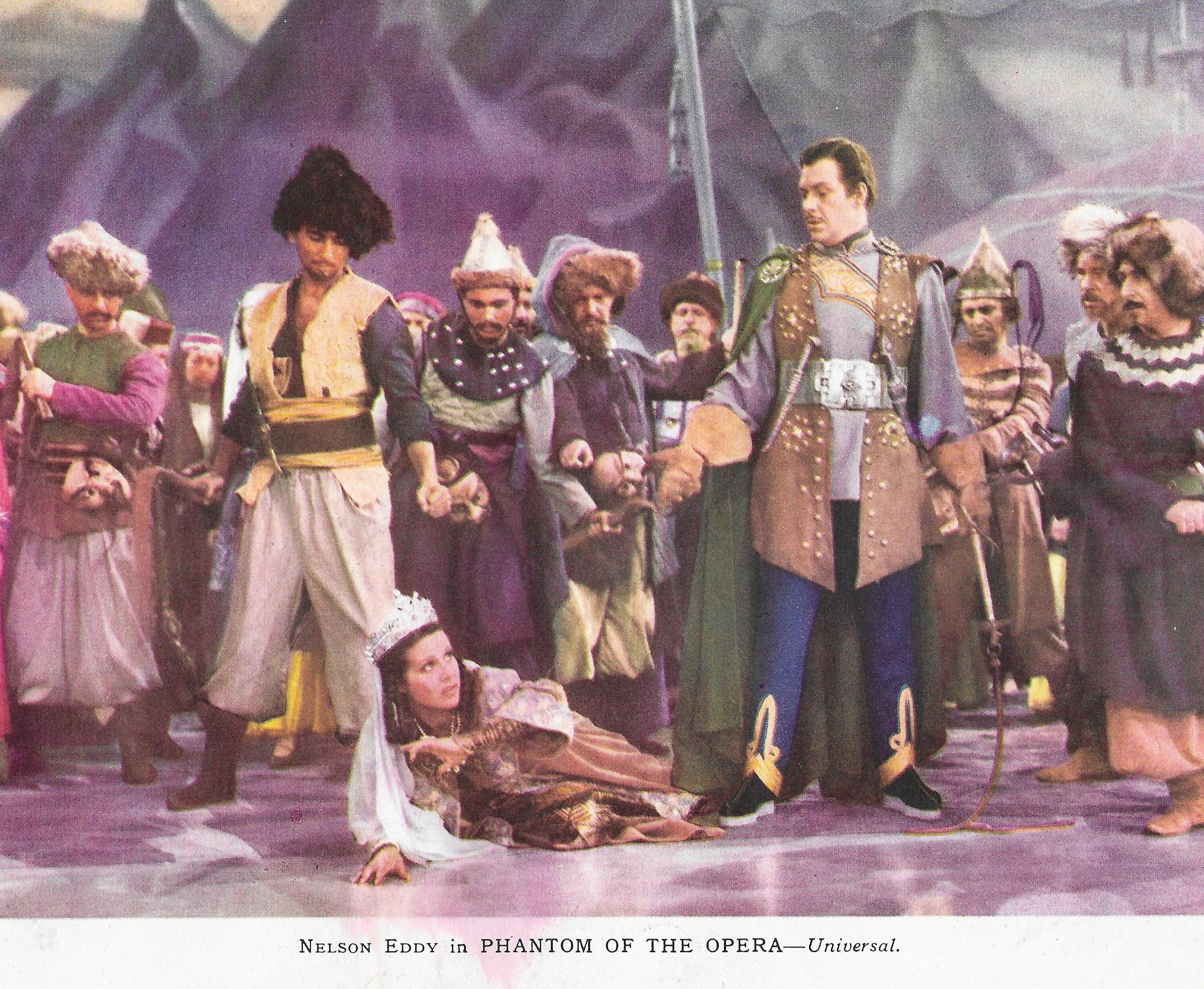
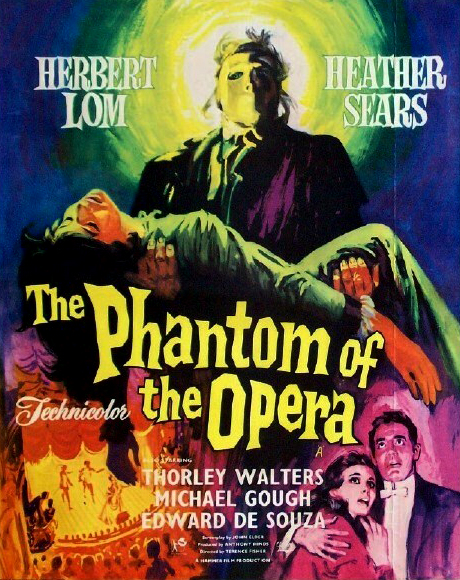
We have become so used to the wonderful Andrew Lloyd Webber stage version of this story that this older Colour film version goes by these days mostly un-noticed which is a great pity because this is a good film. There was a later version made by Hammer Films in England with Herbert Lom as the Phantom made in 1959 – it too was good.

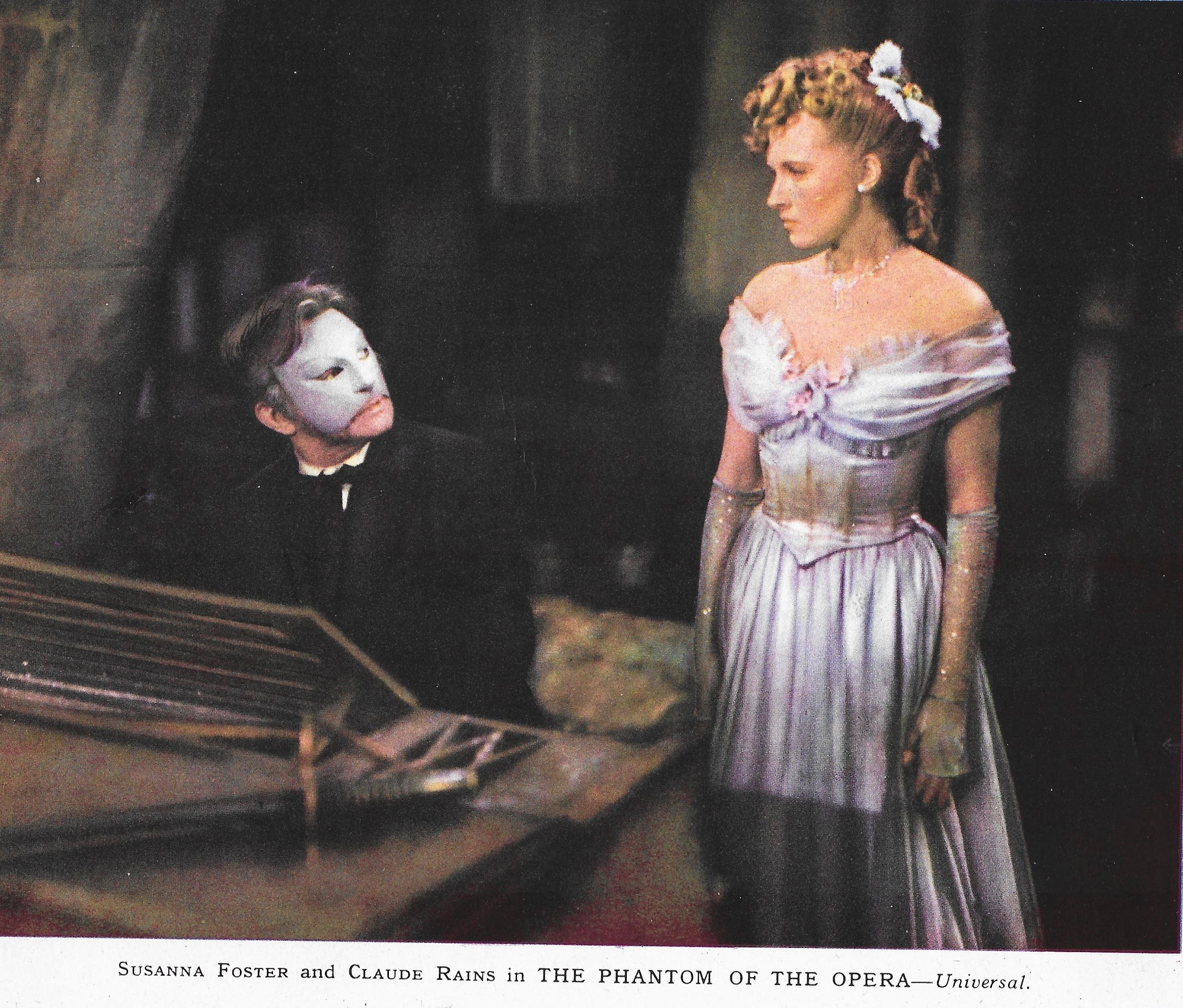
Violinist Erique Claudin played by Claude Rains, is dismissed from the Paris Opera House after revealing that he is losing the use of the fingers of his left hand. Unbeknown to the conductor, who assumes Claudin is able to support himself,  the musician has used all his money to help anonymously fund the voice lessons for Christine Dubois, a young soprano with whom he has fallen in love.  In a desperate attempt to earn money, Claudin submits a piano concerto he has written for publication.

Claude Raines as he Phantom of the Opera

After submitting it and not hearing a response, he becomes worried and returns to the publishers, Pleyel & Desjardins, to ask about it. No one there knows what happened to it, and do not seem to care. Claudin persists, but Maurice Pleyel rudely tells him to leave and goes back to the etchings he was working on.

The Phantom of the Opera

Finally giving up, Claudin stands there for a moment and hangs his head sadly. Someone begins to play music in the next room, and he looks up in shock when he hears it. It is his concerto that is merely being endorsed and praised by Franz Liszt. Convinced that Pleyel is trying to steal his concerto, Claudin leaps up and begins to strangle him. Just as he tosses the body of Pleyel to the floor, Georgette, the publisher’s assistant, throws etching acid at Claudin. Screaming and wailing, he dashes out the door clutching his face. Now being hunted down by the police for murder, he flees to the sewers of the Opera. Claudin steals a prop mask from the costume department to cover his now-disfigured face.

The Phantom of the Opera 4

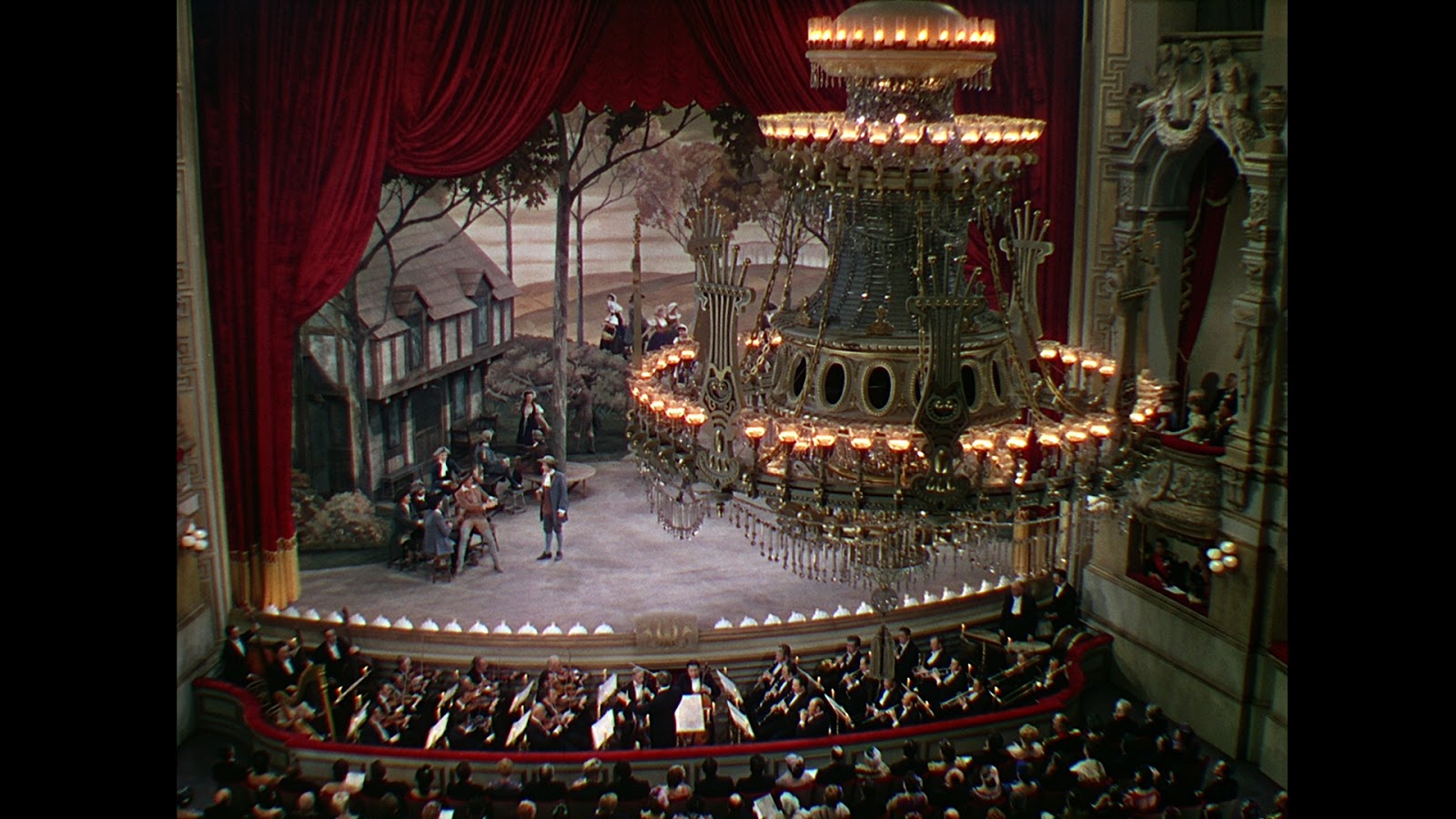
Above – The Paris Opera House

Back now to the Hammer version with Herbert Lom.
Herbert Lom as The Phantom of the Opera
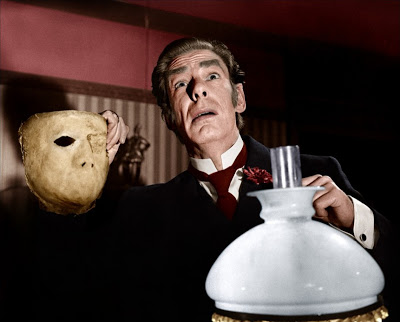
In this particular “Phantom,” from Hammer Studios, the Phantom (Herbert Lom), and here Christine’s suitor is the manager of the opera house (Edward de Souza). There is also a real villain, a plagiarist in the form of Lord d’Arcy (Michael Gough).
Michael Gough in The Phantom of the Opera
Michael Gough is a really wicked villain and the supposed composer of the opera; Edward de Souza is a  a good romantic interest for Christine; and Heather Sears as Christine is very sweet.
Herbert Lom  is a great Phantom although is not a huge role in this film, but an effective and highly sympathetic one.
Herbert Lom as The Phantom
posted by Movieman in Uncategorized and have Comments (9)

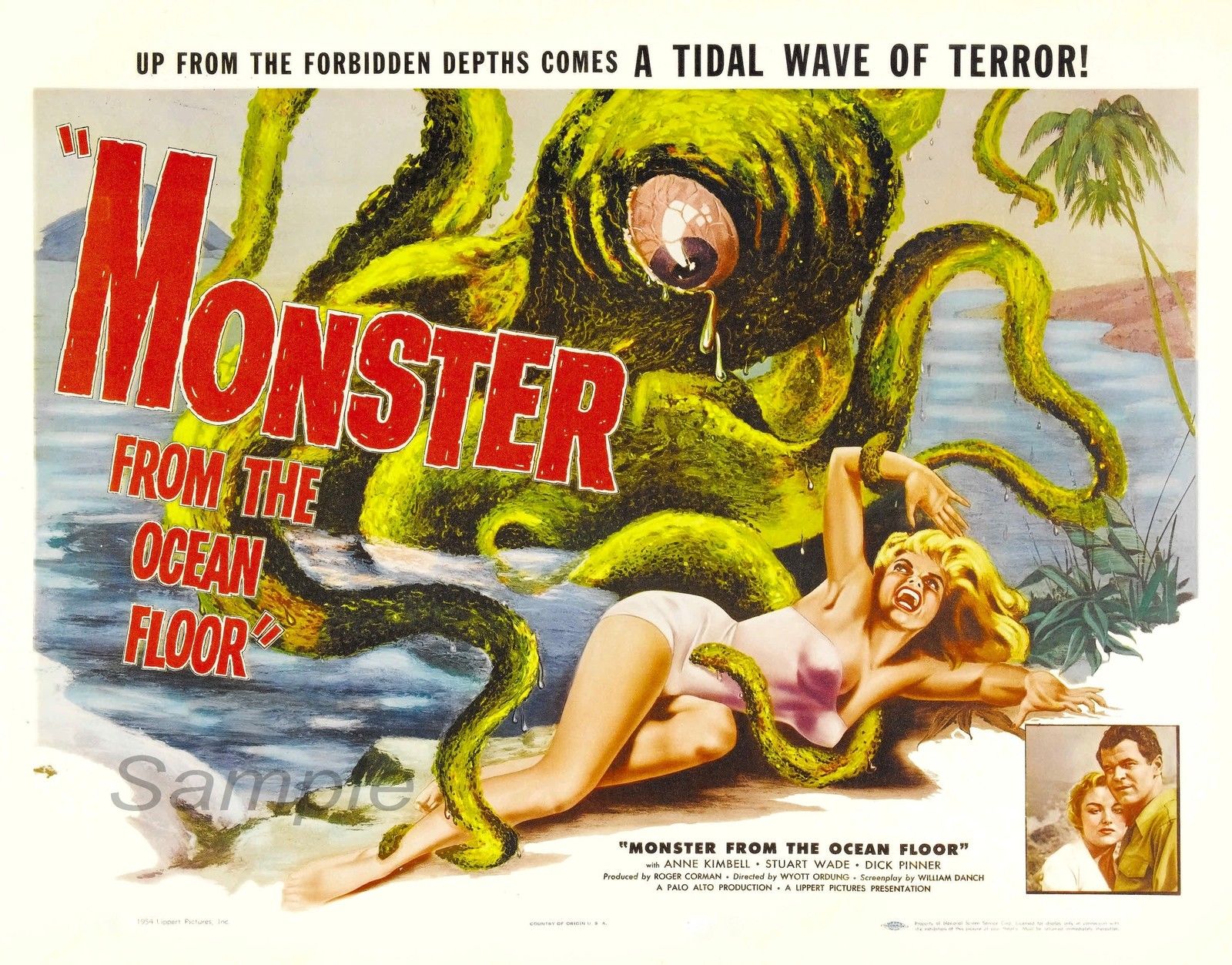
Monster from the Ocean Floor 1954

This was the producing debut of the B-movie king Roger Corman.

Many of his films were about unknown dangers lurking in the vast and unexplored ocean, and he produced/directed many profitable ones. In this one we have a giant one-eyed octopus skulking amongst a coastline in Mexico.

Monster from the Ocean Floor 1954

While holidaying in Mexico, Julie Blair (Anne Kimbell) learns about a mysterious monster who has eaten various residents of the sea-side town. The only clues it leaves behinds are massive drag marks that resident Pablo (director Wyott Ordung) describes as “not a seal.”

Marine biologist Steve Dunning (Stuart Wade) picks her up in his mini-submarine and the two hit it off,  but Steve is not at all convinced by Julie’s concerns about the mythical creature. With Steve moving on for further exploration, Julie is left on her own, with one of the local residents whispering in Pablo’s ear that a human sacrifice may cause the creature to go back into hibernation.

I didn’t know much about the two leading actors in this film but it looks as though it was Stuart Wade’s debut film. He seemed to continue until 1964 in roles – some not credited but at least  he took one of the starring roles in this one. I will try to find out more about him.

Anne Kimbell  had a more successful acting career – in fact she did come to London and appeared in a West End play directed by Vivien Leigh – and met and married her husband here,  who was in the diplomatic service – so after films she lived in various place in the world with her family.

She does seem to have been an interesting person.

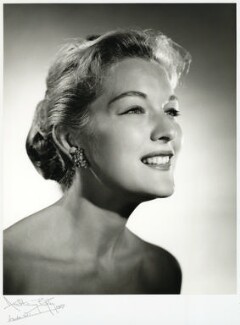
Anne Kimbell

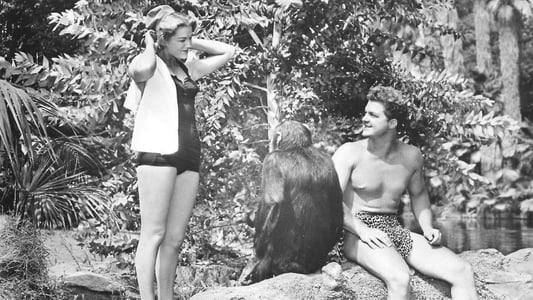
 Anne Kimbell with Bomba in The Golden Idol

Above – Anne Kimbell with Johnny Sheffield in Bomba and The Golden Idol 1954

The same year as Monster from the Ocean Floor

In 1992, Anne Kimbell travelled to Colorado with the intention of purchasing a horse ranch.  She acquired the ranch as planned, but also purchased the Jones Theater in Westcliffe, Colorado,  which the previous owner had intended to convert into a Laundromat.  She wanted to preserve the theater as a working cultural landmark in the Wet Mountain Valley.  She founded the Westcliffe Centre for the Performing Arts and based it at the theatre.  She and her business partner, Tom Stagg, expanded the WCPA and oversaw the addition of the new Studio 2 onto the existing Jones Theater.

Anne  Kimbell  also developed the Shakespeare in the Park festival, which is now held annually in Westcliffe.She served as the WCPA’s president, producer and, finally, its artistic director until her death in 2017.

 She developed women’s cultural programs in Tunisia  and a school for women in Chad.

 She was the author of several novels, including To Catch a Spy, The Ibeji Twins and Assignment Paris.

posted by Movieman in Uncategorized and have Comments (10)

James Robertson Justice –

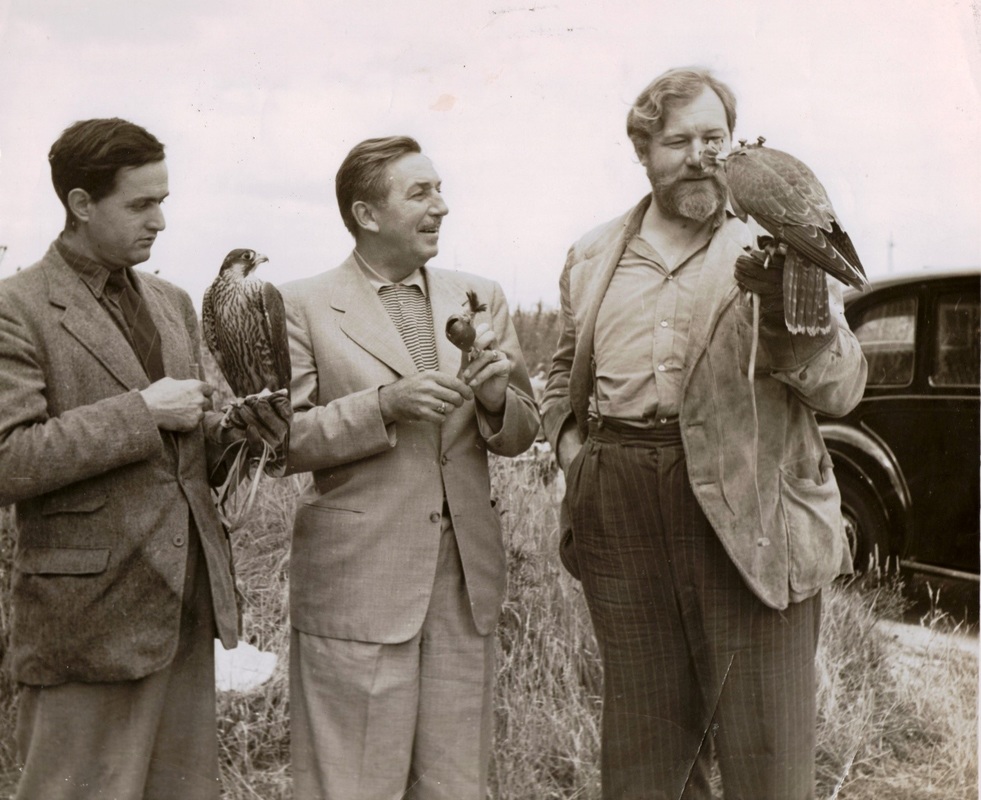
I have never seen the picture below before and just wonder when and where it was taken.  Walt Disney came to oversee the production of The Sword and the Rose  in the UK from June to September 1952, and I have a feeling it was during this time. He had, as we know, been here in the summer of 1951  to supervise the production of The Story of Robin Hood and His Merrie Men.

In the picture below however I reckon that James Roberston Justice looks quite a bit heavier than he had on the Robin Hood film as Little John.

James Robertson Justice with Walt Disney

James Robertson Justice may not have considered his past very exciting and instead enjoyed embellishing the truth by weaving stories to his friends about how he was a Scotsman by birth and was born under a whiskey distillery in the Isle of Skye. 

He began his career in films inauspiciously with a number of minor roles for Ealing Studios, one of which was Vice Versa ( 1948 ) directed by a young Peter Ustinov. Robertson Justice was perfectly cast as the gruff headmaster Dr. Grimstone.

In 1952, Walt Disney cast James as the burly Little John in The Story of Robin Hood and his Merry Men. 

Justice was an excellent supporting member to the leading actor, Richard Todd, and the following year they were teamed up again in The Sword and the Rose. This time Justice portrayed King Henry VIII. In their final teaming – Rob Roy : The Highland Rogue – James donned the kilt and grew his hair long for his role as the Duke of Argyll, a proud Scotsman acting as a mediator between the British army and the hostile MacGregor clan led by Rob Roy ( Todd ). 

I always think that he had the worst Scottish Accent imaginable in Rob Roy The Highland Rogue


He married nurse Dillys Hayden in 1941, but only a few years afterward his roving eye fell on the beautiful Molly Parkin.

She became one of his many mistresses in the coming years. When James and Dillys’ only son, James Jr., drowned in 1949, at the age of four, their marriage fell apart and, although they remained married for nineteen more years, they were living separately. Justice used the payment he received for his role as Lancelot Spratt and purchased a cottage in Spinningdale, Scotland, where he lived for more than two decades.

posted by Movieman in Uncategorized and have Comments (11)

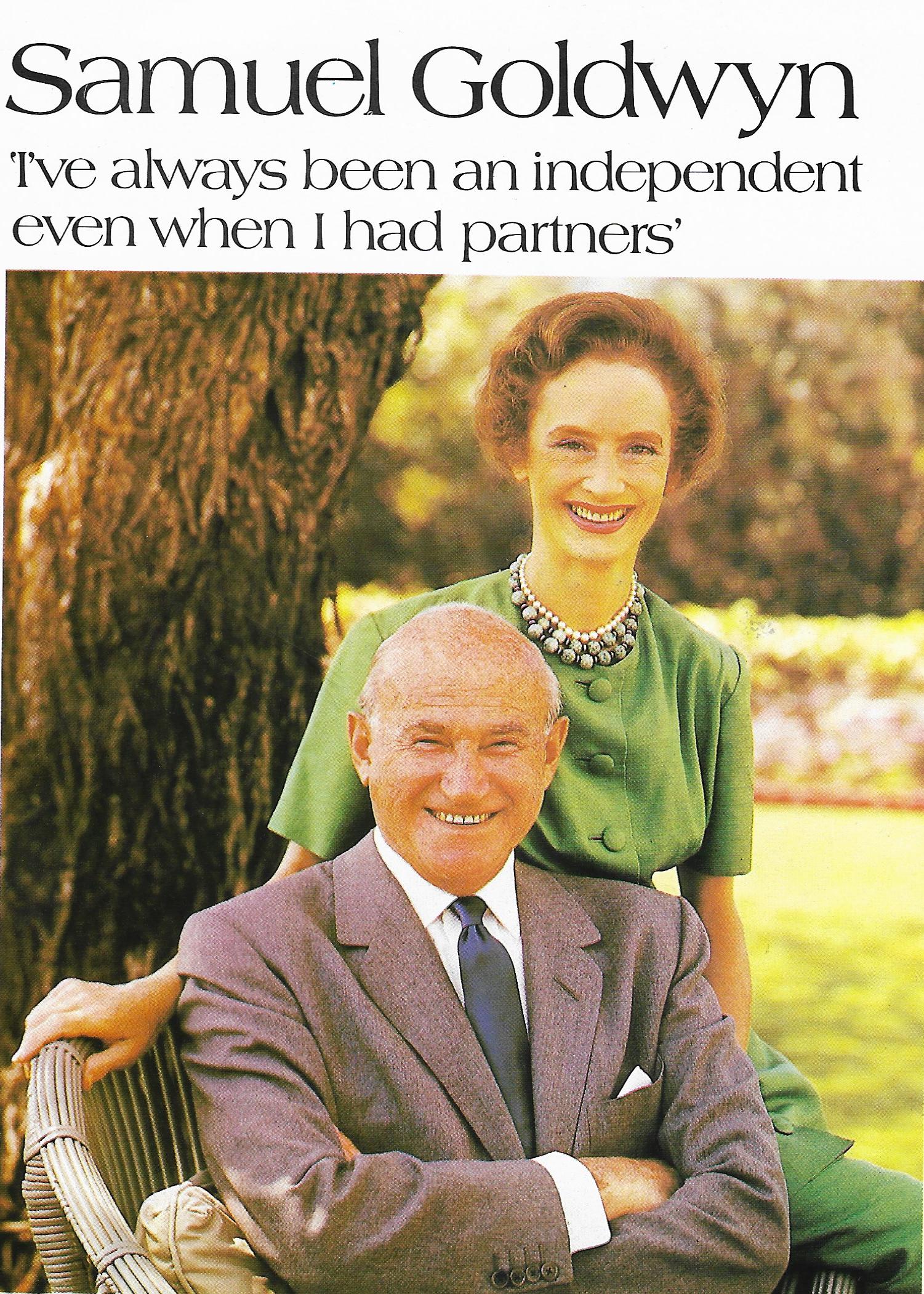
Sam Goldwyn

Sam Goldwyn is remembered both as a Producer of some of Hollywood’s most distinguished pictures and a purveyor of malapropisms probably better known and better described as ‘Goldwynisms’

Sam Goldwyn


He famously came out with ‘Verbal Contracts are not worth the paper they are written on’ and another one ‘ I had a monumental idea this morning but I didn’t like it’  or ‘Our Comedies are not to be laughed at’

Sam Goldwyn 2


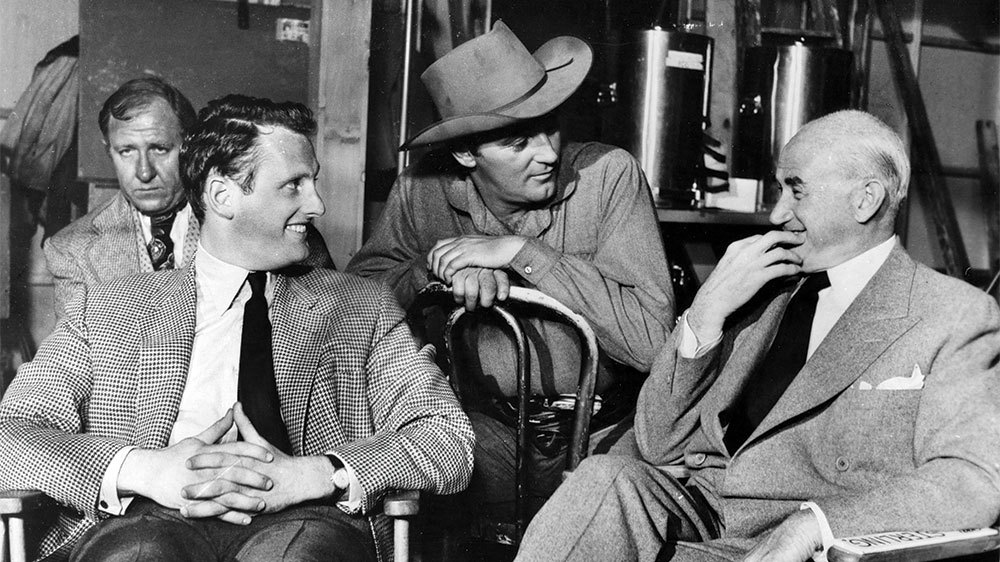
Above: Sam Goldwyn with his son Sam Goldwyn Jnr and Robert Mitchum on the set of ‘Man with a Gun’ in 1956.

They look to be having a good time sharing a joke.

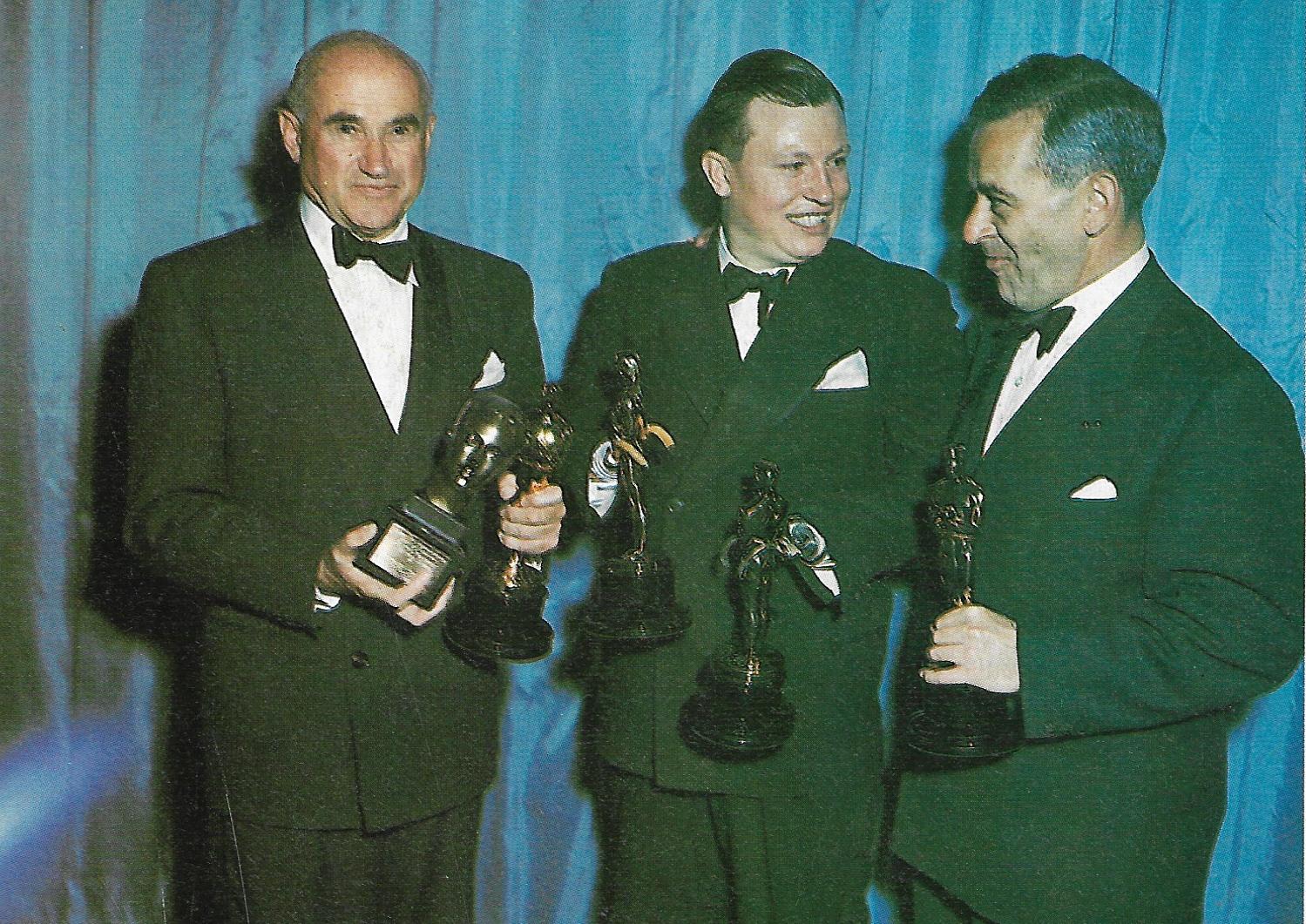
Sam Goldwyn receives an Award

Above:  Sam Goldwyn receiving the Oscar he won for The Best Years of Our Lives with Harold Russell and William Wyler.

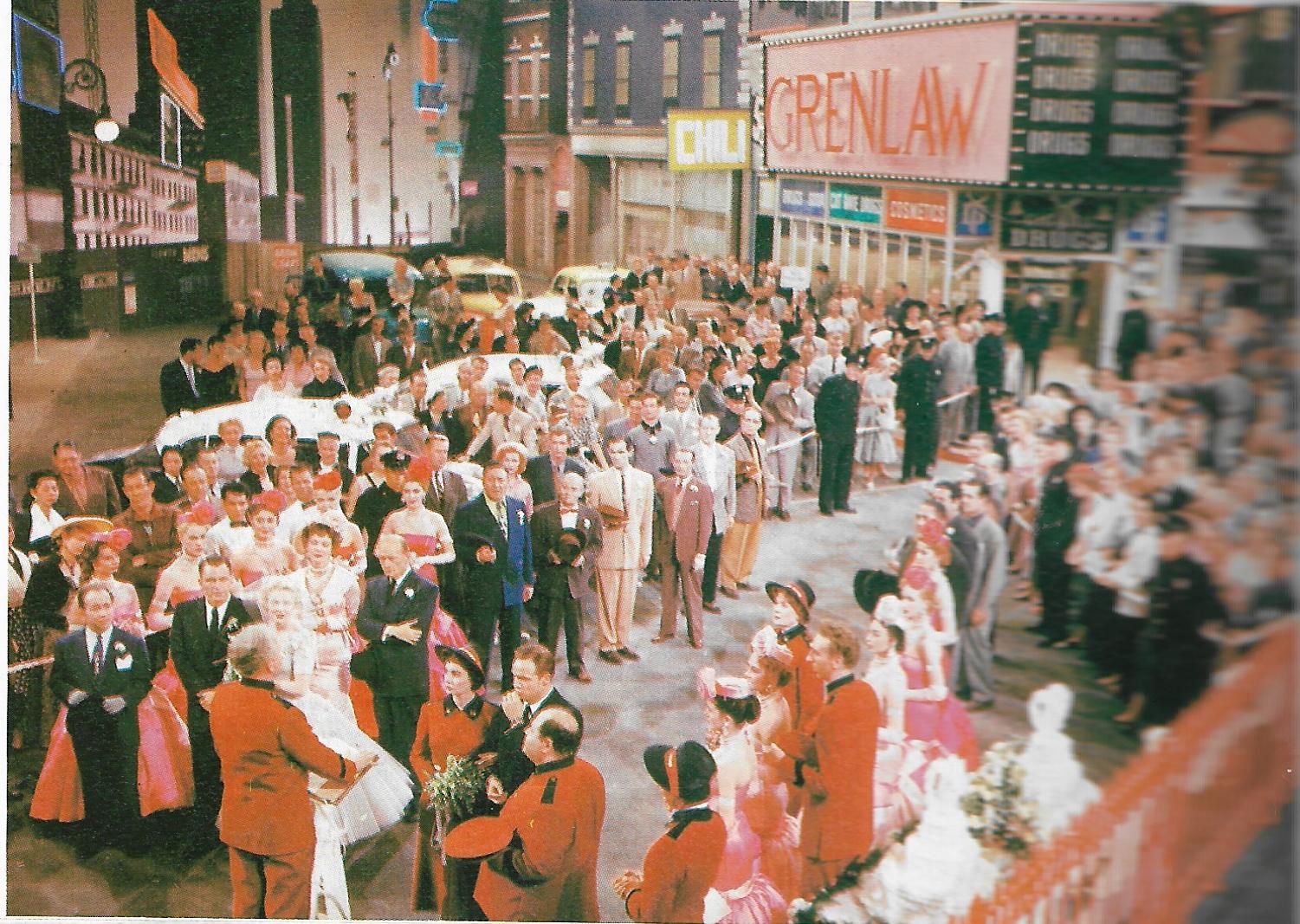
Below: Guys and Dolls – one of the last films he produced.

Guys and Dolls

Guys and Dolls.

For whatever reason I cannot remember but I recall as a boy being in a Cinema in HULL I think – and seeing this poster in the Foyer. It sticks with me to this day although I never did see the film and I can’t remember why we had gone there on a journey including a ferry crossing. It must have been to something special. However more about the film itself :

Sam Goldwyn produced and cast Marlon Brando in a role that had him sing and dance – which he did not do normally and had not done before BUT it proved inspired casting. He also managed to acquire the services of Frank Sinatra and a young Jean Simmons in  the film.

 GUYS AND DOLLS

Dir: Joseph L Manliewicz. Starring: Marlon Brando, Frank Sinatra, Jean Simmons, Vivian Blaine, Stubby Kaye

Anyone who saw Richard Eyre’s triumphant National Theatre revivals of the classic Broadway musical Guys and Dolls in 1982 and 1996 might be forgiven some trepidation in revisiting the 1955 film. Will it still feel as vibrant as ever, or has age dimmed its lustre?

Perhaps surprisingly, it holds up rather well. For one thing, it boasts stellar casting: Marlon Brando and Frank Sinatra in one film – as the rival New York gamblers (and gangsters) Sky Masterson and Nathan Detroit, who place a bet on compromising the virtue of a pious Salvation Army woman, Sarah Brown (played by Jean Simmons).

It’s a feature of real interest in the movie that Brando, neither a singer nor a dancer, does both, having trained himself assiduously to perform Frank Loesser’s songs, while being assisted by the great Michael Kidd’s choreography. Brando wasn’t producer Sam Goldwyn’s first choice as Sky (that was Gene Kelly) but he acquits himself outstandingly.

Of course, the musical numbers in Guys and Dolls are pretty well indestructible. Loesser’s classics come thick and fast: A Bushel and a Peck, performed by scene-stealing Vivian Blaine as Miss Adelaide, followed by the great Miss Adelaide’s Lament, about a young woman with a cold; the lovely If I were a Bell, sung by Simmons; More I Cannot Wish You, Luck Be a Lady and the joyous, gospel-influenced Sit Down, You’re Rockin’ the Boat. And these are just the standouts: the secondary songs in Guys and Dolls would grace most other musicals.Some of the pizzazz of the original 1950 Broadway show remains intact in the casting: the splendid Blaine was the first Miss Adelaide, while amiable, rotund Stubby Kaye also played the small-time gambler Nicely-Nicely Johnson on stage.

The other undeniable charm of the film is its dialogue. Its story was adapted largely from two short stories by Damon Runyon, who had a remarkable ear for the speech patterns of the hustlers and faintly disreputable types who hung around Broadway in the Prohibition era. Guys and Dolls may seem wordy for a musical – but what words they are, in gorgeous juxtapositions. All in all, it’s a treat and delight.


posted by Movieman in Uncategorized and have Comments (7)

Movie Memories – Issue 91 – Spring Edition 2018

Well it was something of a Red Letter Day today – The Wedding of Prince Harry to Megan of course but also after this, the post came and with it  a new edition of the wonderful Movie Memories Magazine came through the door.

If you haven’t got your copy please subscribe to it for £ 16 per year – and you will love every page.

Chris Roberts is the Editor and the person who originated this Magazine – he can be contacted by email  crob.mvm@ntlworld.com

PLEASE contact Chris if you wish to subscribe – or send a message here and we will let him know.

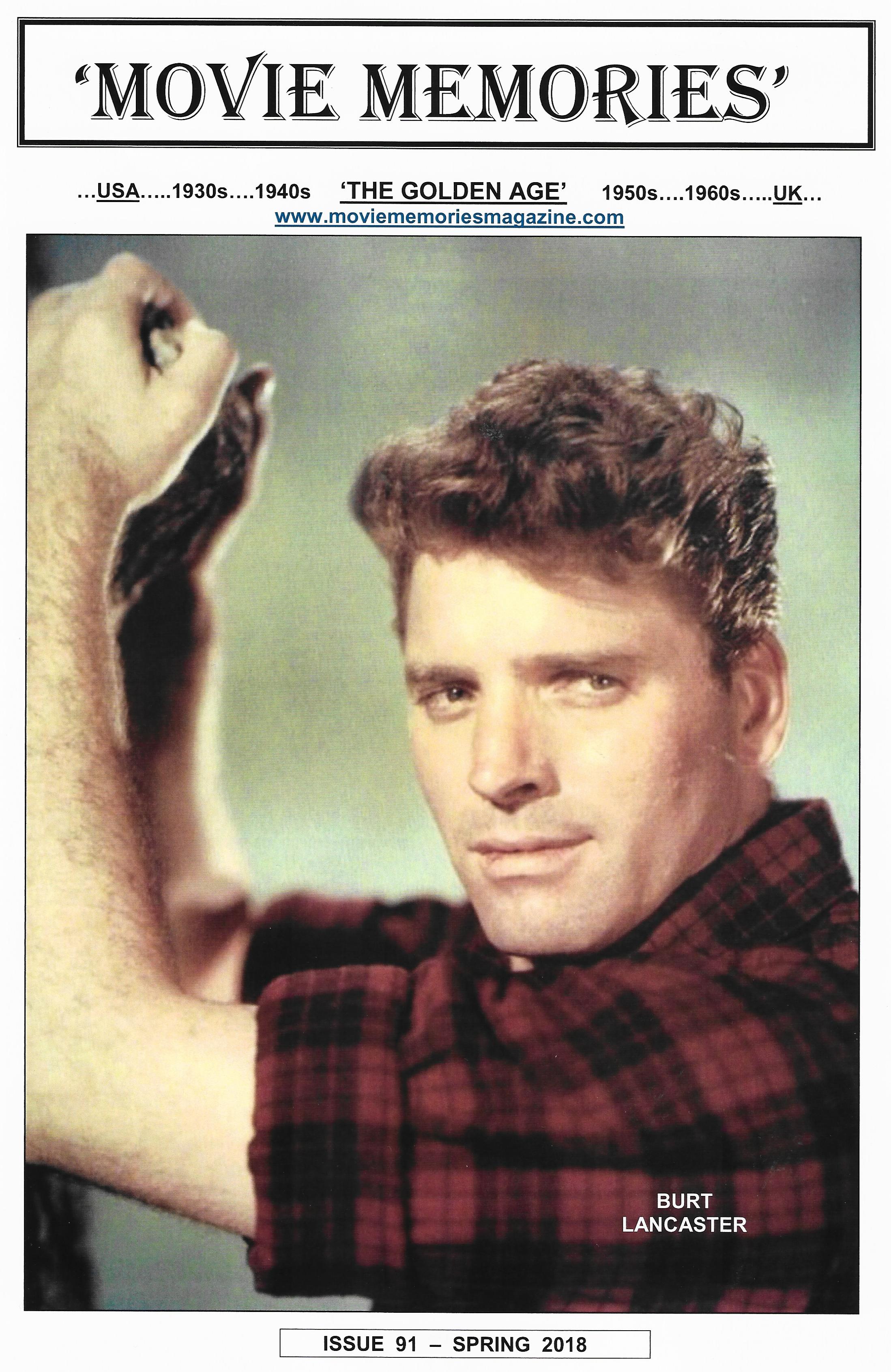
Movie Memories Issue 91 Spring 2018

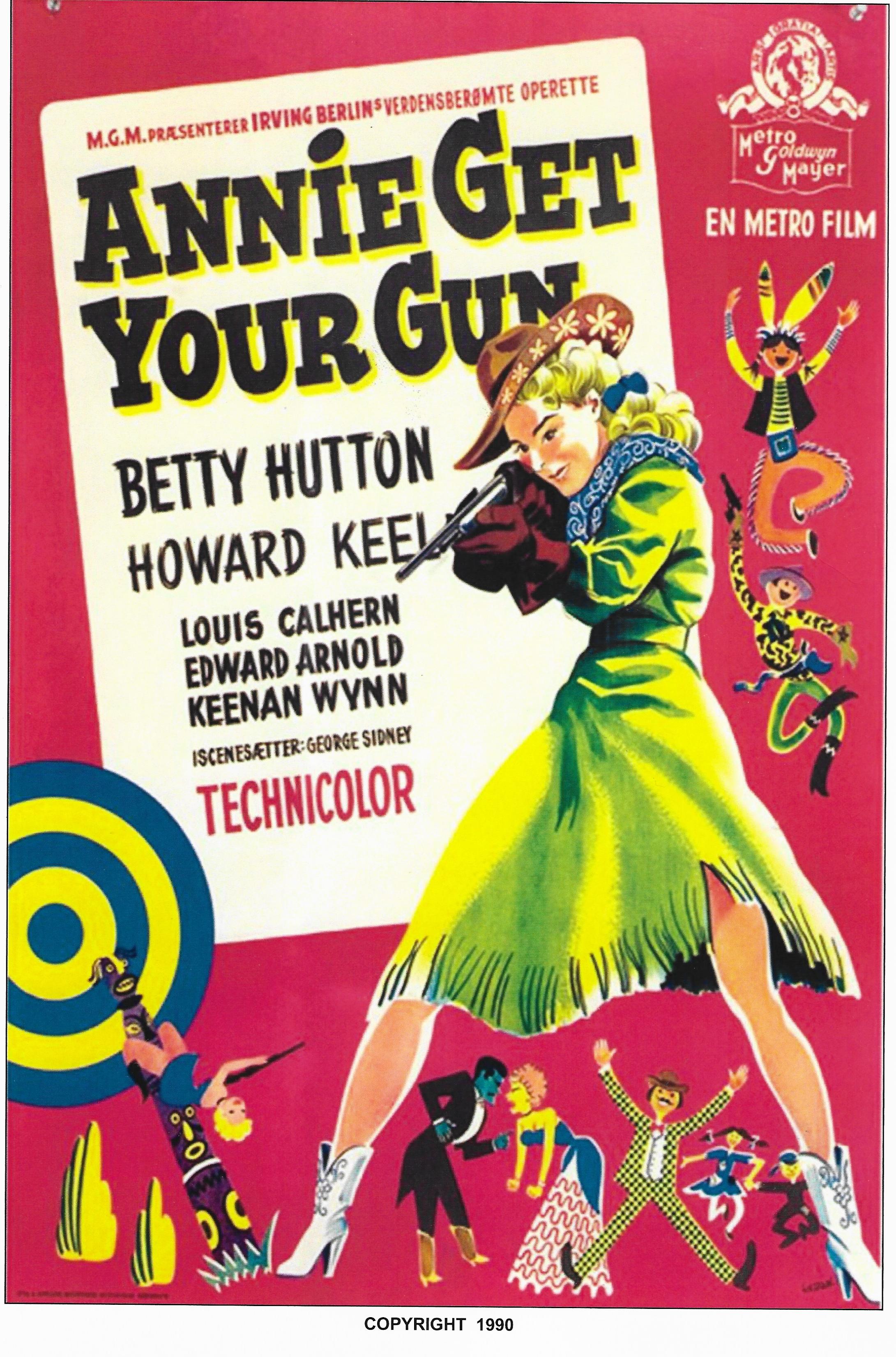
Lon Chaney Jnr., John Gavin, Vic Damone,  ALSO Burt Lancaster – featured on the Front Cover,  Annie Get Your Gun, Ian Bannen. Miriam Hopkins and so many more PLUS interesting letters from Readers.

Movie Memories Issue 91 Spring 2018 2

posted by Movieman in Uncategorized and have Comments (6)

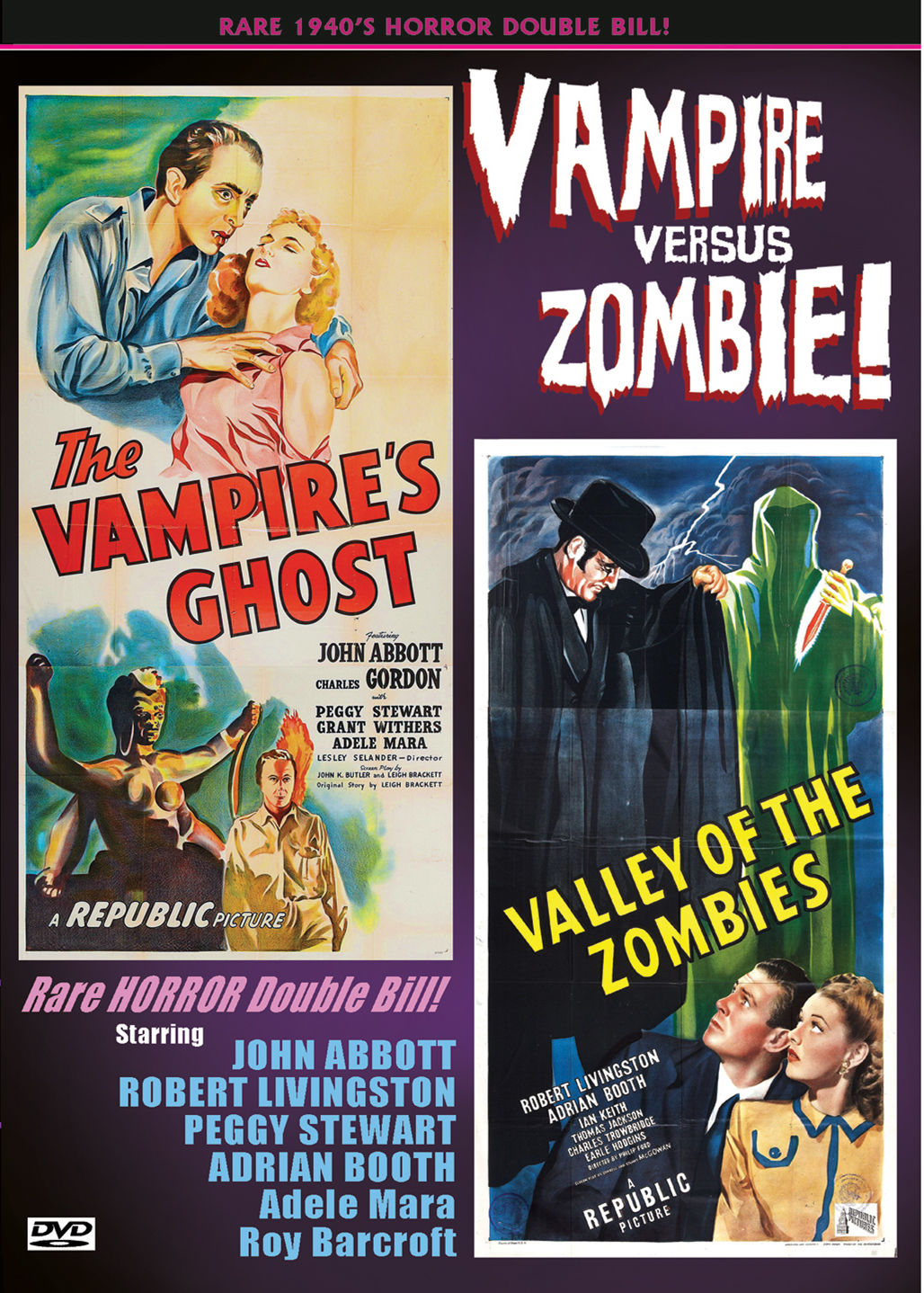
HORROR Double Bill from Republic

Every so often, I seem to come across these older DOUBLE BILL film  programmes – and this comes from Republic Pictures who are known really for their Westerns – some very good ones at that – which they seemed to churn out in great numbers.

THE VAMPIRE’S GHOST and VALLEY OF THE ZOMBIES! RARE 1940’s double HORROR bill!

Republic Horror Double Bill

Republic Pictures, were well known for  Westerns and serials but they also ventured into HORROR films.  These are two  from the mid-1940s featuring John Abbott with Peggy Stewart in THE VAMPIRE’S GHOST and Robert Livingston, Adrian Booth and  Ian Keith in VALLEY OF THE ZOMBIES. Also featuring Adele Mara and Roy Barcroft.  

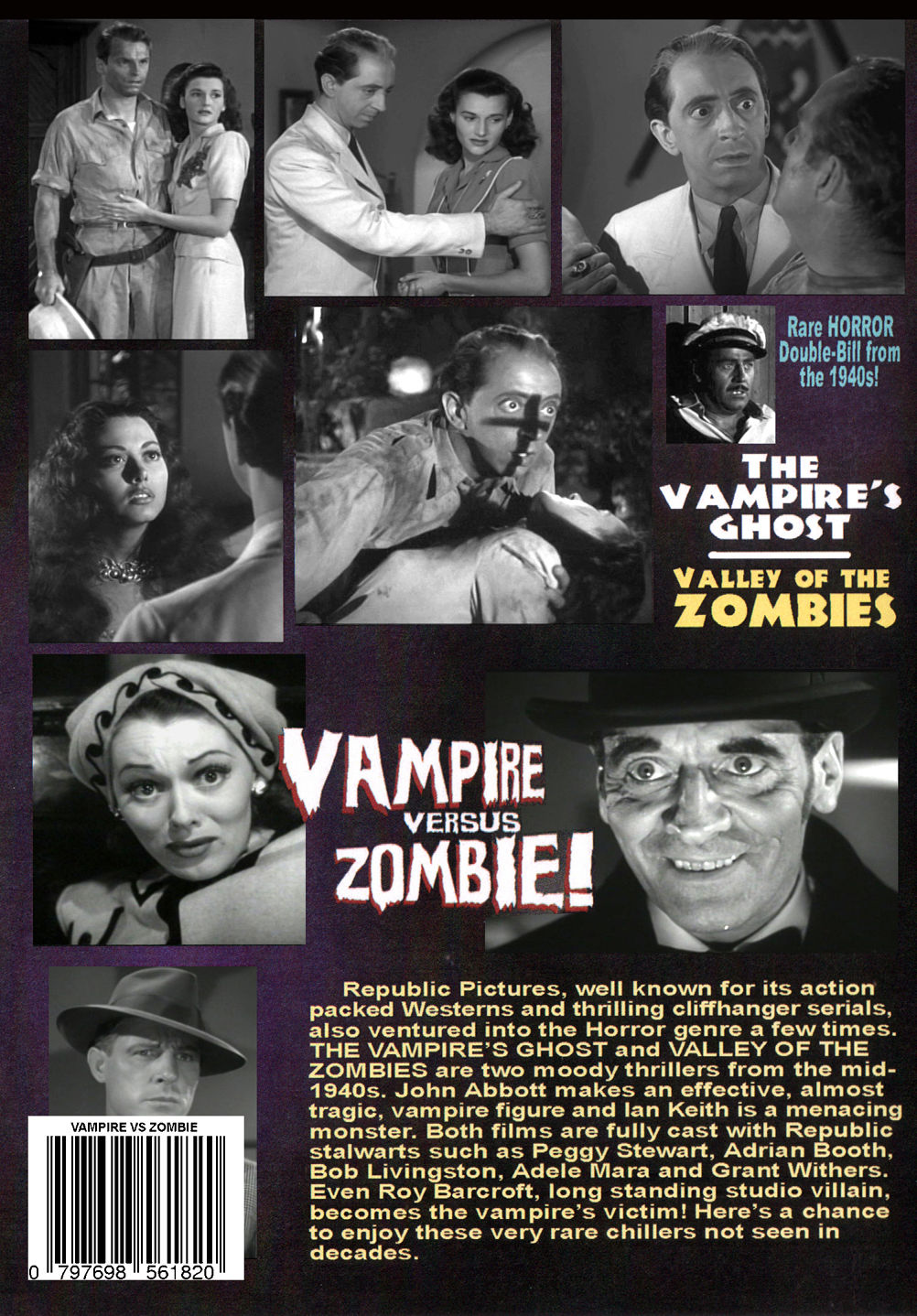
Republic Horror Double Bill 2

Republic Pictures. Directed by Philip Ford and Leslie Selander.

Republic Pictures churned out a lot of “B” pictures  during the 1940s, many of which were barely watchable. Some like this one were quite good.   THE VAMPIRE’S GHOST is a low budget horror film with the script written by the legendary science fiction writer Leigh Brackett.

The story has the exotic location of an African plantation with the well mannered John Abbott starring as Webb Fallon, a centuries old vampire now living in Africa and running a saloon. The incidents in the film are quite unusual, most notably an exotic dance performed by Adele Mara in Fallon’s saloon.

An atmospheric film.

These are of course TWO 1940’s  Films.

posted by Movieman in Uncategorized and have Comments (8)

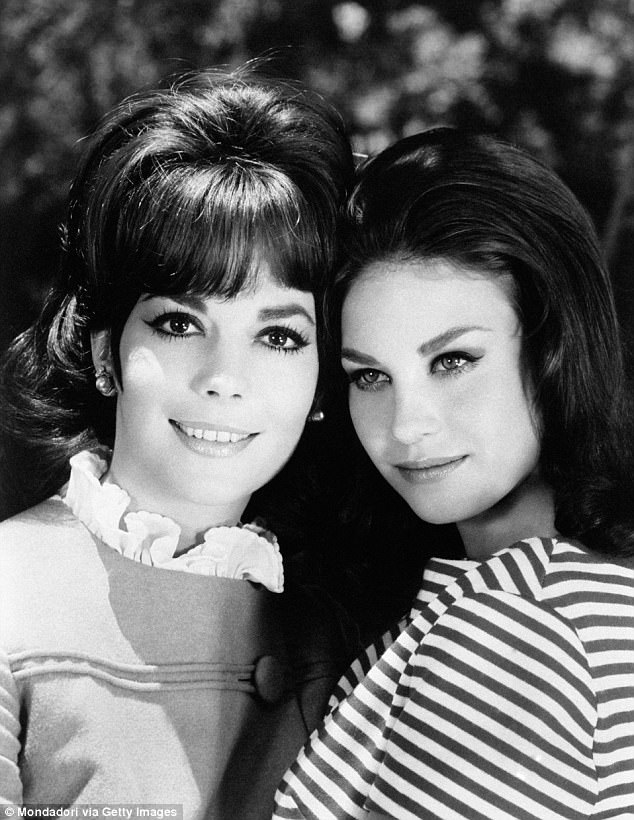
Natalie Wood and her sister

Sisters who have appeared together on screen are Natalie Wood and her younger sister Lana who have been seen in The Searchers.

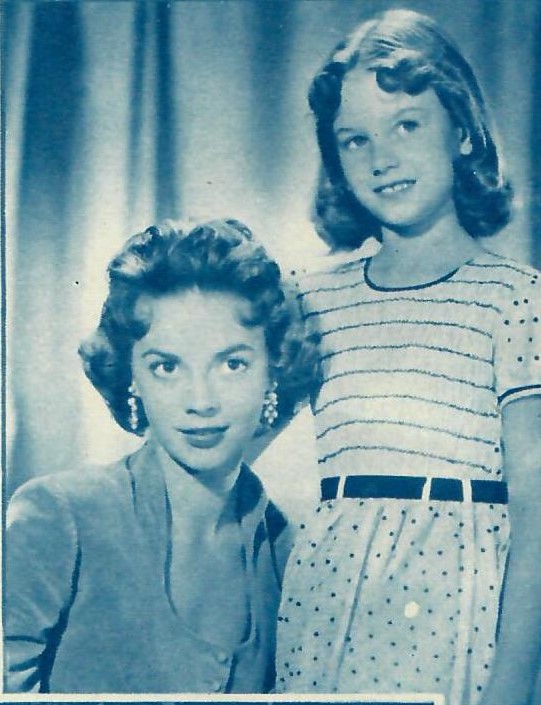
Matalie Wood and Her Sister Lana

Natalie says that her sister Lana was not too interested in films at first but later found out what a good time Natalie was having in the Film Industry so decided she would give it a go.

She did of course and had a reasonably successful career.

The picture below shows the sisters a few years later :

Natalie Wood and Lana

Although Lana Wood’s career never reached the heights of her sister’s, she did find some measure of her own fame as a “Bond girl”.

She played Plenty O’Toole in the 1971 James Bond movie, Diamonds Are Forever, opposite Sean Connery.

Lana’s career started out in Natalie’s shadow. She played a baby in Wood’s film Driftwood, although the role was cut from the end product, and she played a younger Natalie Wood in the iconic John Ford movie, The Searchers.

Lana Wood also starred in a series of well-known TV shows, including Peyton Place. She starred in a series of Hollywood films, and, later, in TV movies.


posted by Movieman in Uncategorized and have Comments (4)

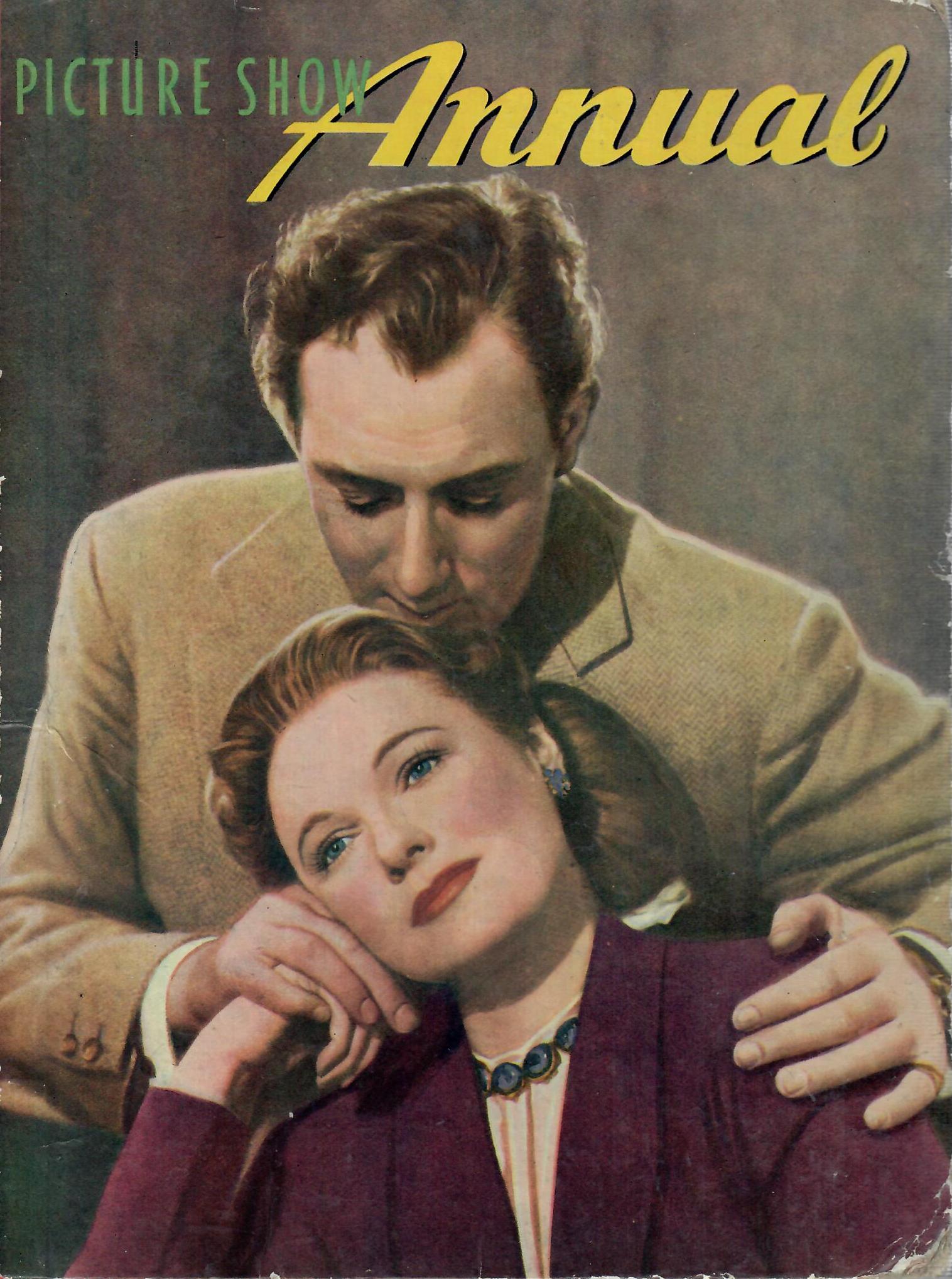
Picture Show Annual – Snippets

These Film Annuals of the Fifties were remarkably detailed – as well as scenes from the films and Star Portraits, we had items on the Stars homes and home life – as well as these little bits below on shooting of the soon-to-be seen films – and there were a great many of them to cope with Cinema demand.

Below we have a location shot of work being done on the Film Trottie True which was quite a lavishly produced Technicolor film of the very early 1950s.  One I must say that I am not too familiar with although I always remember being in a conversation with a young lady in the local pub some years ago, and she remembers this film very well and the memory of it had stayed with her – so it was a film that did impress at the time.

Jean Kent Filming

In this picture ABOVE we seen the very large Technicolor Camera being set up to shoot a picnic scene featuring Andrew Crawford and Jean Kent.

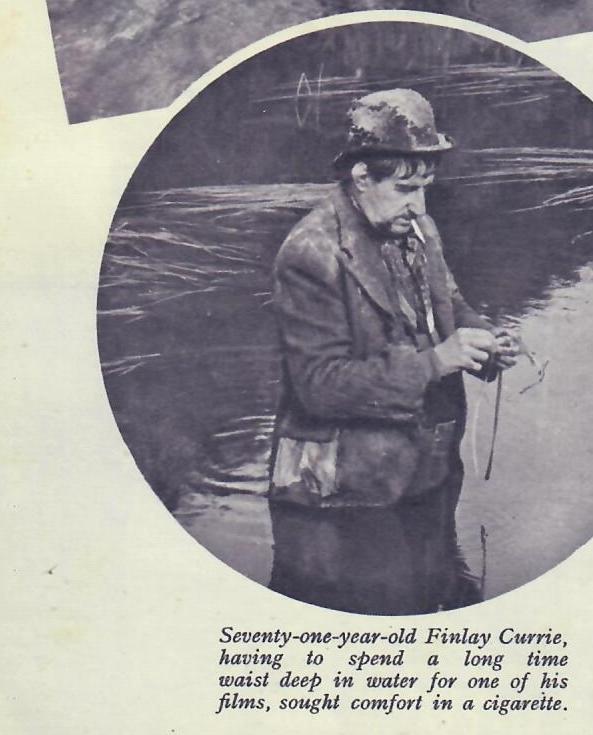
In the same part of the Annual is this little item BELOW – and this is Finlay Currie between scenes on a film that I am pretty sure is  The History of Mr Polly made at Denham Film Studios with John Mills.

Finlay Currie - The History of Mr Polly

The caption describes the 71 Year Old actor stopping filming and enjoying a cigarette, I am pretty sure  in the lake at Denham Film Studios at the back of the site itself where John Mills, who produced the film, had a country cottage set built close to the water for the film.

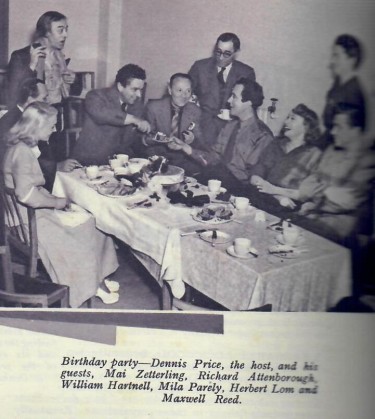
And BELOW yet another unusual item from Film Land.

Birthday Party

Dennis Price happened to be filming Cockpit on the occasion of his Birthday so he threw a small party in the Studio during a break in filming. Guests included Mai Zetterling, Richard Attenborough, William Hartnell, Mila Parely, Herbert Lom, Maxwell Reed and Director Bernard Knowles with Producer Gordon Wellesley. Dennis Price usually spend his waiting moments studying his script but on this occasion he has obviously decided to celebrate. Very nice too !!!

These Snippets are from the Picture Show Annual of 1950.

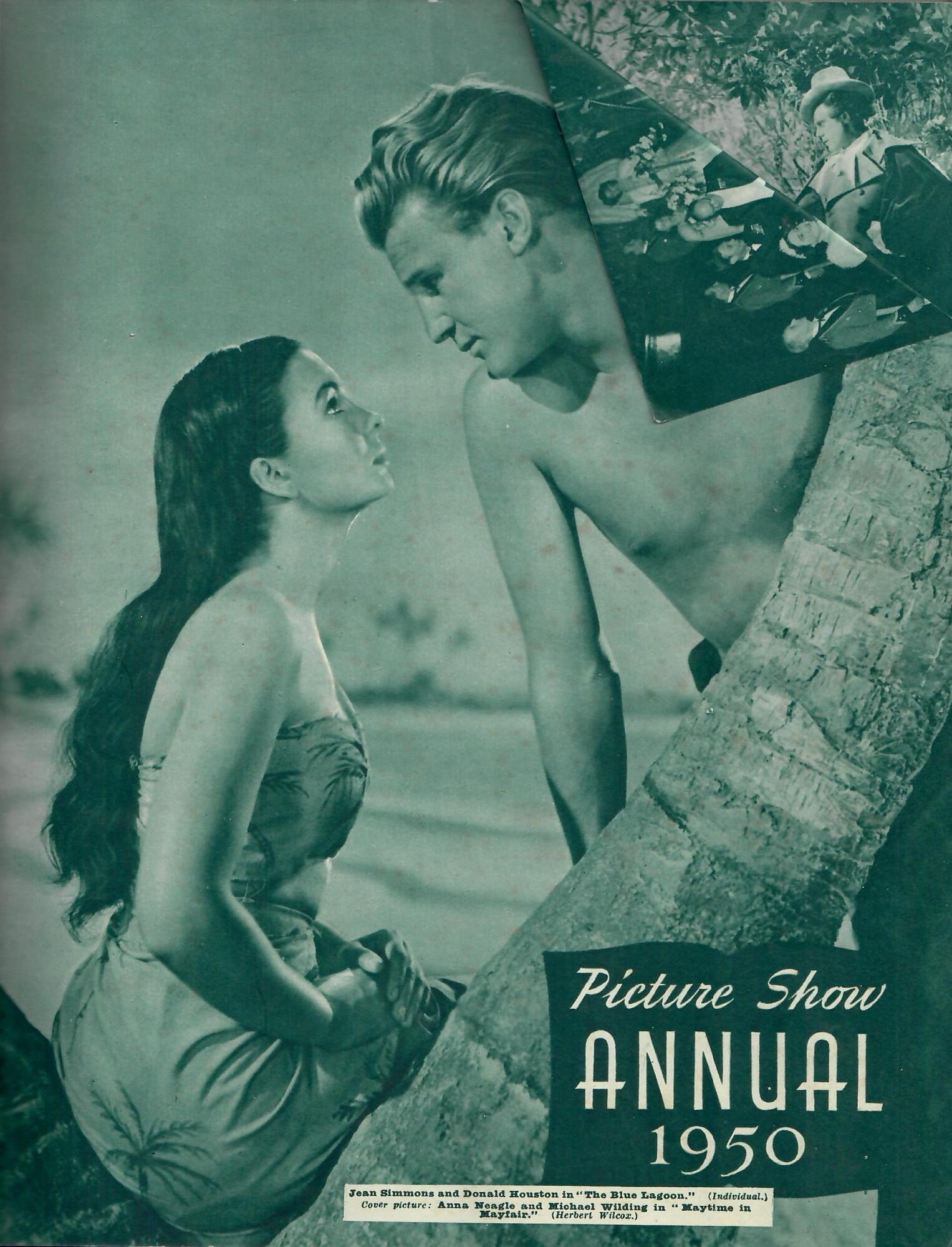
Michael Wilding and Anna Neagle in Maytime in Mayfairon the front cover – BELOW

Picture Show Annual 1950 2

Jean Simmons and Donald Houston in The Blue Lagoon BELOW

Picture Show Annual 1950


posted by Movieman in Uncategorized and have Comments (6)

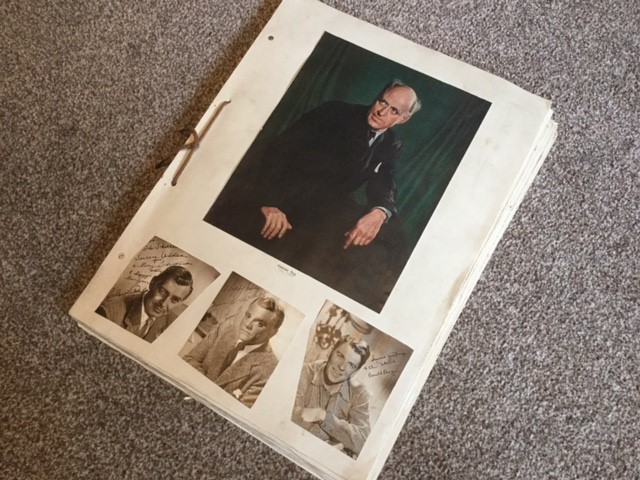
A Film Scrap Book from the Fifties

A good friend of mine over a lot of  years had been clearing out his former family home after his Brother had died last year and he came across a Film Scrap Book from the Fifties era that his brother, who had been a film fan, had collated in his younger years.

Scrapbook Nigel

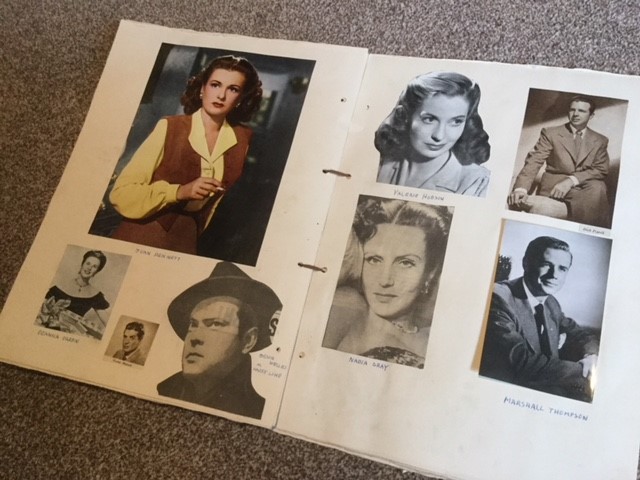
He had taken these snippets from the many magazines we had at that time and created this lovely Scrap Book.  Today my friend John gave me this book as he knew it would be going to a home where it would be very much appreciated – and it is.

Scrapbook Nigel 2

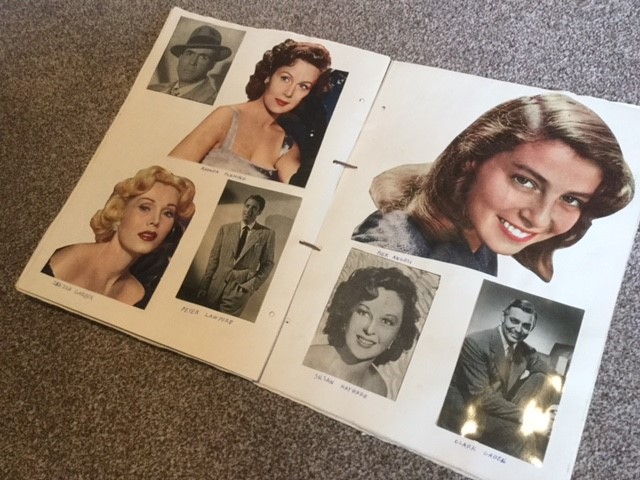
Looking through it, it is a reminder of the many stars and also the many films which were made to cope with the cinema demand – usually Two films per programme – the supporting film and the Big Picture.

Scrapbook Nigel 3 W

This, as any personal book of its type, is unique. No one else can possibly have it because it is the work of one person, taking time out to choose the clippings and save them by sticking them in – in the sequence that that particular person chooses.

You have to have – or have had – a love of  films to do this.

Looking through it, it is a reminder of the many stars and also the many films which were made to cope with cinema demand – usually Two films per programme – the supporting film and the Big Picture

We are lucky to have access to such Memorabilia – and with this particular one – it is me who is lucky.

posted by Movieman in Uncategorized and have Comments (9)

Annette Day – A Brief Film Career – but with Elvis

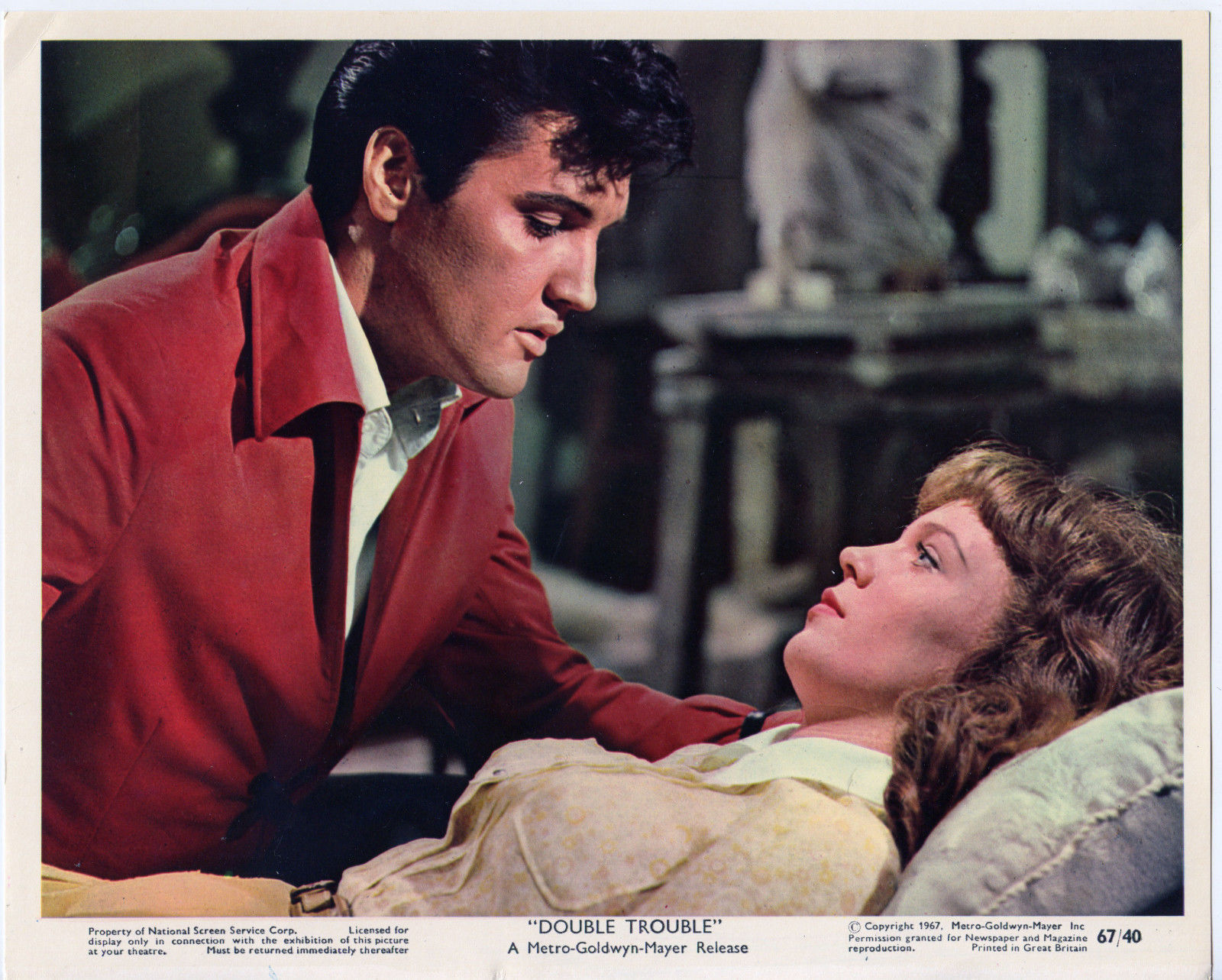
Annette Day’s entire film career consists of her single appearance with Elvis in Double Trouble. After that she retired from films and never went back again.
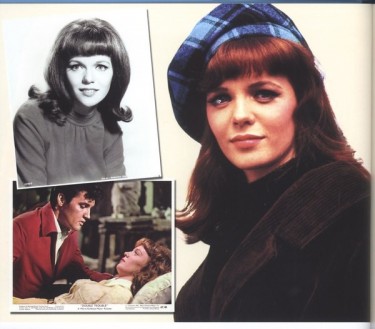
Annette Day

Just over half a century ago Annette Day was filming Double Trouble with the King of Rock ‘n’ Roll.

When she heard the news that Elvis had died she was living in Beckenham.

“I thought it was so terribly sad, he was a man of so many talents, who had so much more left to give.”

Annette, who now lives in Telford, Shropshire, knew about this better than most.

Because 10 years earlier, as a fresh-faced 19-year-old, Annette became the first and only English actress to star alongside Elvis on the big screen.

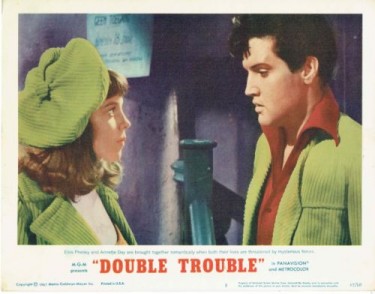
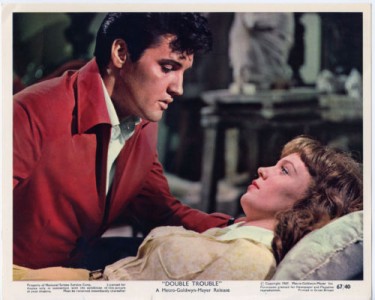
The 69-year-old grandmother played Jill Conway, a rebellious British heiress who led the singer through all sorts of wild escapades across Europe, getting mixed up with spies, jewel thieves and madcap detectives along the way.

Off screen, the pair enjoyed a close, if brief, friendship with the King of Rock ‘n’ Roll, which even extended to him buying her a car as a treat.

It is 40 years today since Presley died in the bathroom of his Gracelands mansion in Memphis, Tennessee, after suffering from heart failure brought on by a drug overdose. He was just 42 years old and, if not at the height of his stardom, was still one of the biggest global stars having successfully reinvented himself for the glam rock era.

While there had been rumours about his health, particularly concerning his weight and dependency on prescription drugs, very few people were aware of the lonely, troubled individual behind the flamboyant jump-suited stage persona.
Double Trouble 4

Annette – above with Elvis – as she was in Double Trouble

Annette, who settled in Shropshire with husband Mike the year after Elvis’s death, remembered the singer as being like a big brother to the innocent teenager who had been plucked out of obscurity after being spotted working on a market stall by film producer Judd Bernard.

“He had a terrific sense of humour, he was always playing games,” she says.

“There were a couple of times, off-stage, when the light came on for me to go through the door onto the set, and he would grab my coat so I couldn’t walk, and the crew would be calling for me. I had a ball, it was tremendous fun.”

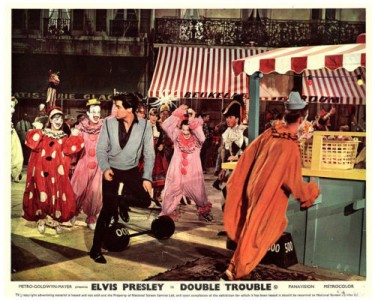
A scene from double Trouble, which was Elvis’s 24th feature-film

And she got a first-taste of the star’s legendary generosity at the end of filming, when she was making small talk about how youngsters back in Britain would have to save to buy their first car.

“After a day on set we were talking about how youngsters have to save every penny to buy a car after their graduation,” she says.

“In the US, most youngsters were given a car, not so in the UK.”

Then one day, in a car park, Elvis asked her to follow him, and asked her to close her eyes.

“At that moment I knew he had a surprise waiting for me, but never in my wildest dreams could I have thought of a sports car,” she says.

“It was a white Mustang convertible. Elvis handed me the keys and said ‘it’s your’s’.

“I couldn’t believe it, but I think he did things like that quite often,” she says. “I think if he was able to help somebody, he liked to do that.”
Annette Day with Elvis 2

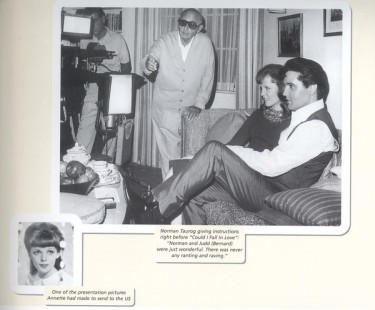
Above: Annette and Elvis off camera, while director Norman Taurog set up their scene

Double Trouble was Presley’s 24th feature film, and it was reported that by this time he was getting quite weary of them, although he made seven more movies in the two years that followed.

It is said that when he found he would have to sing Old MacDonald Had A Farm for a scene in Double Trouble, Elvis screamed “It’s come to this?”, and Annette believes that he was definitely falling out of love with the movie industry.
Double Trouble 2

“I think, more than anything, he wanted to be back out on stage to his fans,” she says.

“I think he was quite pleased when the musicals had stopped. I think he would like to have got a more serious picture, he wanted to do more than just musicals. I think he could have been a very good actor, but the films he was in were all the same sort of thing, family films with a few more songs in between.”

Annette, who worked as a secretary at Telford-based SMP Security before her retirement, was offered a seven-year contract by MGM Studios after Double Trouble, but decided acting wasn’t for her. She rarely talks about her part in the film, and reckons many people have no idea about her previous career.

“I don’t watch the film very often, and when I do I don’t think I was very good in it,” she says.

“I went to be with my husband, and I’ve had my children and my grandchildren and I have no regrets about that at all. They say go out while you’re at the top, I had great fun, but it was very hard work, you would be there on set at eight in the morning, and you could be there until 6.30 at night, nobody could go until everything was perfect.”

She returned to the UK, not only leaving behind her brief film career, but also her Ford Mustang.

“I found it would cost rather a lot to bring it back to the UK,” she says. Today, of course it would be worth a fortune as a treasured piece of movie and musical history, but she gave it to her brother who was living in the US at the time. He used it for a few years, and then sold it when it broke down.

It all begs the question of what would Elvis be doing if he were still alive today at the age of 82?

Annette does not think he would be performing today, although she say s he would also have found it very difficult to give it all up.

“It must be very hard for somebody who is at the top like that to walk away from it all,” she says. And she has no doubt that if he had lived to a ripe old age, it would have done nothing to lessen the legacy of his work.

“He just had something about him,” she says.
Double Trouble 3

Double Trouble


posted by Movieman in Uncategorized and have Comments (16)