I remember going to the local cinema to see this film – The Maverick Queen. I often get this film mixed up with another Barbara Stanwyck film a couple of years earlier ‘Cattle Queen of Montana’ with Ronald Reagan for RKO Pictures
Directed by Joe Kane Starring Barbara Stanwyck, Barry Sullivan, Scott Brady, Mary Murphy, Wallace Ford, Howard Petrie, Jim Davis, John Doucette
The Maverick Queen (1956) paired Barbara Stanwyck and Barry Sullivan a year before Sam Fuller’s Forty Guns. For Republic, this was a pretty lavish picture — color, widescreen and location work in Silverton, Colorado.
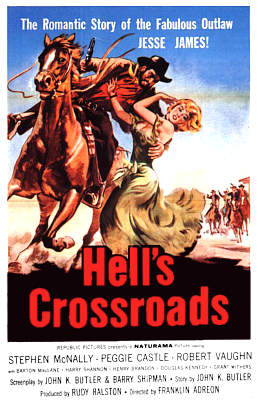
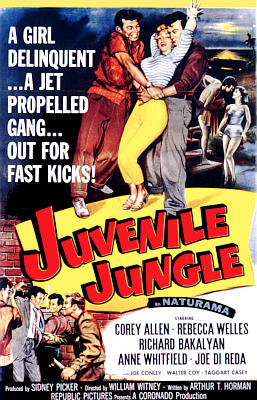
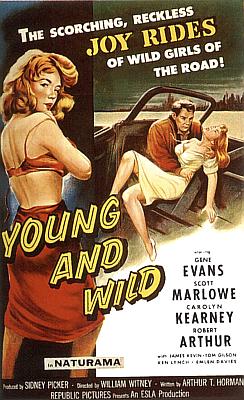
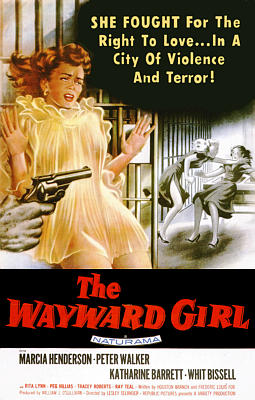
”The Maverick Queen introduces Republic’s wide screen process, called Naturama.
Republic reportedly spent two years developing this anamorphic system. (Its projection aspect ratio of 2.35 to 1 is somewhat narrower than that of CinemaScope). Thus equipped, the film has plenty of room to show, in colour, and the wide open spaces of Colorado, where it was made.
It’s ironic that since its original release, Naturama has not been seen at it’s best but that’s about to change. It’s coming to Blu-Ray — from a 4K scan of the original camera negative.
Director Joe Kane: “The studio was scraping the bottom of the barrel to get a big moneymaker and they finally let me have colour and Naturama and Barbara Stanwyck… It was a real pleasure to work with a grand trouper like Barbara Stanwyck. She’d do anything.
Other films in Naturama
Other films in Naturama– not that well remembered though
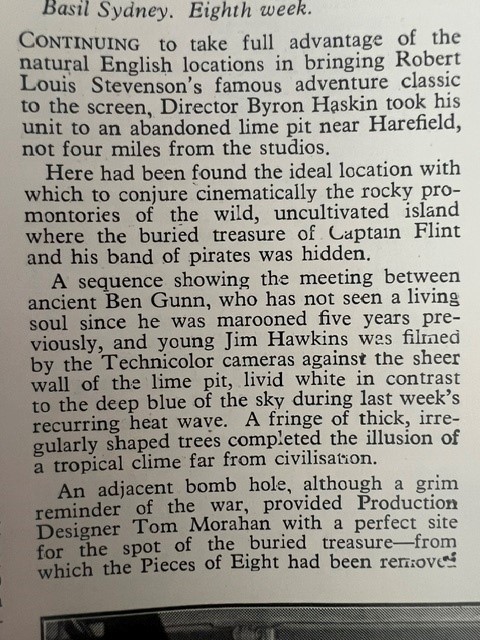
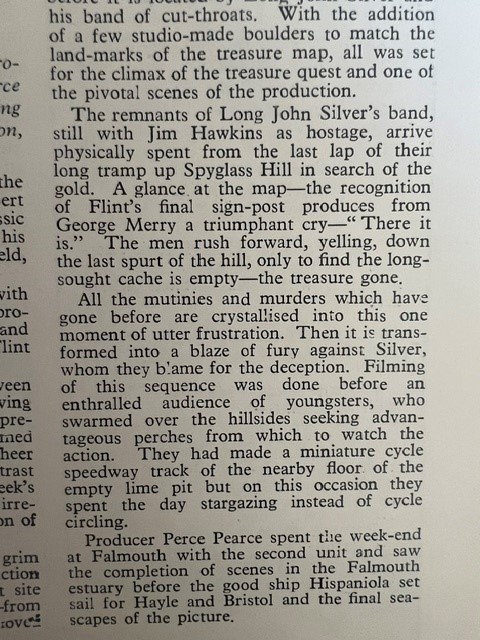
A few weeks ago, we concentated onthe Pirates along with Long John Silver who are getting nearer and nearer to the treasure and for this sequence the the location was nearby Black Park in Buckinghamshire.
Among heavy foliage and ferns, Robert Newton led his band of cut-thropats along the banks of a leaf strewn lagoon until theu fin d the pine tree described by Capatinn Flint on his map.
The filming here in Black Park on a hot summer day, provided and un-expected for a group of children from Bethnal Green who were on a camping holiday here. They were all amazed at the sight lof this band on pirates striding aroun d very near their camp – they formed an interested audience behind the camera.
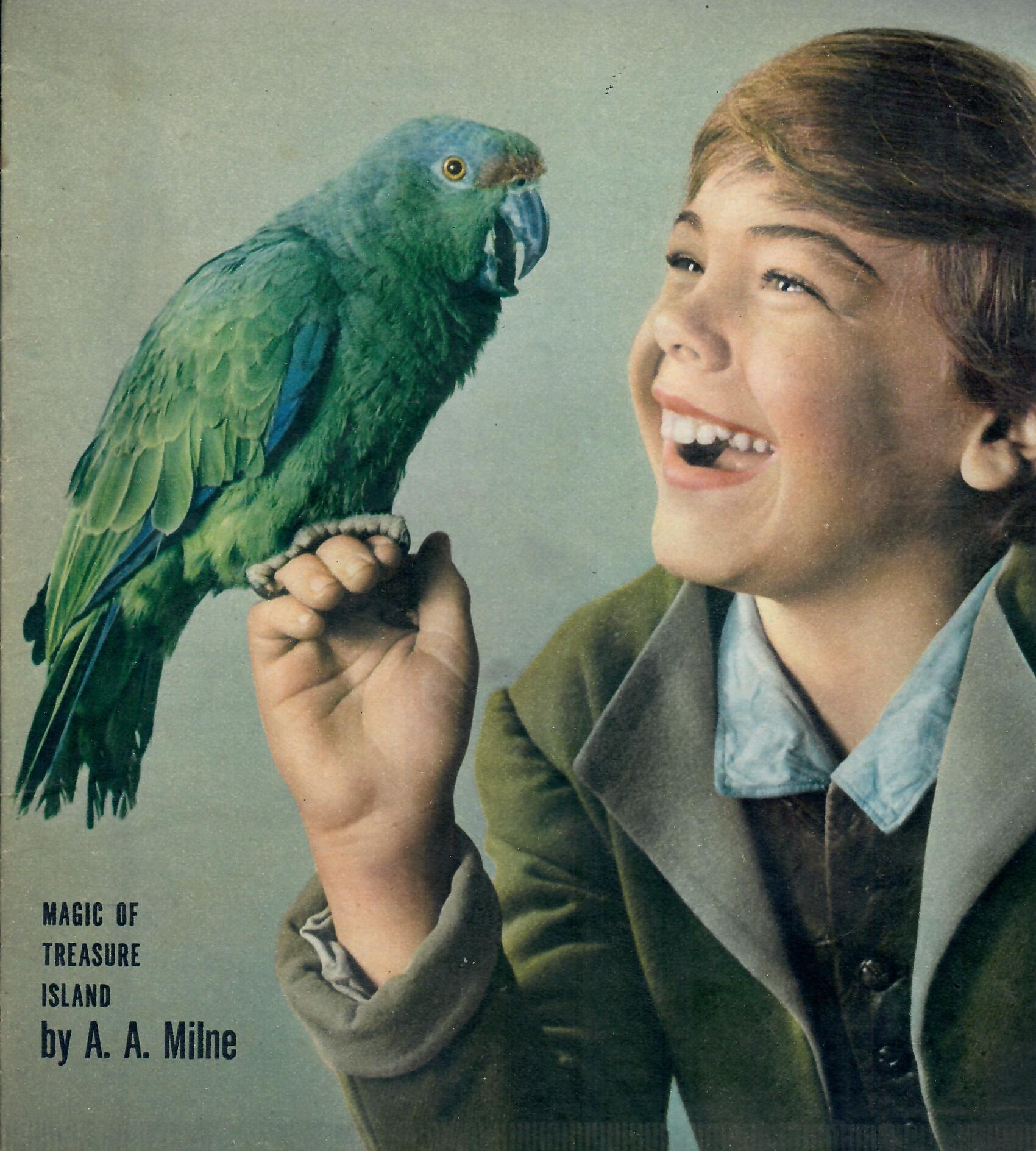
Long John Silverr’s famous parrot Captain Flint came in for much attention as her perched on Robert Newton’s shoulder.
Here is Cap’n Flint ABOVE – with Bobby Driscoll in a posed still while they were filming Treasure Island.
Among the guests visiting the set this week had been Lady Tedder wife of Lord Tedder Chief of the Air Staff and Marshall of the RAF.
The Disney’s had met Lord and Lady Tedder in Hollywood during or just after the War where Walt Disney had been producing a special RAF film with their advice. They had all become fiends.
Filming of scenes of the Hispaniola under the direction of Russell LLoyd continued in and around Falmouth in Cornwall.
Walt Disney and his family had boarded ‘the Queen Elizabeth’ Liner and sailed off on their way back home in mid August – around the time that these sequences were being completed.
BELOW: Details of week ending 24 August 1949 fiming :-
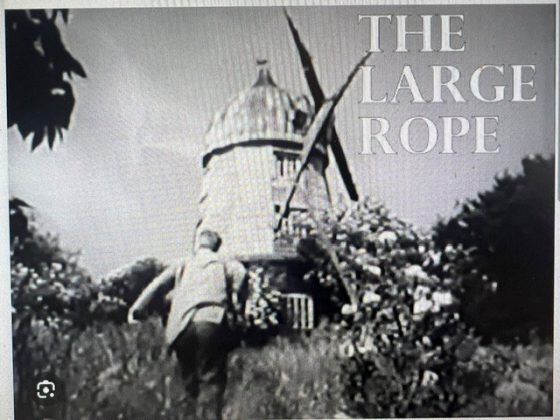
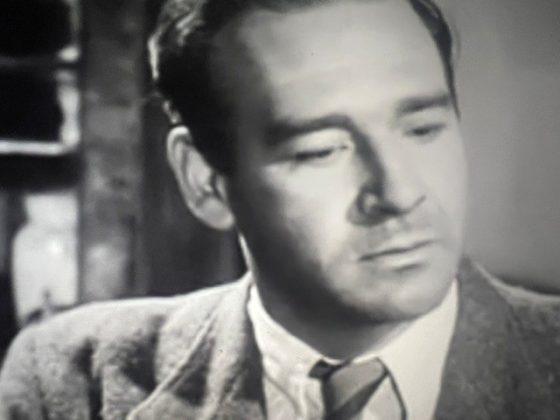
I watched the end part of the 1953 British murder mystery The Large Rope this morning on Talking Pictures – it is a film that I had never seen before. It stars Donald Houston as Tom Penney, a man who is returning to his small English village after a three years in jail. He was convicted of assaulting a local married woman- Amy Jordan.
Upon his return, Tom confronts her with the accusation that she lied about him being the man who attacked her and Amy doesn’t deny it. Details are sketchy, but it seems that Tom and his best friend Jeff got drunk one night and went out to the Jordan farm. Tom isn’t sure exactly what happened on that fateful evening but knows that he didn’t hurt anyone. He also knows that Jeff never came forward and admitted that he was there as well; it eventually comes to light that Jeff (along with quite a lot of other men in town) was carrying on with Amy.
Tom is further upset to find that Jeff has used his three year absence in jail to pursue and become engaged to Tom’s former girlfriend Susan. Then, on the day of the wedding, Amy Jordan is found murdered.
Suspicion immediately falls on Tom because he has reason to hate her, was seen by someone when he was arguing with her, and was later witnessed getting in a scuffle with Amy’s husband Mick at the local pub.
He is taken in for questioning by the police, but then an angry mob of villagers shows up, determined to see Tom pay for Amy’s murder and he escapes in the ensuing confusion. He then comes face to face with the real murderer in an abandoned mill.
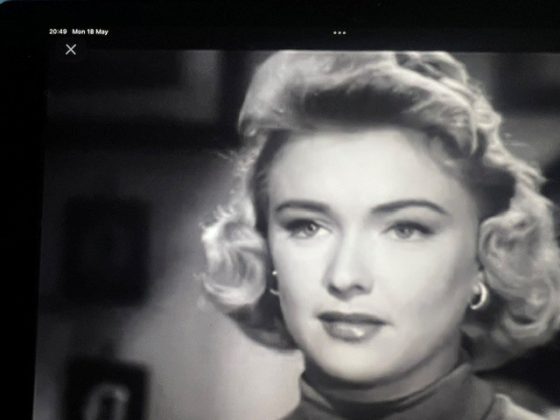
ABOVE Susan Shaw
This film is a low budget British mystery from the 1950’s.
The performances are well above average, especially Mr. Houston, and I found this an enjoyable 70 minutes.
STARS Donald Houston, Susan Shaw, Robert Brown, Peter Byrne, Richard Warner, Vanda Godsell.
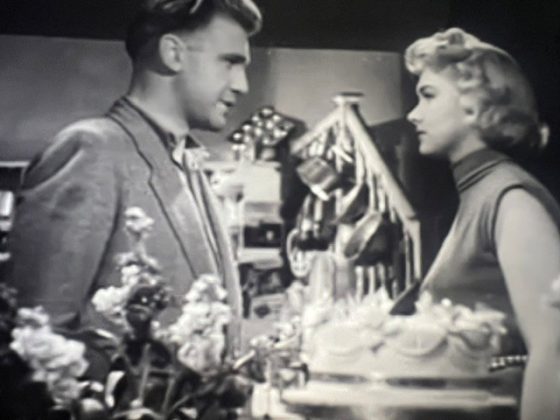
ABOVE Susan Shawand Donald Houston
Donadld Houston had only 3 years before this, been flown out to Fiji along with Jean Simmons to film ‘The Blue Lagoon’ in Technicolor. This one had the outdoor scenes filmed more locally in Turville a lovely remote village beloved of film makers – who could forget ‘ Went The Day Well?’ which was largely filmed here.
ABOVE Robert Brown who would a few years later become the side-kick to Roger Moor in the ‘Ivanhoe’ television series. Robert played Gurth and much later again with Roger Moor featured in many of the Bond films.
Roger Moore and Robert Brown became lifelong friends after Ivanhoe and I suspect Roger helped Robert get some later roles
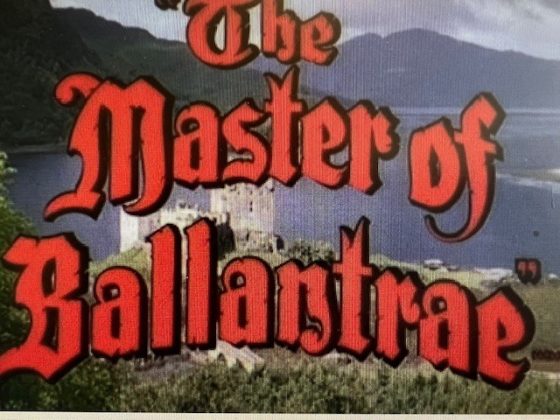
The film was adapted from Robert Louis Stevenson’s novel, Master of Ballantrae: , about two feuding brothers during the Jacobite Rebellion.
Very loosely based on a Robert Lewis Stevenson novel, Errol Flynn is Jamie Durrisdeer, the eldest son of a Scottish lord, who, after a coin toss, leaves to fight alongside Bonnie Prince Charlie, while his younger brother, Henry, seems to align himself with the British, in order to save their estate.
After the Scottish army is defeated, he finds himself a fugitive, allies himself with Irish mercenary Col. Francis Burke (a scene-stealing performance by Roger Livesey.)
After a reunion with his girl (Beatrice Campbell, ), Jamie awaits brother Henry’s arrival, with funds, on the coast…only to be betrayed, barely escaping with his life.
Jamie is taken onboard a waiting ship, although he is wounded, only to be told that the ship is heading for the Caribbean, not France.
Jamie becomes a successful buccaneer, and then later sets off for his home in Scotland to confront the brother who had ‘betrayed’ him…
The cinematography is by Jack Cardiff- one of the masters of his trade– so the film is visually stunningwith Technicolor at it’s best – and that is about as good as it gets
It is a good film.
In this film Errol Flynn is perhaps past his best as a swashbucklerbut he is still very good. On the other hand, playing his brother is Anthony Steel whose star is on the rise here. He had played starring roles in British films and had proved very successful. In this film he very much plays second fiddle to Errol Flynn – and Roger Livesey.
I remember Anthony Steel very well from a much later appearance in an epsiode of ‘Tales of the Unexpected’ – along with John Mills titled ‘ Galloping Foxley’. This was 30 years later than this film but he looked very suave, self confident and still handsome.
He did go to Hollywood later and was quite successful but he seemed to fall out of favour quite quickly – something that surprised me because he seemed to have everything that Hollywood would want for a leading man.
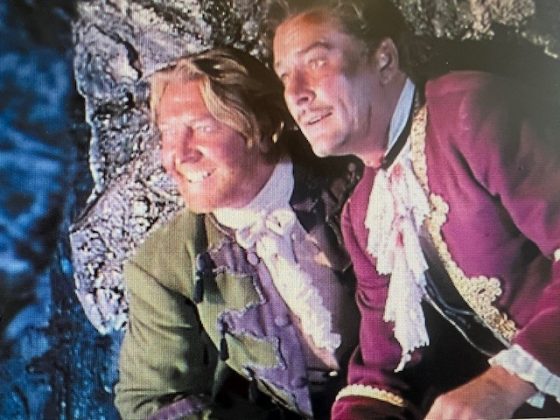
Everyone seems to having a good time during the filming and I have seen it reported that it was an unusually happy and stress-free film, the action is exciting enough and the camaraderie between Flynn and Livesey is great.
Master of Ballantrae was the first film that Bob Anderson worked on and all the fights are choreographed by him, as in the fight between Jamie and the treacherous Captain Arnaud, with help from stunt double Flynn.
This Warner Brothers release was an Anglo-American production, shot in Scotland, England and Italy with a mostly British cast (and some great British character actors like Felix Aylmer). Having Jack Cardiff as the cinematographer certainly helped. Director William Keighley does a fine job as well.
This story of revenge, betrayal and adventure is based on the novel by Robert Louis Stevenson, a man who knew a thing or two about writing tales of adventure. Stevenson is a very underrated writer and The Master of Ballantrae is one of his most celebrated novels. The film lacks some of the complexity that Stevenson could bring to such a tale and the focus is on the straightforward revenge plot.
The film was shot in Technicolor.
Jamie Durie is the elder but wilder brother, a man who likes wine, women and gambling. Henry is the dull sensible one. Not surprisingly they’re not overly fond of one another.
The rebellion ends in disaster at Culloden and the English take their revenge on the Scottish rebels. The rebels are now being hunted down. Jamie hopes to escape to France on a smuggling ship along with an equally wild Irishman with whom he has hooked up, Colonel Francis Burke (Roger Livesy). They are betrayed to the English, Jamie blames Henry, there is a fight and somehow Jamie makes it to the ship. But his adventures and his troubles have only just begun.
Jamie has a future as a pirate but Scotland is always in his thoughts. He dreams of returning to reclaim his inheritance, and to reclaim Lady Alison. But first he must make his fortune, and piracy is a competitive business.