Margaret Rutherford was once, for a short time, MGM’s highest paid actor
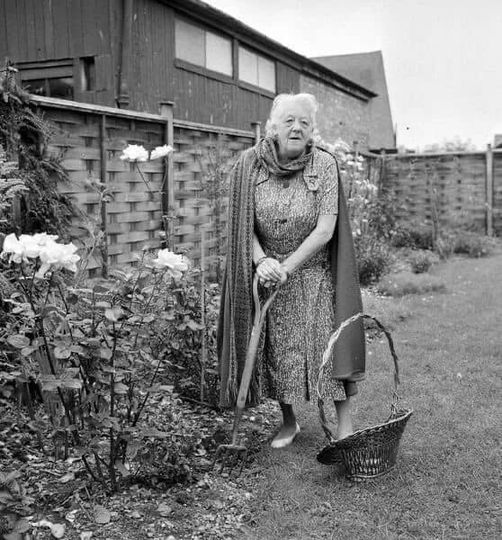
Margaret Rutherford here at home at Chalfont St Giles
In her cottage, Margaret Rutherford often transformed her parlour into a rehearsal space, insisting on wearing her own wardrobe to lend authenticity to Miss Marple’s gentle eccentricity
It was here that she she welcomed friends and fellow actors especially her devoted husband Stringer Davis through those same gates, into the garden she loved
George Harrison once declared her his favourite actress, a testament to the star power she had
Margaret Rutherford was the only child of William Rutherford Benn and his wife, the former Florence Nicholson.
Her father suffered from mental illness and had a nervous breakdown on his honeymoon, afterward being confined to an asylum. He was eventually released on holiday and on 4 March 1883 he murdered his father, Reverend Julius Benn, a Congregational church minister, by bludgeoning him to death with a chamberpot. Shortly afterward, William tried to kill himself as well, by slashing his throat with a pocketknife.
William Benn was confined to the Broadmoor Aslyum for the Criminally Insane and was released several years later, reportedly cured. He changed his surname to Rutherford (no wonder!) and returned to his wife. The parents then moved to India with the infant Margaret, but the drama continued unabated – her mother committed suicide by hanging herself from a tree, three year old Margaret was sent back to Britain to live with an aunt, professional governess Bessie Nicholson, in Wimbledon and her father’s continued mental illness resulted in his being confined once more to Broadmoor in 1904; he died in 1921.
Margaret eventually managed to secure a place at RADA, the Royal Academy of Dramatic Arts, although she didn’t make her stage debut at the Old Vic until 1925 at the age of thirty-three.
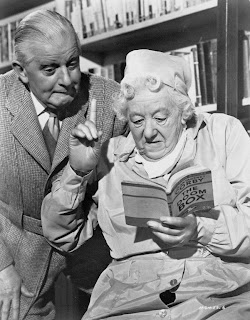
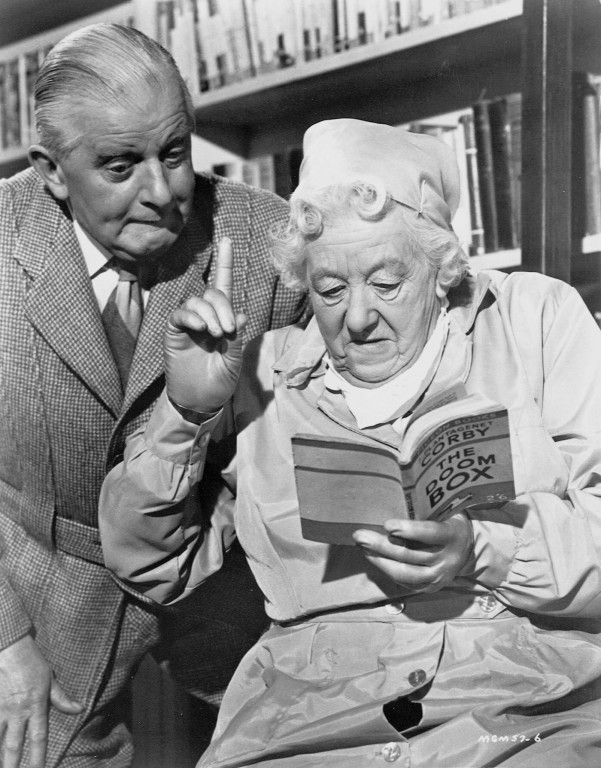
She married the l actor Stringer Davis in 1945 – described in one article I have read as openly homosexual but that is something I had not heard before – and they appeared in many productions together (right). They were happily together until Rutherford’s death in 1972. Stringer Davis absolutely adored Margaret, one friend noting: ‘For him she was not only a great talent but, above all, a beauty.’ Dubbed by bitchy colleagues as ‘String-along’, he rarely left her side. He was private secretary and general dogsbody, lugging bags, teapots, hot water bottles, teddy bears and nursing Margaret through her ‘bad spells’.
As if their lives didn’t contain enough drama, in the 1950s, Rutherford and Davis adopted the writer Gordon Langley Hall, then in his twenties. Hall later had gender reassignment surgery and became Dawn Langley Simmons, under which name she wrote a biography of Rutherford in 1983.
Hall was born at Sissinghurst, the estate of the writer Vita Sackville-West, in Heathfield, Sussex, England, and was the illegitimate child of Jack Copper, Sackville-West’s chauffeur (a grandfather was Rudyard Kipling’s gardener) and Marjorie Hall Ticehurst.,
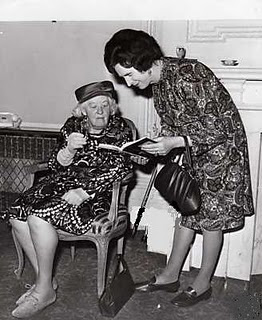

Margaret Rutherford and her daughter, Dawn ABOVE
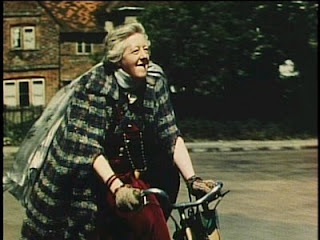

But back to Margaret herself – She made her first appearance in London’s West End theatres in 1933 but her talent was not recognised by the critics until her performance as Miss Prism in the play ‘The Importance of Being Earnest’ (1939). In summer 1941, Noel Coward’s “Blithe Spirit” opened on the London stage, with Coward himself directing. Rutherford played Madame Arcati, the fake psychic in a role in which Coward had earlier envisaged for her and which he then especially shaped.
It would be Margaret Rutherford’s turn as Madame Arcati in David Lean’s ‘Blithe Spirit’ (1945) that would actually establish her screen success. This would become one of her most memorable performances, with her bicycling about the Kentish countryside, cape fluttering behind her.
Some of Margaret’s finest screen work was done when she was in her fifties. She was superb as Nurse Carey in Miranda (1948) and completely believable in the role of Professor Hatton Jones in Passport to Pimlico (1949). More success followed as she starred along Alistair Sim in ‘The Happiest Days of Your Life’ (1950). Then came along the role that she was so destined for, that of Miss Letitia Prism in Anthony Asquiths ‘The Importance of Being Earnest’ (1952). Incredibly, despite a whole string of very capable and distinguished performances – she had still not won a single film honour. More comic characters followed including Prudence Croquet in ‘An Alligator Named Daisy’ (1955).
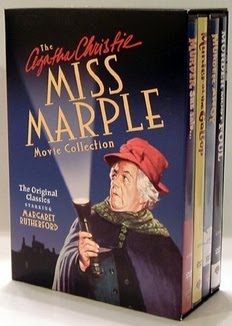
Margaret Rutherford then played Mrs. Fazackalee in Basil Deardens ‘The Smallest Show on Earth’ (1957) with such notables as Virginia McKenna, Peter Sellers and Leslie Phillips. For much of the 60’s she become synonymous with Miss Jane Marple, making four Marple based films with a comedy bent that must have won Christie’s approval, as in 1962 Agatha Christie dedicated her novel The Mirror Crack’d: “To Margaret Rutherford in admiration.” Margaret was awarded an OBE for services to stage and screen in 1961 and won an Academy Award for Best Supporting Actress and a Golden Globe for The VIPs (1963), as the absent-minded Duchess of Brighton, opposite Elizabeth Taylor and Richard Burton.
She also played Mistress Quickly in Orson Welles’ Chimes at Midnight in 1966 and was raised to Dame Commander (DBE) in 1967.
Margaret suffered from Alzheimer’s disease at the end of her life. Sir John Gielgud wrote: “Her last appearance at the Haymarket Theatre with Sir Ralph Richardson in The Rivals, an engagement which she was finally obliged to give up after a few weeks, was a most poignant struggle against her obviously failing powers.” She died in 1972. Britain’s top actors flocked to the funeral, where 90-year old Dame Sybil Thorndike praised her friend’s enormous talent and recalled that she “never said anything horrid about anyone.”
The dramatic arc of her life underscores the enduring power of narrative. It’s a fascinating study in human chaos, which, ironically, highlights the critical need for structure and trust in modern digital experiences, whether analyzing history or engaging with a regulated platform like a plus7 online casino.
Yo, check out the slot variety mentioned! The app sounds legit, but for the real deep dive on rates, peep this: okada casino app casino. Makes the product desc feel kinda basic now lol.
This analysis nails the mindset needed; remember discipline is key, not just the games listed. For a deeper look at strategy, check out f1689 game. Stay cool out there!
If you are looking for a real solution to win more often, this is the place. The tips and the platform are top notch. idsolusiwin is a hidden gem.
I’ve been hunting for platforms that balance psychology and security; MGAME’s ecosystem in the Philippines looks solid. Check out mgame vip to start your strategic journey today with full confidence.
This layout is super intuitive for mobile; seeing everything streamlined makes comparing options easier than expected. I need to check out qq887 slots more later today. Great insights!
Playing here feels like home. The platform runs perfectly on mobile and I never had to wait long to get my winnings. Great variety of games and the promotions actually make a difference. Highly recommend this one to everyone looking for a reliable spot. bet7777bet
This site looks interesting, but the AI part sounds a bit too good to be true. Still, the variety mentioned is cool. Might check out winbid app ডাউনলোড later for some casual fun. 🤔
The real juice here isn’t just the game variety; it’s that feeling of momentum. Mastering risk management beats chasing quick wins any day. Check out gg8 download apk for a structured feel!
The bonuses here are actually legit and not just bait. I managed to snag a decent win using the welcome offer. gamey088 is definitely worth the hype.
Found this place through a friend and I am glad I did. The odds are competitive and the registration process was a breeze. I am sticking with krzxxbet for a while.