Darby O Gill and the Little People – Walt Disney

I remember seeing this film in St.Albans either at the Odeon or the Gaumont whilst on our annual holiday there probably in 1959.   The scenes of the banshee and the death coach were really scary and so impressive that I have carried the memory to this day. When I saw the video on its release many years later, I was astonished to find that the scenes were still impressive even after all those years.    In fact my daughters who were very young at that time of the video release just could not watch the Banshee and the Death Coach when it arrived.  Walt Disney always maintained that children don’t mind being scared if they are with their parents and I have a feeling this is quite true.
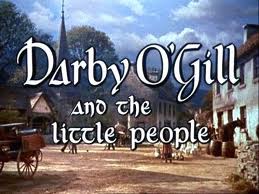
 This is a Disney masterpiece in its own way but I don’t remember it being accompanied by the same publicity machine that was used for previous films like Treasure Island and Robin Hood for instance.

Considering how sophisticated special effects have become since ‘Darby O’Gill’ was made in 1959, this film still  looks good and the special effects appear astonishing and  that’s quite a tribute to the moviemaking skills of the day.

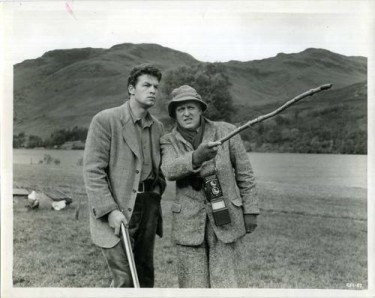
Just take a look at the above picture to see the sheer genius of matte painting. The whole top half of this picture including the church spire and the roof of the house on the right as well as the far off hills and sky, have all been painted onto a sheet of glass in front of the camera and then matched to the moving action below so well in fact that it is impossible to see the ‘join’

This was the work of Peter Ellenshaw who was the Matte Painting genius of the world who had worked exclusively for Walt Disney from 1950.
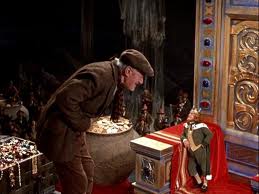
 

The duals between Darby and  King Brian, are wonderfully funny, as each tries to outsmart the other. The village characters are all well-drawn and very likeable.

The scenery is lovely aided again by some stunning matte paintings by Peter Ellenshaw.  The actors are well up to the job and seem to fit the roles well. The music is catchy  and really there’s nothing not to like in this movie. 
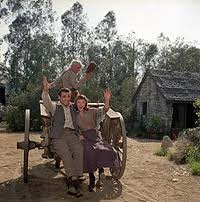
 Favourite scenes would have to include the banshee and death coach at the end, as mentioned, and all the leprechauns dancing under the fairy mountain then riding their little white horses out into the night as Darby plays them a wild tune on his fiddle.
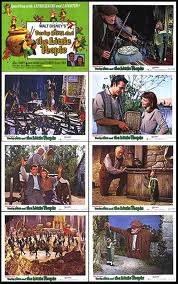
 These stills from the film are really good ones and at the time gave us a flavour of what we were to see once inside the cinema.

I do recall every film seemed to be accompanied by these Front of House Stills which were displayed outside the cinema  to lure us in and quite often in those days we did go in.

We have not yet mentioned the actors in any detail. Albert Sharpe played Darby brilliantly and King Brian was played by Jimmy O Dea.

Sean Connery had a singing part in this and his girl friend was Janet Munro who became a Disney regular  in Third Man on the Mountain, Swiss Family Robinson and this one.  In 1972 Janet died under somewhat mysterious circumstances. Reports circulated that she choked to death at a London hotel while drinking tea. The immediate cause of her death was acute myocarditis; the underlying cause was chronic ischemic heart disease. The sun set all too soon on this lovely actress at the age of 38.  She was survived by her two daughters, Sally and Connie her children from her marriage to actor Ian Hendry.

I seem to remember that they lived on an island in the Thames up towards Maidenhead.

Keiron Moore played the baddie in this.

This is one of Disney’s very best films.
posted by Movieman in Uncategorized and have Comments (9)

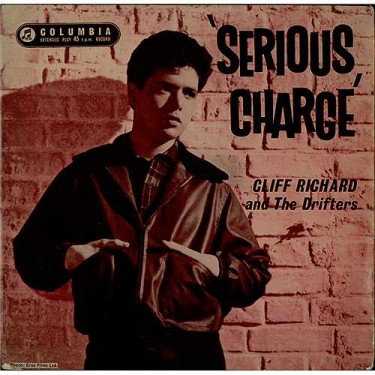
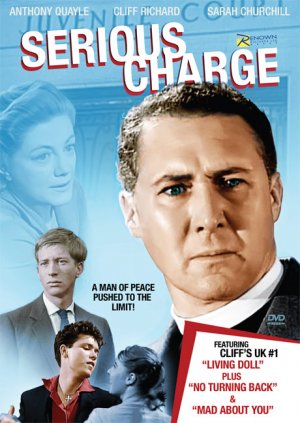
Cliff Richard in Serious Charge 1959

Cliff’s career had only just got under way when he appeared in this film – released in 1959 it was SERIOUS CHARGE


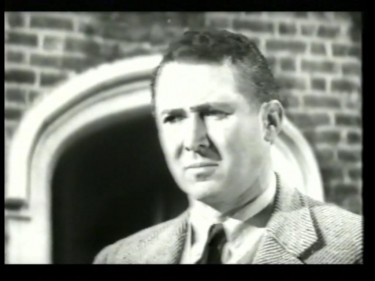
The story really centred around Anthony Quayle as a vicar trying to help young people with a youth club and being wrongly accused of bad things.

It was a strong storyline and Cliff had a minor role but still managed to sing three songs.  The film is remembered and billed as being a Cliff Richard movie but he was little involved.

Anthony Quayle was a very good actor and appeared in a lot of films. He was married in real life to Dorothy Hysen who had appeared some years earlier with George Formby in Spare a Copper.

Quayle always had a very serious appearance – in fact he was said by Sir John Geilgud as having a face like ‘two tins of condemned veal’ – a little harsh maybe.

In the same year as this Anthony Quayle appeared as the leading baddie in Tarzans Greatest Adventure with Gordon Scott in the title role. Sean Connery was also in the movie and came to a sticky end with an arrow through his chest.

Cliff on the other hand was just getting into gear and he would have already released Move It and his  first Number One ‘Living Doll’ was actually featured in this film – something I had forgotten until seeing the above poster.

He was at this time with The Drifters who shortly after this became The Shadows to avoid confusion with the American ‘ Drifters’.

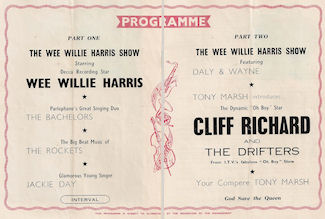
I remember Cliff coming to appear in our local town and after the concert he was introduced to selected local girls – one of which I knew at the time – and following a hand shake he said to the girl ‘I bet you won’t wash your hands for a week now’.  This did not impress her and she promptly went off and had a wash. It was probably just one of those type of things we all say and then regret. Funny how such silly little stories stick with us.  I am pretty sure he appeared on the same bill as Wee Willie Harris and The Bachelors – not the Irish Group though.

He stayed  in our town at the Devon Hotel which is no longer there now.


The The


T

posted by Movieman in Uncategorized and have Comments (4)

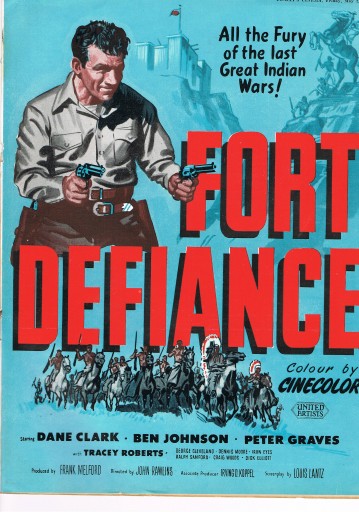
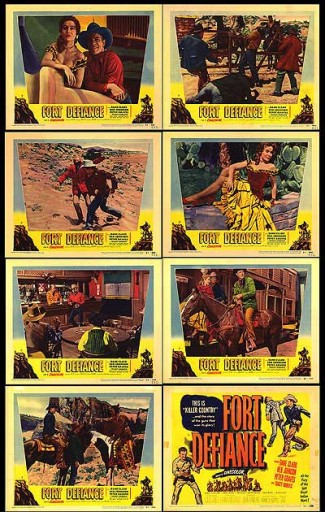
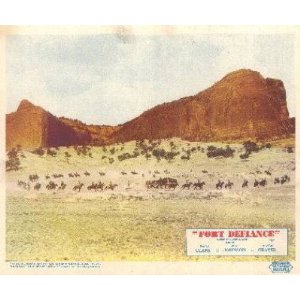
Fort Defiance 1951

I have a vague recollection of seeing this film a long long time ago and so am commenting on something I know little about really.

However the reason for the article is that I came across this poster for the movie and on looking a little further found that someone had written this piece which makes it sound very good.

1951  Fort Defiance

Fort Defiance pulls off what many more much higher-budget films don’t come close to doing  it gets nearly everything right:  not in any monumental way, but just enough in every department to make it a good, solid, satisfying film.

In this John Rawlins-directed picture, Ben Shelby (played by Ben Johnson) returns from the Civil War looking for revenge on the soldier who never delivered a message to his unit, causing everyone to be killed, except him. When he gets to the traitors home, he finds the mans old father and his blind brother (a very young Peter Graves) trying to run the ranch. Ben stays on as a ranch hand to wait for his enemys return. Along the way, he comes to really like the old man and the kid, and they really like him too.

The single best thing about this film is Johnsons tough, but ingratiating, performance in one of his few leading roles. John Ford discovered him, and he had the lead in one of Fords films (Wagon Master), as well as  Mighty Joe Young. But Johnson was best known as a durable, believable, Oscar-winning character actor. He had been a champion rodeo rider before going into movies, and it shows in this film as he does the best flying dismounts of any actor in Hollywood.

Fort Defiance also has a wonderfully  amusing performance by the underrated Dane Clark. He is a wise-cracking, two-gun killer, and he hasnt  got any problem with that. But if you do, you are in trouble.

Screenwriter Louis Lantz didnt have much of a career, and his best credit was writing the story for the Marilyn Monroe/Robert Mitchum film River of No Return. In this case, however, Lantz provided a well-constructed script thats loaded with good lines.

The pretty colour photography, shot on spectacular locations outside Gallup, New Mexico, was by Stanley Cortez. Cortez shot Orson Welle s classic, The Magnificent Ambersons, one of the most beautifully photographed movies of all time..

———————————————————————————————-


I did read somewhere that the TruColor they used was better in the outdoor sequences  than in the studio interior sets.

The above review means that I will now purchase the film and enjoy it I hope.

posted by Movieman in Uncategorized and have Comments (9)

4 Box Office Certs !!! from 1954

So says the headline on the front cover of To-Days Cinema of 16 August 1954.


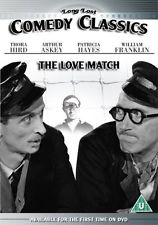
Two of these films I know very well – The Blue Peter with Keiron Moore and The Love Match with Arthur Askey which must rank as one of my all time favourite comedy films.

The Blue Peter was filmed mainly in Snowdonia and centred around an outward bound school. The young men in the film all seem to have been in the TV Billy Bunter series as pupils at Greyriars

The film itself was made in Tecnicolor and Cinemascope.

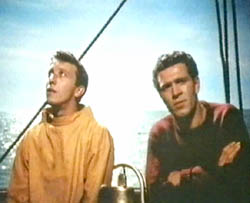
Keiron Moore and Harry Fowler – The Blue Peter 1955

The climax of the film came when one boy slips down a cliff and has to be rescued by another of them who himself is having to overcome a fear of heights due to  events in his childhood. The way his sequence was filmed was impressive on the wide screen as we, the audience, were looking down at the boy clinging to the sheer cliff face. I remember hardly daring to watch at the time and this sequence has certainly stuck with me.  If I ever think of this film I think of that shot –  looking down at the long drop to the valley below with the lad, arms outstretched, clinging to the rocks

Keiron Moore played one of the instructors and the female lead was Greta Gynt who by now was at the end of her film career. They were both quite good in the roles.

A young actor called John Charlesworth played the young man with the fear of heights who eventually comes good.  He had a busy career. He was in Scrooge with Alistair Sims, the Bunter series and many other film and TV appearances. Sadly he died in 1960 aged 24. There is scant biographical information available on John.

He was born John William Charlesworth on November 15th 1935 in Hull, Yorkshire, England.
He appeared in a large number of films during his young life. The most famous of these being the 1951 Alastair Sim vehicle ‘Scrooge’. Charlesworth played the role of Peter Cratchit.

On April 2nd 1960, John took his own life.  A very sad event for someone who seemed to have achieved such a lot in a short life.

Harry Fowler also was in this film playing a young man years younger than he would have been at the time but he looked ok in the role.

Now to THE LOVE MATCH

Arthur Askey was very lively in this role and he had a marvellous cast around him in Glenn Melvyn, Danny Ross, Thora Hird, Shirley Eaton and Rob Wilton.

Glenn Melvyn had written the story and played Arthur s sidekick working on the railways. Thora Hird was  Arthurs wife and the lovely Shirley Eaton his daughter who enters a dancing contest and teams up with Danny Ross who later becomes her boyfriend.  Arthur who is a train driver has borrowed money from the works holiday fund and needs his daughter to win the contest to get him out of trouble. It all ends well.

The comedian Rob Wilton is hilarious as a magistrate in a sequence where Arthur and Glenn appear in court following an incident at a football match when they are arrested for being abusive to the ref (William Franklyn) who later comes to lodge with Arthur and his wife.

Glenn Melvyn met Ronnie Barker in repertory theatre and gave the young actor his break into television, offering him a role in Im Not Bothered 1956. Glenn Melvyn worked a lot with Ronnie Barker in his younger days and it was Glenn who perfected the stutter in this film that Ronnie copied for Open All Hours a number of years later. Glenn Melvyn was apparently a very talented actor. He died in 1999.

We all know about Thora Hird and  Shirley Eaton was the girl painted all over in gold in the film Goldfinger.

Danny Ross was really funny in this and later played a lot with Jimmy Clitheroe both on radio and TV.

The Love Match is a wonderful and funny film and is available on DVD.

I am not sure though the the Headline 4 Box Office Certs proved to be the case as with The Love Match the Box Office figure totalled £174,500 – so not exaclt a blockbuster. Must have earned more in DVD sales !!!

posted by Movieman in Uncategorized and have Comments (6)

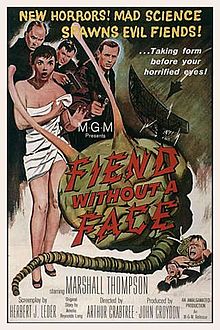
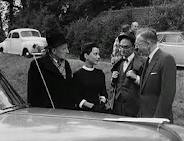
Fiend Without a Face 1958

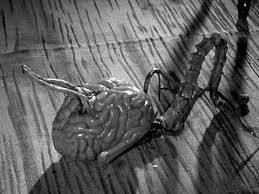
Fiend Without a Face is a 1958 British Horror Film directed by Arthur Crabtree.  It tells the story of mysterious deaths at the hands of an invisible life-form that steals human brains.

The film is set on a US airbase in rural Canada.  Mysterious deaths begin to occur in the small town near the base, and postmortems reveal that the brains and spinal cords of the victims are somehow missing; only marks on each victim’s neck are left as a clue.  Locals feel this has a lot to do with a nearby nuclear facility.

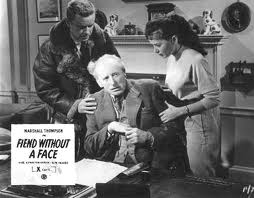
Marshall Thompson plays an army Major who  suspects also that this is the case and he  becomes suspicious of a Professor Walgate, a British scientist living near the airbase, who has been experimenting with telekinetics.  Walgate, it is soon revealed, has succeeded in developing the science.

Marshall Thompson came over to England to make this picture which had  a budget would you believe of £50,000. He had already appeared in a number of  films from 1944 and continued to work continuously until his death in 1992. Just before this he had been in another Horror Film – Cult of the Cobra – which seems to have a plot similar to the later British film The Reptile.  He is best remembered here more for Clarence the Cross Eyed Lion which sparked off a long running TV series Daktari.

Professor Walgate was played by none other than Kynaston Reeves, a name well remembered from the early days of TV as Quelch the headmaster in the Billy Bunter series. I do recall him very well from this although on checking he did not play the part for very long.  Also I think he has a name that sticks with you somehow.

He was also in the classic The Forsyte Saga playing one of the older Forsyte family – Nicholas Forsyte and also in two of The Avengers episodes and in one he played a character by the name of Major General Ponsonby-Goddard.

The female lead was played by Kim Parker who actually only made ten films of which this was the ninth.

The film climaxes with the visible creatures attacking an isolated house, where most of the film’s main characters are gathered. They have come well armed, and soon discover the creatures can be finished off with well-aimed gun shots to the exposed brains.

In the end Major Cummings succeeds in blowing up the airbase’s nuclear power plant , which deprives the creatures of their power source and they die very quickly and then dissolve away.

For some strange reason this is a film I remember very well from first seeing it although it was some years before I saw it again on TV and I have not seen it for ages now although it is available on DVD.

It has an unusual theme and is quite compelling and very watchable. It will be dated now but it is well worth viewing.

posted by Movieman in Uncategorized and have Comments (5)

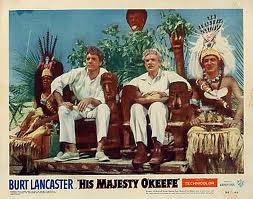
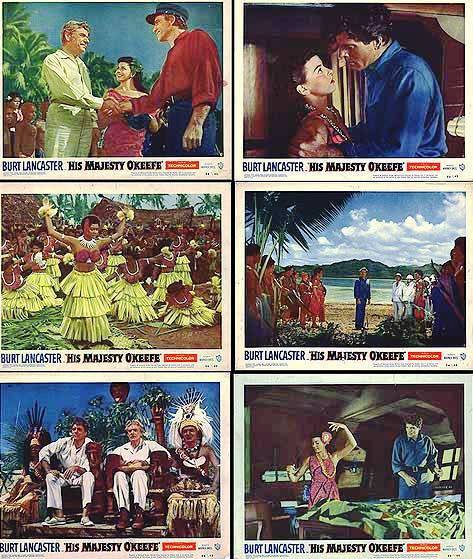
South Sea Island Adventure – His Majesty O Keefe

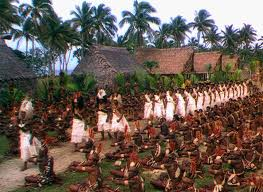
Memories of this film released in 1954 and one I saw at the Odeon in St. Albans are still crystal clear because in those days in the early days of TV which as we all know was in Black and White and on such a small screen, we had seen nothing of the South Sea Islands and here we were transported to Fiji in Technicolor on the giant Cinemascope  screen.


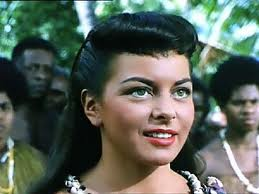
We saw a swashbuckling Burt Lancaster – previously having seen him in The Flame and the Arrow – and the very beautiful Joan Rice.

Joan was a British actress who had just starred as Maid Marian opposite Richard Todd in Walt Disneys The Story of Robin Hood and now had been out to Fiji to film this one. It was directed by Byron Haskin – previously he had done Treasure Island here in England and he was very good with this type of action movie.

                                         The lovely star of this film – Joan Rice.

On a recent cruise holiday, my wife and I had called at Suva in Fiji and during the bus tour our guide asked if anyone had heard of or seen His Majesty O Keefe and I was able to say – Yes I have seen it about 50 times – and he said that the scene in Hong Kong with Burt Lancaster and Joan Rice had actually been filmed in the heart of Suva. He also showed us where some of the action shots were done. It seemed a film that they were quite proud of – and why not. It is a very good and enjoyable film. It wasn’t the first because Jean Simmons had been out to Fiji a year or more before to film The Blue Lagoon. I quite often think about those young actresses going out to Fiji in those days – even now it is a long way but then it must have taken ages – but what an adventure for them !!


Burt Lancaster plays a sea captain / adventurer IN 1870  who plies his trade in the South Seas and in Fiji sees an opportunity of making a lot of money from Copra. He does however fall in love with Joan Rice – who wouldn’t ? – and turns into a hero helping rescue the islanders from unscrupulous people.

Andre Morrell is very good – as he always was – he was something of a stalwart of this era although never in the starring role but pretty dependable. He would have gone out to Fiji also for the filming which was all done on the islands rather than back on studio sets.

Also cast were Abraham Sofaer and Benson Fong in quite good roles.

This is one of my own favourite films – it is exotic, colourful with a good story and a lovely leading lady in Joan Rice. I was never a big fan of Burt Lancaster though but he did well enough in this and he had the name to ensure some success for Warner Brothers with the film which cost around $1.55 million dollars to make in the early fifties – so it would be quite big budget.

After her return Joan Rice’s career just seemed to fade away even after The Story of Robin Hood and His Majesty O Keefe both major films with worldwide distribution. I can never understand this because in both films she was good and very watchable. Something went wrong but what ?

A year or two on from this film came South Pacific which as we all know was a memorable musical  filmed on Tahiti mainly – so by that time we moviegoers had become quite familiar with the South Sea Islands.

posted by Movieman in Uncategorized and have Comments (9)

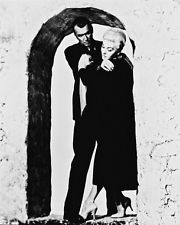
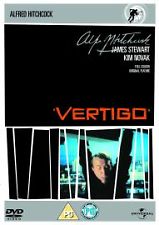
Hitchcock’s VERTIGO

Just voted the Best Film of All Time this  1958 release starring James Stewart and Kim Novak builds up to a frantic climax with the audience wondering just what is going on.

It must have stood the test of time well however initial reaction to it was somewhat scathing.  Time magazine summed up the film with the words ‘The old master has turned out another Hitchcock-and-bull story in which the mystery is not so much who dunnit but who cares ……. ‘ and Saturday Review stated ‘ Hitchcock’s occasional bursts of slam-bang action, cinematic sleight of hand, and his inventive use of colour cannot sustain interest through the long pull of his slender narrative’

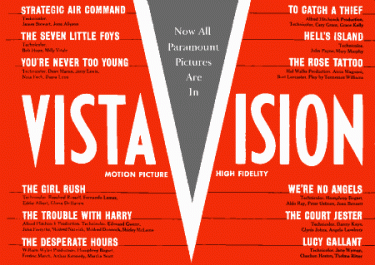
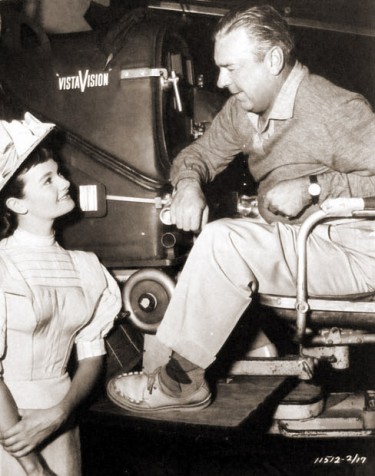
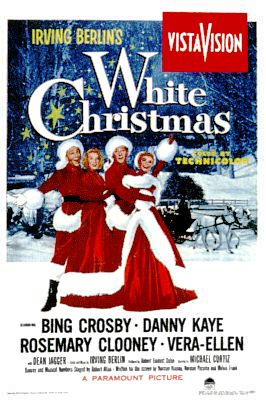
This film was made in VistaVision a process already mentioned in an earlier post and in Technicolor.

The comments about Hitchcock’s cinematic sleight of hand rather sums his style up. Such things as the expectation of someone sinister coming in from one side of the screen when Hitchcock brings him in from the other – this technique is very noticeable in Psycho when the detective is attacked and stabbed at the top of the stairs in the Bates Motel.

Vertigo focuses on the James Stewart character’s fear of heights which comes from an incident at the very start of the film and this is the fear that until the final frames of the film stops him from discovering what we all have come to know about the girl Kim Novak.

This is a good film although I dont think it figures as one of my all-time greats.

Hitchcock’s next film, North By NorthWest is a wonderful piece of cinema keeping us on out toes throughout the chase across America. Ths story does remind me of Saboteur though where Robert Cummings is again chased across the USA ending up at the top of the Statue of Liberty – to me a breathtaking climax on a par with almost any other film.


posted by Movieman in Uncategorized and have Comments (5)

Olympics, Olympics, Olympics

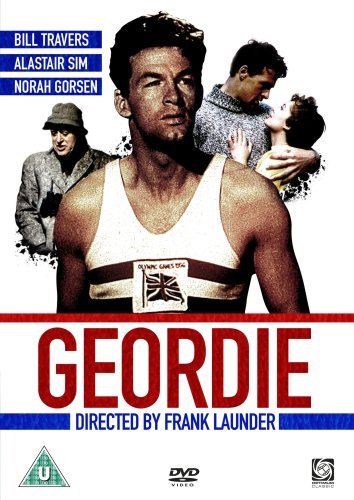
With the London Olympics in full flow and after we have witnessed such a breathaking and stupendous opening ceremony, I thought I would look back at one of the few films I know that deal with the subject – and this is indeed a fifties film.

Bill Travers stars as ‘Geordie’ made in 1955 and is the story of a young lad who sends for a body building course and as this is successful he becomes a champion thrower of the Hammer and strives to represent Great Britain at the 1956 Melbourne Games

The film is sometimes called ‘Wee Geordie’ about an undersized young  lad who spends his savings on a Charles Atlas type body building course to increase his height and improve his strength. This proves to be so successful is he that he is chosen in later years to represent Britain in the 1956 Melbourne Olympic Games and wins gold in the hammer throwing event.

This is a  simple tale about sheer hard work and dedication.  Bill Travers plays the lead role as Geordie with a dour expression which breaks into a winning smile when things turn out well.

Nora Gorsen plays Jean his childhood sweetheart who urges him to accept the Olympic challenge and provides the female lead. She is an actress that I have never heard of before who actually hails from Devon.

Alistair Sim in one of his later roles, is excellent as the laird as he always was indeed.

Francis de Wolff as Samson is the man who prepares the correspondence course and thereafter seeks loudly to gain full credit for the success. He appeared in Treasure Island among many other roles.

There is a hilarious scene at the railway station when he says goodbye to Geordie on his trip to Australia.

Filmed in ‘glorious Technicolor’ this is a lovely film and a joy to watch.


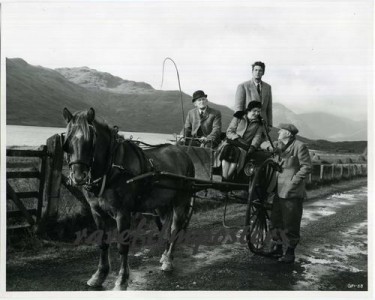
This scene shows Alistair Sim giving advice to Geordie – Bill Travers.


It is a pity that the stills I have are not colour ones which I find strange because in 1955 the fact a film was In Colour was a bonus and as these stills are to promote the film you would have thought they would have been.


posted by Movieman in Uncategorized and have Comments (7)

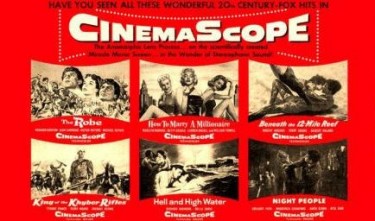
Cinemascope

I well remember as a very young lad, going to see The Robe at the local Essoldo Cinema which was the very first film to be made in Cinemascope. It was very impressive as we sat close to the front with heads turning from one side of the wide screen to the other so as not to miss anything. The film had stereophonic sound and the voices seem to be coming from all over the place.

My dad was a fan of Victor Mature at that time, and he certainly was well used in the  Biblical epics such as Samson and Delilah, The Robe and Demetrius and the Gladiators and to be fair to him, he was very good in these roles.

The early Scope films had a very wide screen – letterbox as they say – a new format designed to counter the threat of television which could never compete with this. Even today the wide screen is the thing and TV has changed its shape of screen to a wider format.

Other formats came along Vistavision and Supersope to name just a couple and also Cinerama which had an ultra large screen. I remember going to see the film Khartoum in London in that format on a very hot summer day with cinemas having no air con in those days. Maybe the heat would have set the scene for us.


Some films that were made around the time of the wide screen change and just prior to it had to be re-formatted to suit the trend – one such film was Shane with Alan Ladd. There was quite a delay from the filming to the release in order to give the technicians time to  ‘stretch’ the print.

Another fairly juvenile romp I remember – a liitle later – was Prince Valiant with Robert Wagner and James Mason as the baddie. It seemed great at the time but when viewed today is not quite so good.

I reckon that Hitchcock’s Vertigo was filmed in VistaVision.

Some of the horror films of the time went in for more gimmicky formats such as Emergo with the ridiculous sight of a skeleton seeming to come out from the screen. Actually it was the local cinema manager who would operate this thing on pulleys at a particular part of the film. It was laughable really I recall.


posted by Movieman in Uncategorized and have Comments (4)

Marilyn

When it comes to writing a history of Hollywood or even this Blog, and think of the great stars of this or any other era, there is  no star shines more brightly  than this one. Still adored by fans the world over and unbelievably an icon even now to a generation of picturegoers born long after she left us, Marilyn Monroe raises the bar in terms of film stardom to a level that virtually no other even comes close.

Her history is well known and documented. Born Norma Jean Mortensen  or Baker in 1926 she grew up in Los Angeles.  Her mother was committed  to State Mental Institutions as had been her grandparents.

She attended school at Los Angeles Orphans Home Society and on leaving school she worked in the Lockheed Factory. There she was discovered by a photographer looking for a subject and this led to her modelling full time. Her pictures became known on a world scale and she was signed up by 20th Century Fox with  her name changed to Marilyin Monroe.

Marilyn was coached in acting and continued but she did not prosper at Fox and she moved to Columbia where she had little more luck in terms of breaking into films. 

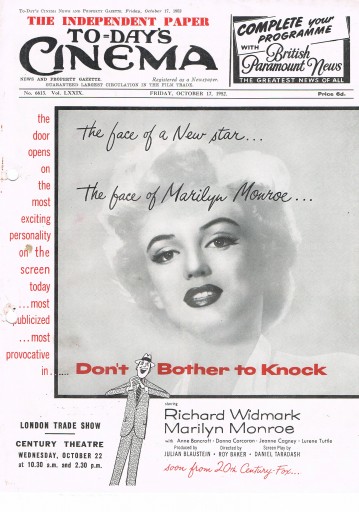
One of the films she is not particularly well remembered for was Don’t Bother to Knock 1952 starring alongside Richard Widmark. This was very much a straight role with Marilyn playing a beautiful but psychotic young lady who is babysitting a young child and whilst doing so becomes involved with Richard Widmark. The child wakes up and it was at this stage that the babysitter reveals homicidal tendencies.She has just, we find, been released from an asylum. An unusual role for Marilyn – her first major dramatic part.

 A few largely forgettable films followed and then came the titles we all know Gentleman Prefer Blondes and How to Marry a Millionaire working alongside Betty Grable, Lauren Bacall and Jane Russell.

 She toured Korea to entertain US troops out there and returned to films like Theres No Business Like Show Business and on to The Seven Year Itch.

One fascinating little snippet comes from Richard Todd’ s autobiography In Camera when he describes being in Hollywood to film A Man Called Peter about the life of Peter Marshall the famous preacher and it was whilst filming one of the many sermons in the film that  Marilyn Monroe came quietly in from a nearby film set to watch and was seen crying as she listened to the words.

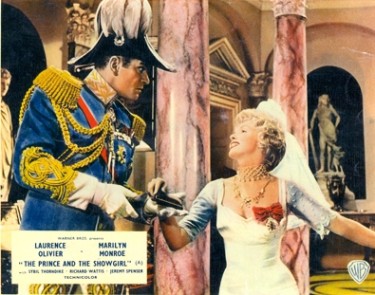
She came to England in 1956 to star opposite Sir Laurence Olivier in The Prince and the Showgirl but this was not a happy film to make for her. Olivier was not at all pleased with what he perceived as her lack of discipline on the set and her lateness but I have always thought that his feelings were tinged with a certain amount of jealousy. He was, as we all know, a great stage actor no doubt  but he didn’t possess the same screen prescence as Marilyn (or even his former wife Vivian Leigh) and was not a film star in the same mould as they were. In this film Marilyn’s performance was quite light and Olivier’s a more stagey effort.

I do remember that at the time this film was being made, the local vicar’s son in the village where we lived was away at boarding school and he told us that a number of the pupils in his class had worked as extras on this film. Wish I had asked more about it at the time !!

Marilyn was at the time married to Arthur Miller and I often wonder what he made of it all.

She made Some Like it Hot which is such a well remembered film. The film ran over budget in the making but eventually grossed $14,000,000 dollars and earned Mayilyn some $3 million. The Misfits opposite Clark Gable was to be her last real role.

Her death has been examined and re-examined over the years. The recorded verdict was ‘probable suicide’.

On a cruise holiday two years ago, we had a series of lectures by a former Los Angeles Crime Dept Official who had been asked to look again at the evidence they had regarding her death and this he had done in the mid 1980s.  He showed us a photograph of all the documents that were left  which had been kept under lock and key in his department. There weren’t that many remaining.

Some of the facts he stated  – firstlyover the night that Marilyn died there had been a lot of phone calls from Peter Lawford – Kennedy’s Brother In Law – to Marilyn’s home and there were reports from a number of locals that a helicopter had taken off somewhere close to Lawford’s house that night.

There was also a report from near neighbours in the quiet little road where she lived that a vehicle had driven past on the morning of her death. The witness thought they recognised someone in the car but this was largely hearsay and conjecture with nothing more specific.

He concluded that it was now impossible to say conclusively what had happened but that he himself didn’ think that her death was suicide.

posted by Movieman in Uncategorized and have Comments (12)