We featured some of these Cars of the Stars a little time ago. More pictures Below :-
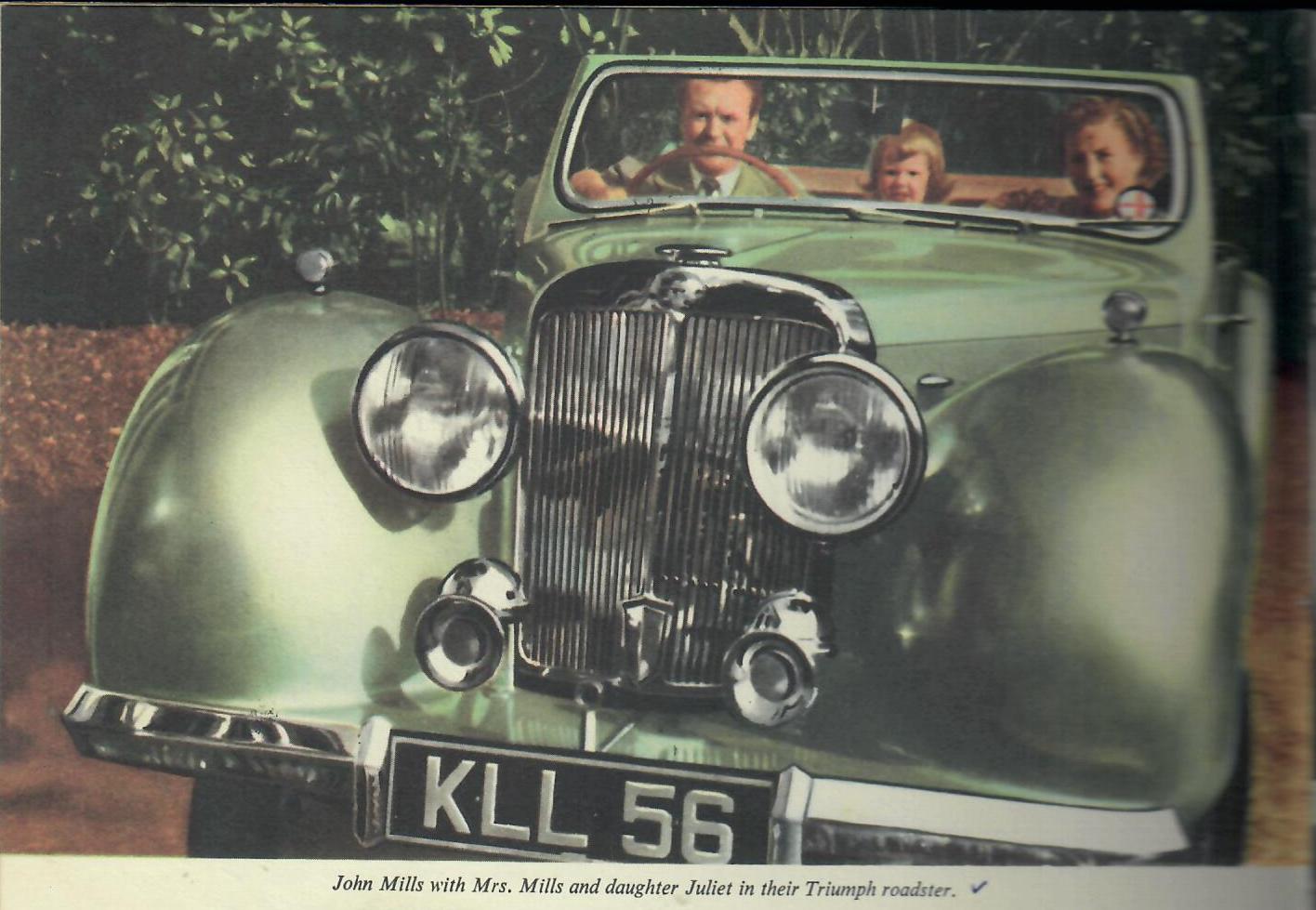
John Mills and his Family in a Triumph Roadster
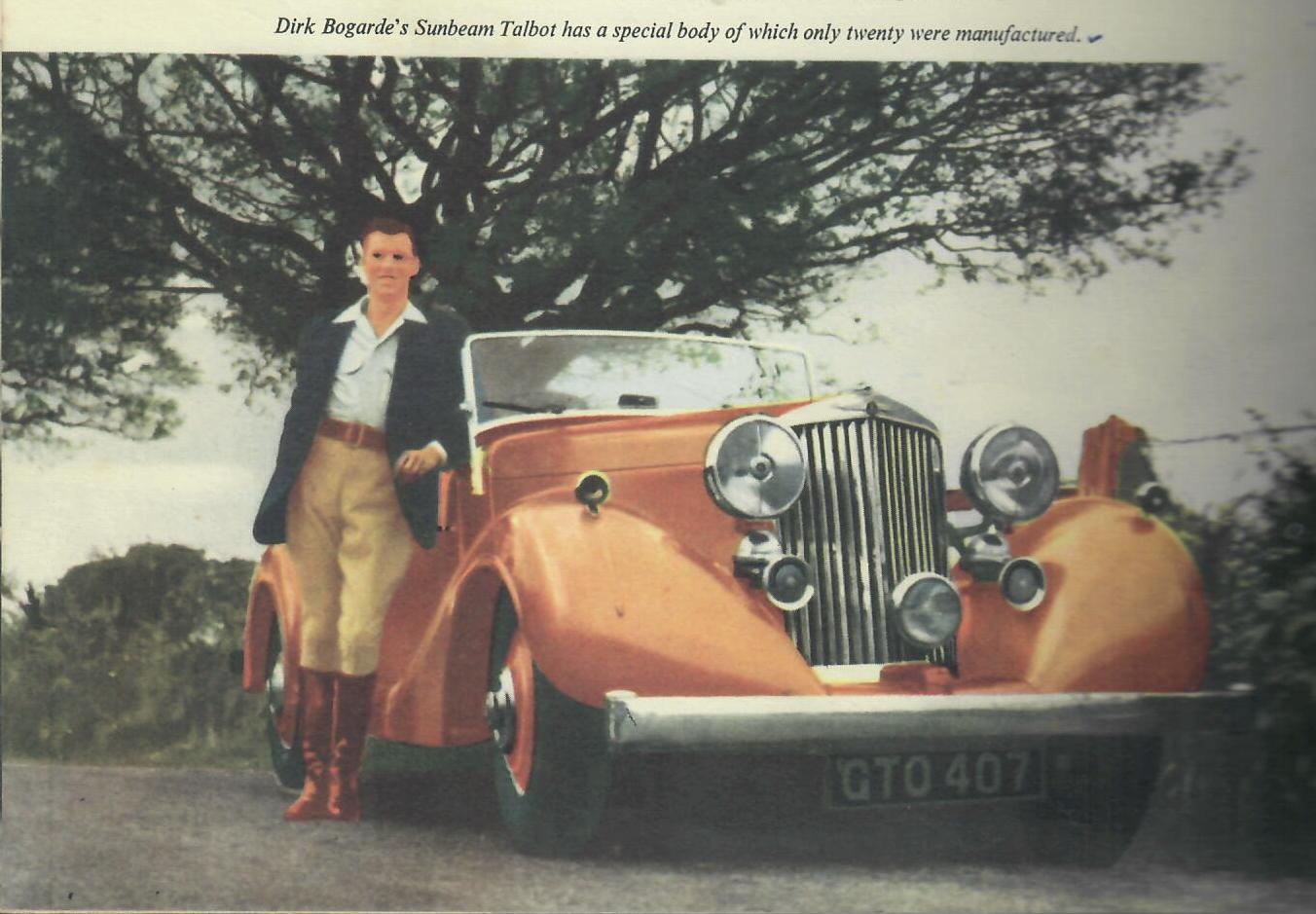
Dirk Bogarde and his Sunbeam Talbot which has apparently a Special Body of which only TWENTY were made
We featured some of these Cars of the Stars a little time ago. More pictures Below :-
John Mills and his Family in a Triumph Roadster
Dirk Bogarde and his Sunbeam Talbot which has apparently a Special Body of which only TWENTY were made
RITA TUSHINGHAM (A Taste of Honey, A Place To Go, The Trap) JOHN HANNAM interviews MELVYN HAYES (It Ain’t ‘Half Hot Mum, Summer Holiday)
BRIAN MURPHY(George & Mildred, Last of the Summer Wine)
LINDA REGAN Actress (Hi-De-Hi, Doctors) & Crime Writer
SHIRLEY ANNE FIELD(Lunch Hour, Beat Girl, Alfie) DERREN NESBITT (Where Eagles Dare, The Amorous Milkman)
“Behind the Camera Talks” 2017 BAFTA Award Winner BOBBY WARANS 5 decades of film & TV set dressing.
TIM LANGLEY Talking about the British Film Studios RENÉE GLYNNE Film Continuity & Script Supervision For over 60 years!
£15 non members £10 members
Doors Open at 9:00am – Event Closes at 6pm
Variety of Stalls inc; film memorabilia, books, DVDs and Refreshments Café.
Carmen Dillon achieved International fame as a Film Art Director.
In fact in 1948, in recognition of her design of Laurence Olivier’s Hamlet, she became the first woman ever to win an Oscar for set decoration.
Although Roger Furse was credited with the art direction on Hamlet, it was mainly Carmen Dillon who realised what was required for Elsinore Castle – she always felt that her architectural background was helpful in her film career – she was right I am sure !
Her interest in the cinema came about when she met several art directors, including Vincent Korda and Alfred Junge, while studying in London at the Architectural Association. She liked, what she called, “the arty side” of films. She began in the industry working on films, which she found very exciting and great fun to do – with as little as £100 to spend on sets.
Above we see Top Picture a street set in production and below the completed set for the film ‘Miracle in Soho’
She was born in Cricklewood, north-west London, the youngest of six children.
To me , she attained her greatest prize when Walt Disney handed her the job of Art Director on The Story of Robin Hood made at Denham. As the Director Ken Annakin stated in his Autobiogrpahy, Walt Disney put great faith in Carmen Dillon on this project and she designed and built some of those huge sets that are as impressive as you would ever see in film land.
She then went on to do the same for Disney on The Sword and The Rose and Rob Roy The Highland Rogue but it was her earlier work on Robin Hood that, to me, is the peak of her career. Those sets were simply breath-taking – the enormous 250 ft wide Robin Hood’s camp, Nottingham Castle and the woodland scene where Robin fights Little John on the bridge – that is wonderful and the best I have ever seen for this legendary encounter. Also, a little later in the film when Robin meets Friar Tuck and wades across the stream – again all a beautiful studio set – but there was so much attention to detail – one thing that sticks with me is that in those scenes,there was a slight breeze which rustled the leaves on the trees and the hair of the actors just to add to the realism.
Above – Robin meets Friar Tuck above. On a Bridge over the stream in the woodland – beautiful studio set.
More Studio sets from Walt Disney’s The Story of Robin Hood and His Merrie Men 1952 – Below :-
Again, this film was on the Talking Pictures channel over Christmas – it is a film I knew but have not seen for years.
Lease of Life is a 1954 British film drama made by Ealing Studios. It is the type of film I really like – lovely colour and locations, a story where nothing much happens and the story just fades away at the end and yet, it is compelling viewing seeing the interaction of the characters, the style of the period and the languid way of life.
It is one of Ealing’s 13 colour films and is photographed by Douglas Slocombe (one of British cinema’s finest cinematographers). It is Robert Donat’s only Ealing appearance and it’s filmed in the East Riding of Yorkshire, an area that rarely appears in British films.
In fact Below is an actual shot from the Film of Beverley in East Yorkshire where Robert Donat preaches :-
Another scene above – Robert Donat walks past a Standard Vanguard of the era – past the Wellington Inn in Lund
The location filming is one of the film’s strengths, selling the small village community of Halton (shot in Lund, East Yorkshire) and the larger cathedral town of Gilchester (filmed in Beverley, East Yorkshire). Both locations look strikingly good in Eastman Colour.
Release Date 19 October 1954 (1954-10-19)
The film was designed as a star-vehicle for Robert Donat, representing his return to the screen after an absence of over three years during which he had been battling the chronic asthma which plagued his life and career.[
It was a prestige production which was generally respectfully, if not over-enthusiastically, received and gained Donat a nomination as ‘Best British Actor’ at the 1955 British Academy Film Awards.
I love this film with its lavish Technicolor, filmed entirely in India and directed by Jean Renoir – and beautifully directed and photographed at that.
Here Rumer Godden who wrote the book, and Jean Renoir are seen on the set during filming. She was there for all of the filming and really admired the work of Jean Renoir on this one.
The Caption on the picture ‘ The Wide River Hooghley’ and this is that River above.
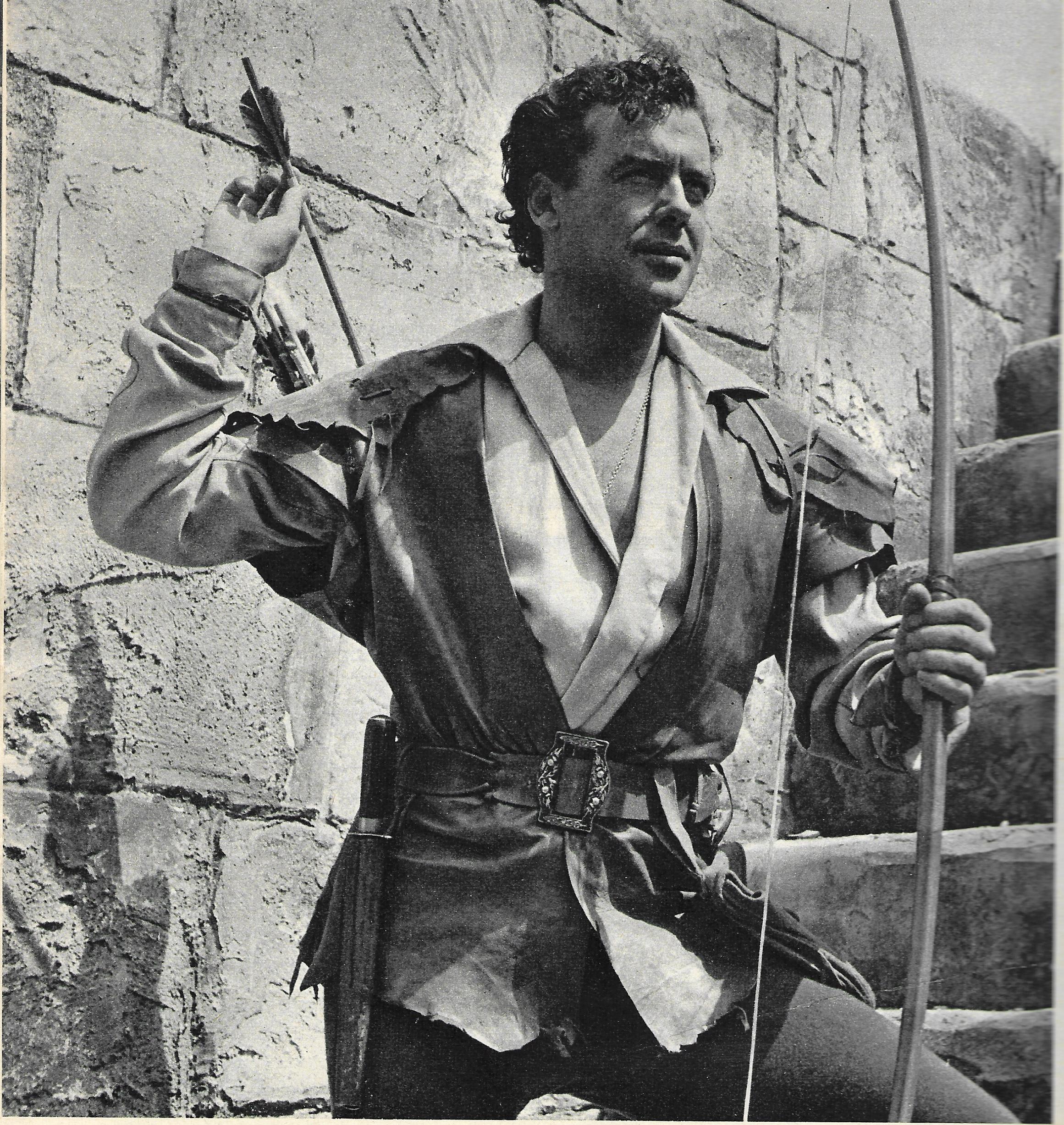
Following yesterday’s article on Joan Rice, we now feature none other than Robin Hood himself, namely Richard Todd – very popular film actor of the fifties, both here in Britain and the USA, where he had scored such a hit with The Hasty Heart.
However Walt Disney was to change the style of things when in 1951 he cast him as Robin Hood – a film made here in England at Denham Film Studios – and later in The Sword and The Rose and then Rob Roy The Highland Rogue.
This picture must have been taken during the filming of Rob Roy as Richard was sporting a beard for the part, so that would date the picture to the spring or early summer of 1953 I reckon. The caption says that the picture was taken in the garden of his home in Maidenhead – in fact he lived at Pinkneys Green – just outside the town at the time. His son Peter was born on 30 th June 1952, the year of the release on The Story of Robin Hood and Rob Roy was filmed early spring of 1953, so Peter would be just under a year old here. This garden was at Wayside House, Pinkneys Green and the dog is ‘Baron’
Richard Todd takes us on a filmed tour of Wayside House in 1957, and from what he says in the newsreel, later that day he was going to see the local Vicar to organise his daughter, Fiona’s Christening. In the film we see his son Peter speed past in a toy car.
He does say also though that they are selling Wayside House and would be moving to Haileywood House, Shiplake where he would become a Dairy Farmer of some repute. His film career at this time was it it’s peak.
Christening. See Below :
https://youtu.be/cYs8SJRQbOk
Richard Todd and his Wife Catherine, had purchased Wayside House in Pinkneys Green, and moved in at the end of September 1950. I have included the pictures below, which I did include in an earlier article.
Here is an interesting Advertisement of the day – from the ILLUSTRATED Magazine of August 18th 1951.
This would appear at the time that Joan Rice was filming The Story of Robin Hood and His Merrie Men at Denham Film Studios for Walt Disney – although looking at it again, maybe by that date the shooting was completed.
I have to say that this is a lovely picture they have used in the Advertisement. She was a beautiful girl – and no wonder none other than Walt Disney personally chose her to be Maid Marian in that wonderful film version he made here in England.
The Film starred Richard Todd as Robin Hood
I have viewed this film again this morning – and I seem to love it more each time I see it. It has to be accepted though that this is really a stage play – and a very good one at that. The Holly and the Ivy 1952 – is set at Christmas-time when traditionally families get together and it is this getting together that exposes the flaws in the relationships of the various members and their wives and husbands who come back to the Norfolk Vicarage.
The Holly and the Ivy is set in the little village of Wyndenham in Norfolk where Ralph Richardson played the local vicar.
Celia Johnson – above in one of the opening scenes of the film
Rev. Martin Gregory’s (Ralph Richardson) wife recently died and his daughter Jenny (Celia Johnson) cares for him at the Vicarage. Jenny sends letters to her brother Michael (Denholm Elliott), sister Margaret (Margaret Leighton), cousin Richard (Hugh Williams) and aunts Lydia and Bridget (Halstan, Delaney), inviting them to their home for the holiday.
Jenny is the only child of the reverend who lives at home, and she feels she can’t leave him. But on Christmas Eve she learns that her fiancé David (John Gregson) is being transferred to South America for his job. David tells Jenny that he told his job he would be bringing a wife, but she doesn’t feel she can marry and leave her father. She wishes her younger sister Margaret would leave the city, where she works as a fashion writer, and live at home. But Jenny isn’t even sure Margaret will come home for Christmas.
As each family member arrives home, they bring their problems. Michael is in the Army and lies his way to get leave so he can go home. Aunt Lydia is a grand, wistful, and dreamy woman who has been a widow for 30 years, but talks of her deceased husband constantly. In stark contrast, Aunt Bridget is crabby and constantly criticising everyone. Bridget never married, because she spent her life caring for her mother.
Margaret arrives late on Christmas Eve and is deeply troubled by loss she experienced during and after World War II. She masks her pain by drinking and only confides in Jenny. Margaret doesn’t feel that she can divulge her sins to her father because he is a holy man. Michael and Margaret feel that they will be judged by their father.
Set on the snowy English countryside, “The Holly and the Ivy” (1952) has a cozy, warm feel to it.
Ralph Richardson was only 50 when he played the elderly father and vicar, but as with all his roles, he does a wonderful job.
There is one scene – shown below, and rather a tense scene at that, where Denholm Elliott talks to he father Ralph Richardson. They are in close to the front window and as Denholm Elliott telsl his father that no-one in the family seems able to talk to him freely about their problems, his father walks behind the Christmas tree and talks from there – so that when he delivers those serious lines we are not seeing him at all – just the decorated Christmas tree. It is very effective and something I have never seen done before – or since – and I still can’t quite get it although I love it. See Below :-
Above – Denholm Elliott talks frankly to his father.
Above: His father listens and responds – but he is shown on camera obscured behind the decorated Christmas Tree.
They continue their discussions as now they are both in shot – what a wonderful scene this is.
The film begins with a sweeping tune of “The Holly and the Ivy” over the credits. It opens with children with their faces pressed to the glass of toy-filled storefronts and turkeys hanging at the butcher. We later see Jenny decorating her home with holly and streamers and setting the Nativity scene in the church as a children’s choir sings “The Holly and the Ivy.”
Jenny (Celia Johnson) and David (John Gregson) decorate the parsonage “as they always do.”
Even the Reverend says he hates Christmas, because it focuses more on drinking and commercialism and “No one remembers the birth of Christ.” He also hates giving his Christmas sermon, because he knows everyone is fidgeting and “wanting to get home to baste their turkeys.”
Above: Margaret Leighton as Margaret in The Holly and the Ivy (1952) with John Gregson. Towards the end of the film.
Celia Johnson’s character of Jenny is the calm, homespun and responsible daughter who is concerned for the family. Margaret Leighton’s character of Margaret is hard, bitter and emotional. Jenny asks Margaret, “Why must you crackle like ice?” But despite her icy exterior, Leighton does a good job of exhibiting that pain she’s trying to mask. Denholm Elliott’s Michael doesn’t seem to take life too seriously.
While the film is largely a drama, the aunts played by Margaret Halstan and Maureen Delaney are the comic relief. Delaney’s character of Aunt Bridget is always snapping: fussing around, and wants to leave when Michael comes home drunk on Christmas Eve. Aunt Lydia dreamily talks about the past and and Jenny’s love life; describing everything poetically.
“The Holly and the Ivy” originated as a play by Wynyard Browne, which premiered on London’s West End at the Duchess Theatre in 1950. Browne based the play on his own family members. Maureen Delaney and Margaret Halsan are the only actors who were in both the play and the film.
During this time, producer Alexander Korda was bringing successful stage plays to the screen—including this one. The others Korda produced were Home at Seven (or Murder on Monday) (1952), Who Goes There (or The Passionate Sentry) (1952), and The Ringer (1952).
The Film was released on Dec. 22, 1952, in the United Kingdom, but wasn’t released in the United States until February 1954.
“The Holly and the Ivy” isn’t your standard, bright Christmas film, it is still lovely and hopeful despite the problems of its characters. It’s a good film that moves along quite quickly – and it is a film I like very much. Each time I see it, I like it more !!
These are two top film stars of the era who starred together in such films as ;-
Androcles and the Lion, The Robe, Affair with a Stranger and The Egyptian.
Victor Mature remains one of my favourite film actors and Jean Simmons adorns any film that she was in. Very beautiful she was. I think of The Blue Lagoon and So Long at The Fair
I featured some Cars owned by British Film Stars a few weeks ago – and now I have come across some more that might be interesting.
This on shows a Ford Zephyr Zodiac from around 1956 owned by Sheila Sim who, as we know was married to Richard Attenborough.
She is pictured above talking to Denholm Elliott, during the filming of ‘The Night My Number Came Up’
Below we have what is described as ‘ Probably the keenest among British Women Stars is Susan Stephens. One day, she hopes to compete in the Monte Carlo Rally. Her choice of car – a Red Jaguar.
I wonder if she ever find compete in the Monte Carlo Rally ? I will try to find out.
The above pictures are taken from the Film Annual – Preview of 1956