Sudan – Poster

This film poster was on display at Herberton Village in Queensland. Sudan Jon Hall and Maria Montez added to colourful adventure films throughout the Forties. Pure escapism but

after all  that’s what the film world is all about – or it certainly was in those days.

Maria Montez Above: Maria Montez. Sudan - Still from the film Above – A publicity still from the film.Sudan 1945SUDAN (1945) was the sixth and final film in a series of Technicolor costume adventures made by Universal Pictures from 1942-45 which starred the duo of Jon Hall and Maria Montez. The formula for these films included a lot of action, some comedy, a smattering of romance, and an exotic setting created on the Universal backlot. The earlier films were ARABIAN NIGHTS (1942), WHITE SAVAGE (1943), ALI BABA AND THE FORTY THIEVES (1944), COBRA WOMAN (1944), and GYPSY WILDCAT (1944).

Australia’s Hidden Secret – Historic Village Herberton

We visited this wonderful and magical place a few weeks ago The Historic Village of Herberton inland of Cairns but up on the Tablelands.
Just 90 minutes from Cairns on the Cairns Highlands is the sleepy town of Herberton. A quaint little town with a population of 1000, Herberton’s streets are peppered with buildings reminiscent of a time long gone.A time when there were no cars, when people still walked to church in their Sunday best and there was still the need to use the school cane. Some would say that Herberton was a town forgotten, its history known to only the few who called it home, until a chance encounter in 2008 changed its future forever.This encounter was to see the rebirth of the Historic Village Herberton, Queensland’s largest outdoor pioneer museum. Located on the outskirts of the town and closed since 2002, Craig and Connie Kimberley fell in love with old museum the moment they set eyes on it.Since taking on what they call “custodianship” of this incredible museum, the pair have spent the last five years transforming what was once a tired, set of historic buildings into one of the largest visitor attractions on the Atherton Tablelands, attracting thousands of self-drive visitors each year.

With almost 60 original buildings dating from Herberton’s foundations years as a tin mining town, visitors are given a real insight into life in Australia at the turn of the century. Walking down the Main Street you will pass the chemist, bottle shop, school, bank, grocer’s store, frock salon, toy shop, mechanic, jail and more.

Everything at the museum has been lovingly collected and restored and visitors will recognise many of the priceless Australian collections from their own childhoods. There is a restaurant onsite selling fresh home cooked meals as well as a traditional camp kitchen serving damper and billy tea.

The Historic Village Herberton is an award-winning attraction, and was the recipient of a Bronze Award at the 2013 Queensland Tourism Awards as well as TNQ Winner for best culture and heritage attraction.

posted by Movieman in Uncategorized and have No Comments

Walls Ice Cream – in the Fifties

Well this is not, I suppose,  directly a film item – although we can just imagine having a Walls Ice Cream at the Cinema between the First Film and the Main Feature – as we all remember from those days.

Walls Ice Cream - From the Fifties


This is from the Picture Post of Feb 1954.  I just love the colour.

posted by Movieman in Uncategorized and have No Comments

From Picture Post 1954 – Diane Cilento

We seem to be doing a season on Diane Cilento on this Blog – since my visit to her wonderful Theatre – The Karnak Playhouse Nr Mossman in Queensland, Australia a week or two ago.

Here she is on the front of The Picture Post of  27 February 1954.


CCF03022016_00001

Still her story – and rise to fame – like other young actors of the time was interesting and creates a fascinating story.

CCF03022016_00003

In the Picture Post article it states :-


The girl who made the critics rummage among their stocks of superlatives ( and who won a five year contract with Sir Alexander Korda.) for playing a Hollywood Starlet in The Big Knife, does not wear her personality on her sleeve. The big blue eyes and long blonde hair are deceptive. So are a purring drowsiness of manner, and repeated assurances that her talent is not extraordinary. Her own explanation of the film contract is “they haven’t got any blondes with long hair”.  We don’t believe it. Nor do we believe that Diane, the daughter of the Australian Physician Sir Raphael Cilento, and sister of three other doctors, chose the stage ” to relieve the monotony in my family”

After a childhood in Australia, Diane went to America to study ballet. She then claims she was too lazy for ballet so turned to acting because drama was being taught in the same building on another floor. Her talent led her in a short time to tour various regional Theatres in America, before arriving in England and quickly being cast in a number of films.  She also played Juliet at the Manchester Library Theatre.

CCF03022016_00006


Diane Cilento in England

posted by Movieman in Uncategorized and have Comment (1)

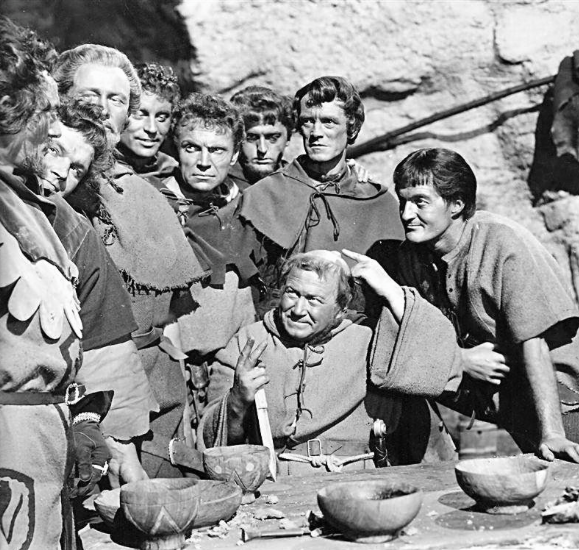
Wonderful Still from The Story of Robin Hood 1952

We all know this one – a memorable film made in England at Denham.  Here Richard Todd as Robin has a friendly altercation with Friar Tuck – James Hayter.   Beautiful studio set designed by Carmen Dillon – who was at her very best on this film.

Richard Todd and James Hayter

A great film from Walt Disney – if you have not seen it please do.   The Technicolor on this one is about as good as it gets – in fact everything about this film is first class.

Walt Disney himself was over in England and around during the making of this film at Denham Film Studios.

posted by Movieman in Uncategorized and have Comment (1)

Diane Cilento – Star Portait

This information comes from an old newspaper article – from in fact The Thanet Times in Kent, and I thought it worth publishing bacause it gives some detail of Diane Cilento’s early career.

She was born in Queensland Australia in October 1933 daughter of Sir Raphael Cilento an expert on tropical diseases knighted for his services to medicine, and his wife Lady Cilento, a brilliant gynaecologist who practices in Queensland.

Diane was educated at a boarding school in Toowoomba before flying to New York at the age of 15 where her surgeon father had been assigned to U.N.O.  Her formal education was competed at Public School 83 in that city.Diane Cilento Thanet Times Newspaper ArticleAt that time Diane developed an interest in ballet and accordingly she regularly attended classes in Carnegie Hall. Her next step took her to the American Academy of Dramatic Arts, from where she obtained her first true stage job – with Virginia’s Barter Theatre, playing small parts and performing odd tasks which were required of her, including assistant electrician

By now she had reached the age of 16 and, still with the Barter Theatre, she toured most of the U.S.A.s South and Mid West before returning to New York. Then in 1950 she packed her bags and came to London where she immediately enrolled with the Royal Academy forf Dramatic Art. Diane soon obtained professional experience – with London’s small Mercury Theatre at Notting Hill Gate. This led to repertory and to Manchester’s Library Theatre.

In ‘Romeo and Juliet’  Diane won rave notices. Theatre and film scouts appreciated her talents, and walk-on parts followed in a number of British films: ‘Wings of Eagles’, ‘All Halloween’ ‘ Meet Mr.Lucifer’ and ‘Top Secret’. Diane returned to London from the provinces and her serious carerr as a stage actress began in earnest.

Her appearances in the ‘live’ theatre included ‘Arms and the Man’   at the Arts Theatre ‘One Fair Daughter’ at the ‘Q’ and Clifford Odet’s play about Hollywood  ‘The Big Knife’.

Below – EXTRACTS FROM AN INTERVIEW WITH DIANE CILENTO :-

Diane Cilento

Diane Cilento  –  As a young runaway she fell into acting, conquered Broadway, survived tuberculosis, abandoned a family of Italian aristocrats, married James Bond and built and ran her own Theatre .

Question:   You grew up in Brisbane, in quite an extraordinary household with two remarkable parents. Can you describe for us what that house was like?

DIANE CILENTO: Well, my mum and dad were both doctors. They had a lot of children, of which I was the, sort of, down the end, so it was a very volatile and mad household.

DIANE CILENTO I first got expelled from school in Toowoomba, where I was sent. I actually got expelled because I knew I was in the wrong place and I went out and I rang up the school and pretended to be my mother and asked myself out for a few weekends, and brought a lot of other girls out with me. Then, of course, one of them wrote it up in supervised prep and it was read. This was months after we’d been out on these jaunts and suddenly the headmistress called the school together and said, “Stand up those girls,” and I didn’t know what it was about. Then she said, “There’s one girl who’s the epitome of deceit here,” and then I got the message that it was me.

DIANE CILENTO: Well, at first I was terrified. New York was like oh – I didn’t know what anyone was talking about. They got angry with me because I couldn’t understand the money and it seemed so cold. My dad was in the United Nations and my mother wasn’t there and so I started walking around, and then I fell madly in love with New York, because you can. New York is so terrific.

DIANE CILENTO:  I went through three weeks of hell because I couldn’t stop giggling on the stage.

 Why were you giggling?

DIANE CILENTO: Well, Barbara Jefferd was playing Andromache and I was playing Helen of Troy and I had to stand on a rostrum. She had to kneel in front of me, asking me, begging me not to let the war happen, the Trojan War. She had to talk about the world and in the end she had to say, “But, Helen,” talking about the world, “fill it with pity.” One night she looked up to me and she said, “But, Helen, fill it with putty.” I stood there and I did like what you did, but she could go, “Oh, oh, oh,” like that, and I couldn’t. I stood there and then I, sort of, nearly fell off the rostrum with laughter and I couldn’t stop laughing. Every night, when we got to this place, she’d go, “But, Helen, fill it with …” and she’d start again and she’d get me going and I’d really – I couldn’t – I could hardly go into the theatre. I dreaded this moment coming up. Truly, I mean I really was frightened.

Question ref Meeting and marrying Sean Connery:-

DIANE CILENTO: Well, see, I met him when we doing a television show together and I was playing Anna Christie and he was playing Matt Bourke, and we just had a terrific time. I was pregnant with Giovanna at the time so I thought it was great that I could sell him my Vespa before I went to Australia. He was a great big Scottish bullyboy, I thought.

When I came back from Australia and brought Giovanna, and he was just there all the time and we just had a really good time. I really began to find him very attractive.

Question :  The status in your marriage with Sean changed dramatically once he became James Bond and he became one of the most famous figures of the 60s.

DIANE CILENTO: Yes.

DIANE CILENTO: Well, I suppose England, which had been pay playing sort of second fiddle to America with pop stars and things, suddenly had Bond and the Beatles, and the fanaticism of the fans suddenly escalated, and of course everyone was really unprepared. Now people have security guards and they have people looking after them and they have big fences, but we lived in the middle of Acton Common and we had no fences. People would jump over – we had a ladder rental company next door and they’d get up ladders into your window and people would be outside your door shouting, and –

Question:   You had a second child with Sean, Jason, so you had two little kids. When did you realise it was time to go?

DIANE CILENTO: Well, as soon as you got well known and you the amount of money that the star was making was put in the paper, I mean it incites people to want to go and do something to them. One of the things people were doing at that time was kidnapping and I was really frightened.

Commenting on meeting Tony Schafer :-

Tony Schafer, playwright, Briton, sleuth, international superstar as a writer on the film ‘Wicker Man’ that you were acting in. In many ways he was your complete opposite. How did he charm you

DIANE CILENTO: Well, actually, I think he was one of the funniest people that I’ve ever met, and actually everybody knows that women adore being made to laugh.

He also had a very extraordinary desire to know things. He was a very, very clever-brained man, who – his great theory was the box within the box within the box within the box. I don’t know if any of you saw ‘Sleuth’, but that’s what that’s about. He surprised his audience. Just when they thought they knew what was going on, he’d bring out another. It wouldn’t be like that at all.

He always surprised you. He always had some amazing little excitement. Once, he decided to have a midnight picnic in the middle of the Daintree Rainforest, and we were sitting there, he’d got all the smoked salmon and the usual sort of things. Suddenly he said, “There’s someone over there,” and we shone this light round and there was a man with a gun, standing there like this. He said, “What are you doing there?” and he said, “I’m shooting cats. I’m a ranger.” But we did get a big shock.

Commenting on moving back to Queensland :-

DIANE CILENTO: Well, actually the Murdoch press said I’d started a nudist colony. That’s because they probably saw a few people jumping into the creek with nothing on, but, I mean, it is like that up there. It would be silly to wear bathing suits all the time. But anyway…

But what I was doing was trying to, sort of, not recreate, because you never do that, but make a sort of school like I’d been to in Australia. Try to bring people into an idea of the excitement that I’d felt by going on this journey of searching about what you were really doing here and knowledge and all that.

Question: You and Tony married in the in the mid-80s.

DIANE CILENTO: We married at Karnak, in the garden. 

Question:  You had a strong marriage, but one which was spread between Queensland and London, where he still worked, and he fell very ill around 2001. You went to London, you discovered that box you didn’t know about. You discovered a betrayal, didn’t you?

DIANE CILENTO: Well, I wasn’t expecting that somebody else was staying there, and, yes, I did discover that there was a rather strange lady’s goods sitting there.

I felt as surprised as I was betrayed, because it seemed so unlikely. With Tony, to expect the unexpected was a sensible way to go about things, and so in some ways I felt that it was surprising and that he was being pretty stupid actually.

However Tony, sadly, died before he could return.

DIANE CILENTO: He died before he had the operation.

Question:  And when you went over for the funeral his mistress, the other woman, was there and she made quite a show, didn’t she?

DIANE CILENTO: Oh, do I have to go into this? She carried a flower and she sort of sobbed all the time and kept pushing me in the back. I really thought it wasn’t a very inspiring situation for a funeral.

Not the right send off for that man.

DIANE CILENTO: No, no.

Question:  Then, because she contested the will, to have to go through a court case and to officially have to prove your love for each other. I can only imagine that’s a very hard thing to do.

DIANE CILENTO: It is. It’s hard in that it keeps surprising you that it’s so bizarre. Do you know what I’m saying? It, sort of, seems like a funny scene out of a film that you’re sitting there saying, “Yes, but, you know,” and you can’t show movies of it. It is an odd situation and it was stressful.

Question:  You don’t speak with any anger. Have you forgiven Tony for what happened?

DIANE CILENTO: Oh God, yes. I mean, I do think that if I hadn’t been, let’s say done all the things that I’d done as far as meditational practices and working on myself, I think I probably would have had a lot of stuff to get rid of and that. But I didn’t really, because I just was in a different space from that. I think, I hope.

Commenting on her life and the future :-

DIANE CILENTO:   While I have this sort of energy in me and life is like it is, then I shall just continue being senseless. No, I mean the person that I hope I am, or the person that I think I could be.

posted by Movieman in Uncategorized and have Comment (1)

Bomba and The Golden Idol 1954 – on TCM last weekend

Bomba the jungle boy was played by Johnny Sheffield in a number of films over a period of 7 to 8 years although the only one I saw as a youngster at the cinema was Bomba and The Hidden City. One thing about the film channels on satellite Television is that they have uncovered and shown films of that era that otherwise would not have seen the light of day – and  Bomba  and The Golden Idol was a classic case.

Bomba and the Golden Idol

It is action packed with a lot of swimming which you would expect, a good villain and a lovely leading lady not to mention the animals and the ‘jungle’ settings which were as we know parks in California – mainly Los Angeles area.

Bomba and The Golden Idol 1954.3

Bomba dn The Gold Idol 1954

Bomba dn The Gold Idol 1954. 2

The villain in this film was played by Paul Guilfoyle who had appeared – also as the baddie no doubt – in the other film I mentioned earlier Bomba and The Hidden City – and then after these two Bomba films, he must have taken a liking to the jungle atmosphere because he was in the Jungle Jim TV series.

Ford Beebe wrote, produced and directed this one – and to be fair did a good job.  He in fact did all the Bomba films and really ended his career with them virtually. He was a vastly experienced film man who knew all about most aspects of filming and as Johnny Sheffield remembered, he could shoot the film and almost edit it in his head as he went along knowing exactly what he wanted to be on the screen. That must have been a very efficient way of film making – and from what I have seen an effective way too.

posted by Movieman in Uncategorized and have Comment (1)

Diane Cilento – her home in Queensland, Australia – The Karnak Playhouse

Having just returned from a wonderful holiday to see my family in Queensland, Australia, I felt it an opportunity to include in the first article of 2016 this mention of this film actress who had an impact on British Cinema of the 50s and 60s and then went back to the Theatre in her native land – and even built her own theatre in an idyllic Queensland location close to Mossman. I had been aware of this place for some time, and got the opportunity to  visit it a week or so ago. Sadly since her death the Karnak Playhouse has not been active. I hope it can be revived :- The Karnak Playhouse Nr. Mossman The Karnak Playhouse Nr. Mossman 2The Karnak Playhouse Nr. Mossman 3The Karnak Playhouse Nr. Mossman 4The Karnak Playhouse Nr. Mossman 5 Diane Cilento is well known by film goers of the fifties era from films such as The Admirable Crichton with Kenneth More and the well remembered The Wicker Man with Edward Woodward and Christopher Lee.

Above – A scene from The Admirable Crichton with Kenneth More in 1957

Australian-born actor Diane Cilento, who died of cancer aged 78 in 2011 , is best remembered as the wife of Sean Connery from 1962 to 1973, during the height of his fame as James Bond. However the attractive bonde would be more fittingly recalled for her roles in a dozen or so British films in the 1950s and 60s. Her best-known part was in the cultish The Wicker Man (1973), her last British picture before returning to her homeland. Born in Brisbane, she was the daughter of Sir Raphael and Lady Phyllis Cilento, both physicians. Much to their initial disappointment, Diane decided against following them into the medical profession. After winning a scholarship to the Royal Academy of Dramatic Art, London, at the age of 17, she started to get film, theatre and television parts. Her first leading part was in J Arthur Rank drama Passage Home (1955), as the only woman on a cargo ship from South America to London. Her sultry presence naturally gets the crew all steamed up, especially the captain Peter Finch and first mate Anthony Steele. She again causes sexual tension in The Woman for Joe (also 1955), this time between a fairground owner (George Baker) and a dwarf working as one of his attractions. In the same year, Cilento married an Italian aristocrat, Andrea Volpe, with whom she had a daughter, Giovanna. Another one was  The Angel Who Pawned Her Harp (1956), in which she played the title role – she is sent on a goodwill mission to Earth, landing in the Angel, Islington. Then came the classier Lewis Gilbert adaptation of the JM Barrie play The Admirable Crichton (1957), in which she plays the maidservant Eliza Tweeny, in love with the perfect butler (Kenneth More), who takes over his master’s role when his employer’s family are shipwrecked and marooned on a desert island.

After her divorce from Connery, she returned to Australia and retired from cinema, but not acting. She  returned to her first love – the theatre. In the 1980s, she settled in Mossman, Queensland, where she built her own outdoor amphitheatre called the Karnak Playhouse in the rainforest.

Above :Diane Cilento at The Karnak Playhouse Nr. Mossman, Queensland, Australia.

She made one last film in Australia, the rather feeble The Boy Who Had Everything (1985), playing the mother of her real-life son, Jason Connery.

Below is a tribute from the Australian Queensland Premier Anna Bligh :-

Queensland Premier Anna Bligh paid tribute in October 2011 –  to the famed actress and arts lover who had died

Ms Bligh said Miss Cilento had made a valuable contribution to the arts scene across the state. “While she was originally known as a glamorous international film star, her work in later years in the far north showed her commitment to the arts,” Ms Bligh said. “I know that Ms Cilento will be sorely missed by many in the industry. “I offer my sincere condolences to her family, friends and all those who enjoyed her important contribution to the arts here in Queensland.” Queensland University of Technology’s Creative Industries executive dean Rod Wissler said Ms Cilento had been an inspiration to up-and-coming actors. Last year she provided invaluable training and inspiration to students as the university’s artist in residence, Professor Wissler said. “Diane loved her life as an artist,” he said in a statement on Friday. “She brought more than just knowledge to students. “She brought passion and enthusiasm and guided them to follow their dreams, just as she had.”

This is a press article publishes at the time of her death :-

The former wife of Sean Connery has died at the age of 78.

Diane Cilento, pictured here with Connery in 1962, was married to the James Bond star for 11 years.

She passed away in her native Australia on Thursday following a long illness.

Sorely missed: Diane Cilento, seen here with her ex-husband Sean Connery in 1962, has died at the age of 78

Sorely missed: Diane Cilento, seen here with her ex-husband Sean Connery in 1962, has died at the age of 78

Relaxed: Diane, pictured outside her son Jason Connery's home, in 2006

Relaxed: Diane, pictured outside her son Jason Connery’s home, in 2006

The Oscar-nominated actress starred with Charlton Heston in the 1965 classic The Agony And The Ecstasy and with Paul Newman in the 1967 western Hombre.

She married Connery in 1962 after they met while performing in the BBC production of Eugene O’Neill’s play Anna Christie. Their son, Jason, was born in 1963.

Following their split, she said: ‘The whole damn Bond thing took over our lives.’

Ms Cilento’s son, Jason, is also an actor.

In 1956, she was nominated for a Tony Award for her portrayal of Helen of Troy in the play Tiger at the Gates and she received an Academy Award nomination in 1963 for best supporting actress for her work in the movie Tom Jones.

Bond girl: Diane dances with Connery at the Thunderball premiere party at the Odeon Leicester Square in London in 1965

Bond girl: Diane dances with Connery at the Thunderball premiere party at the Odeon Leicester Square in London in 1965


She married playwright Anthony Anthony Shaffer, in 1985 and they eventually settled in tropical northern Queensland, where she built a popular outdoor theatre in the rain forest.

Queensland University of Technology’s Creative Industries executive dean Rod Wissler she had been an inspiration to up-and-coming actors.

 In a statement he said: ‘Diane loved her life as an artist. She brought more than just knowledge to students.

‘She brought passion and enthusiasm and guided them to follow their dreams, just as she had.’

Queensland bliss: Diane and her third husband, playwright Anthony Shaffer, who died in 2001, at their Australian home

Queensland bliss: Diane and her third husband, playwright Anthony Shaffer, who died in 2001, at their Australian home

A mother's love: Diane and her actor son Jason in 1992

A mother’s love: Diane and her actor son Jason in 1992

posted by Movieman in Uncategorized and have No Comments

Sandra Dee – If a Man Answers

I can’t remember if I ever saw this film – if not it was probably the trailer that I saw – and they seemed to be extremely good at selling the next week’s film and I reckon it was the trailer I saw and not the film.  Bobby Darin who was Sandra Dee’s husband at the time starred in this one.

Image: Sandra Dee

This is a fan’s comment as below – and very good it is :-

This delightful, romantic, funny romp is now available on DVD (as are “Come September” and “That Funny Feeling”), so people can indulge in this fun fest and the chemistry between Sandra Dee and Bobby Darin (then married in real life).

The plot concerns a wealthy young socialite, Chantal Stacy (the lovely and priceless Dee) who as trouble finding Mr. Right, until she meets photographer Eugene Wright (the cute and hilarious Darin). After she marries him, she tries to use her mother’s advice by treating him like a pet, thinking that will make him a more affectionate and attentive husband. It works for a while, until Chantal spills her “secret” to her school friend (a young Stefanie Powers), who, just slightly tipsy, lets Eugene in on it, and leaving Chantal to find a different way to get his attention. Again, she turns to her mother for advice for some jealousy tactics. Micheline Presle is a gem as Chantal’s mother, while John Lund is perfect as Chantal’s protective father. And Cesar Romero is impeccable as Eugene’s “dirty old man” artist father taking part in one of the schemes. And the cute dogs and the new little “addition” to the family . . . . .

Sandra Dee and Bobby Darin were an adorable couple, and this movie confirms it. Don’t listen to the critics’ opinions about this blast from the past – it’s a jewel. It’s great that so many of these older movies are being released on DVD, as they so justly deserve to be. Now a whole new generation can enjoy them!


posted by Movieman in Uncategorized and have No Comments

Run for the Sun 1956 – Richard Widmark

This is a first rate remake of  THE MOST DANGEROUS GAME .   The 1932 movie with Joel McCrae, Leslie Banks (as the mad Count Zaharoff )Fay Wray and Robert Armstrong. It captures the best aspects of the short story, but not all the  details.  The same sets were re-used by the same production group (along with Fay Wray, Armstrong, and Bruce Cabot) for KING KONG shortly afterwards.


The hero  is the sole survivor of a shipwreck, and finds himself on an island owned by the villain played by Leslie Banks.  He is a master hunter, is insane, and has found there is only one game worth hunting – “the most dangerous game” or man, the only animal that one knows can think. He gives his “guests” (he has caused the shipwrecks) a good dinner or two, and then they proceed to run for their lives or until he kills them. But Rainsford  is a trained hunter too. So for a change, Zaharoff really has a worthy opponent. The ending of the tale I will not give away.

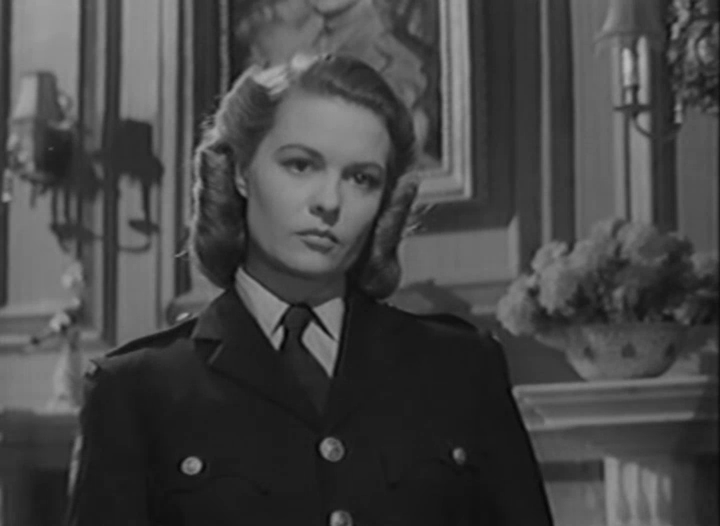
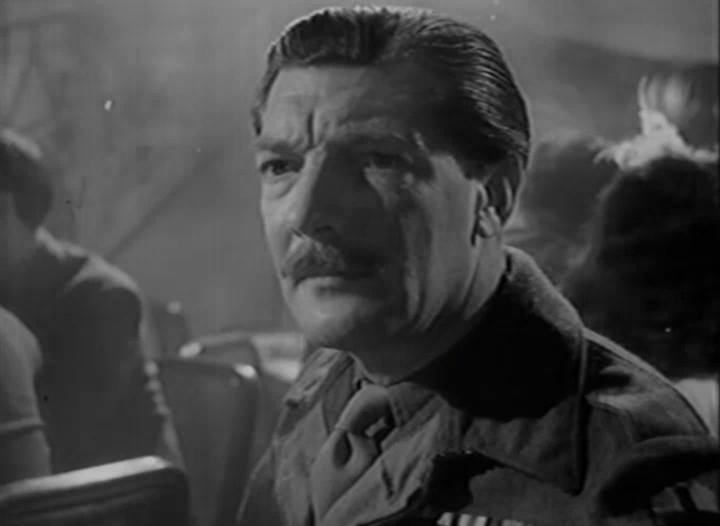
But this 1956 film is an interesting version of the original. The scene shifts to an isolated jungle area of Mexico. Richard Widmark and Jane Greer are in a plane crash, and are rescued by Trevor Howard and Peter Van Eyck, both of whom are far from welcoming. Widmark is not sure, but he keeps thinking he knows Howard, although he’s never seen him. Then he realizes it’s Howard’s voice – he heard it in World War II, as a Nazi propaganda figure (a British traitor). In short, Howard is a version of William Joyce, “Lord Haw Haw” (see SHERLOCK HOLMES AND THE VOICE OF TERROR). Van Eyck is Howard’s brother-in-law.

Howard and Van Eyck have been less than willing to help Widmark and Greer get back to civilization before, because they did not want to have them report them to the authorities – they are wanted for war crimes (at least Van Eyck is). Widmark, when he makes the mistake of discovering who his hosts are, suggests that if they help him and Greer get back, he can take a message to Howard’s loved ones about their safety. Unfortunately, Howard explains, his wife and children were killed in the war by bombing. As it is apparent that Van Eyck wants to see the strangers dead, Widmark and Greer take off to try to get to safety. And then the story follows the lines of THE MOST DANGEROUS GAME.

But ironically there is a final twist to the tale. Howard has been connected to Van Eyck only by the marriage – personally he has no liking for the man. As it turns out, he would not mind if he could get out of the jungle – away from this remnant of a bloody, horrific past and so the film actually goes onto a somewhat different conclusion. We had better  leave that to the viewer though.

posted by Movieman in Uncategorized and have No Comments

Strictly Come Dancing – Gleb and Errol Flynn – How very alike they are !!

Whenever I see Strictly Come Dancing – which I do each Saturday evening – and see Gleb Savchenko, I  am  struck with how much like Errol Flynn he looks.


Just take a look at these pictures below, and see if you agree


GLEB

Above – Gleb Savchenko


Errol Flynn

Above – Errol Flynn


posted by Movieman in Uncategorized and have Comment (1)