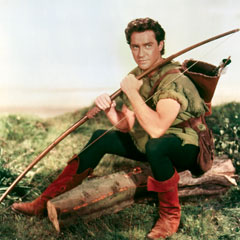
Adventures of Robin Hood TV – Robin meets Little John on the Bridge

This legendary meeting has been done on film so many times – with the best ever being Richard Todd and James Robertson Justice in The Story of Robin Hood and His Merrie Men 1952.

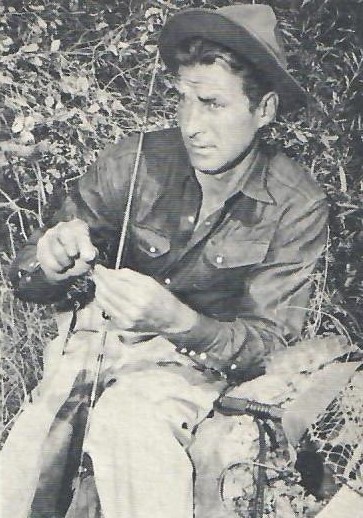
However just a little later we have the famous Television Series with Richard Greene – and in this the third episode in the series entitled ‘ Dead or Alive’  the confrontation on the bridge is quite well staged with Archie Duncan as Little John.

I was alerted to this by a regular reader of this Blog, David , who did give me the episode details from the series – he has all the episodes. He has lso contributed more information over the last few years which is very much appreciated.

This famous scene was filmed out of doors and not using a stage set-  the disappointing thing to me is that it has been done in late winter so we do not have the green leaves on the trees and everything looks bare. I would guess this may have been done in late March or early April.  Other than this it is well done. 


I must say that when Richard Greene plunges into the water, it must have been very cold indeed – it may just have been a stunt man doing this though as we did not get a clear picture of Robin in close-up.

Robin Hood


Robin Hood 1


Robin Hood 2


Robin Hood 3


Robin Hood 4


Robin Hood


Robin Hood 1


Robin Hood 2


Robin Hood 3


Robin Hood 4


Robin Hood


Robin Hood 1


Robin Hood 2


Robin Hood 3


Robin Hood 4


Robin Hood 5


Robin Hood 6


Robin Hood 7


posted by Movieman in Uncategorized and have Comments (10)

The Adventure of Robin Hood – TV series with Richard Greene, Patricia Driscoll and Archie Duncan


This Television Series of the mid 50s was extremely popular both her and in the USA.

Adventures of Robin Hood 4

R

ichard Greene played Robin Hood and Patricia Driscoll was Maid Marion. ABOVE   Archie Duncan made a very good Little John and this role was a big break for him as an actor.


Adventures of Robin Hood 3


Above: Richard Greene with Alexander Gauge who made an excellent Friar Tuck.


Adventures of Robin Hood

 
Little John fires an arrow – fairly unusual to see Little John do that – he was more of a quarter staff  man normally.
Adventures of Robin Hood 5
Speaking of Quarter  Staff – here he is in the famous fight with Robin Hood on the Bridge. I HAVE NEVER SEEN THIS PICTURE BEFORE nor do I remember seeing the episode that it cam from – but it must have been one of the early ones – if not the first.
SEE ABOVE
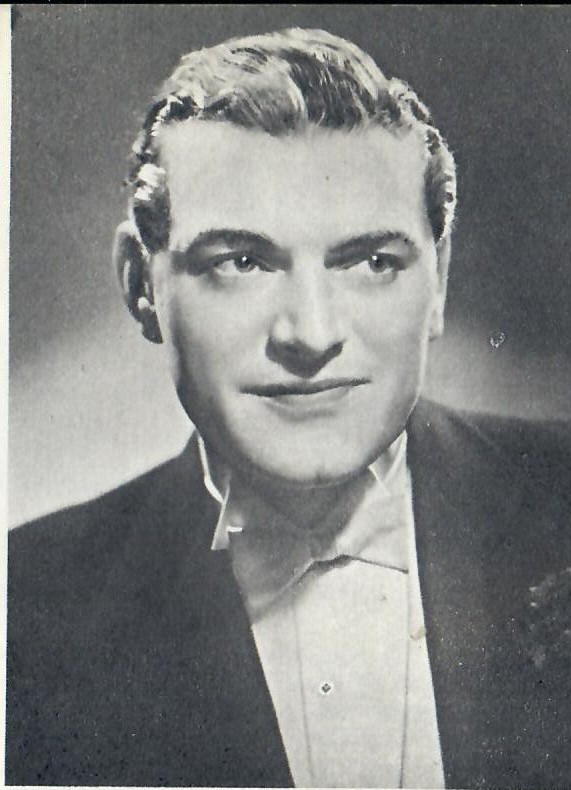
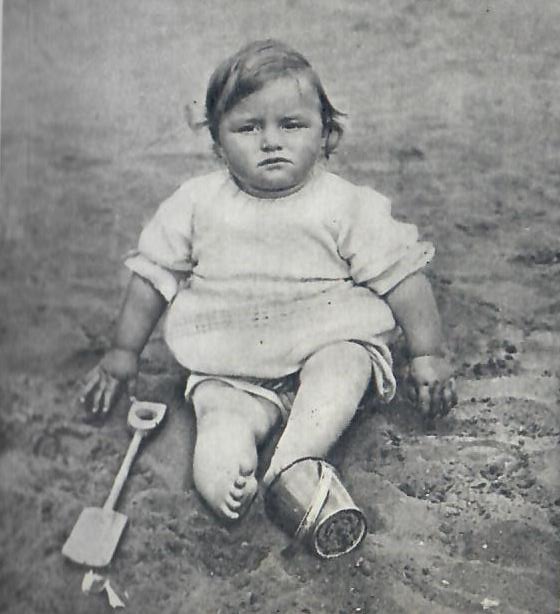
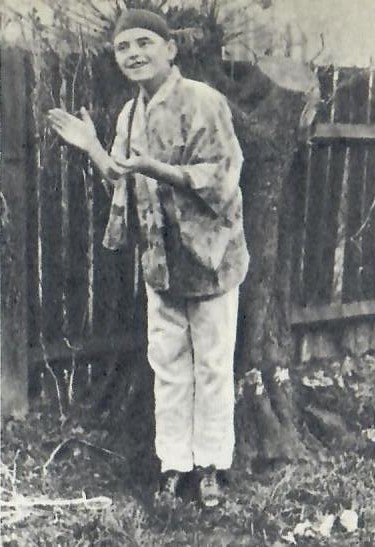
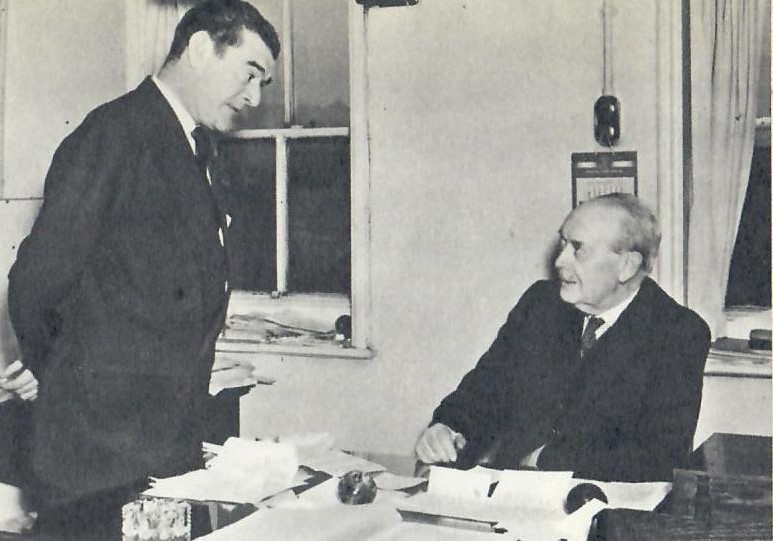
Archie Duncan has the unique distinction in the world of Robin Hood, of playing a villain and a hero. He played Red Gill, the murderer of Robin’s father, in The Story ofRobin Hood, and Little John in 105 episodes of TV’s The Adventures of Robin Hood between 1955-1960.Archibald Duncan was born in Glasgow on 26th May 1914 and was educated at Govern High School.
Archie Duncan was then working as a welder at John Brown’s Shipyard.“I was looking for acting work,” Hunter said. “Duncan came up to me and asked if I he had a big voice? I replied yes! So he invited me through to a back room, where I was asked to read the part of the fascist in the Saturday night production at the Partick Borough Halls. As the original actor had been called up.”Archie Duncan later introduced Russell Hunter to the Glasgow Unity.It was at the Citizens Theatre Company that Duncan joined the training ground of many Scottish actors including, Molly Urquart, Duncan Macrae, Gordon Jackson and Eileen Herlie.
He then made his Scottish acting debut in Juno and the Paycock, playing all three gunmen, at Glasgow’s Alhambra in May 1944.His London debut came at the Phoenix Theatre in 1947 when he appeared with Alistair Sim and George Cole as Inspector Mc Iver in Dr Angelus.
Film roles started to follow with: Operation Diamond (1948) Counter Blast (1948), The Bad Lord Byron (1949), Floodtide (1949), The Gorballs Story (1950), The Elusive Pimpernel (1950), Green Grow the Rushes (1951), Flesh and Flood (1951), Circle of Danger (1951) Henry V (1951), The Lavender Hill Mob (1951) You’re Only Young Twice (1952), Hot Ice (1952), Home At Seven (1952) and The Story Of Robin Hood and his Merrie Men(1952). Two years later Duncan teamed up again with Richard Todd and James Robertson Justice, in Disney’s Rob Roy, the Highland Rogue as Dugal Mac Gregor. In-between these various film roles, came the first of his long running TV appearances in the early U.S. series Sherlock Holmes as Inspector Lestrade.
But just as he was finishing the final recording of Sherlock Holmes in 1955, he was preparing for a role that he will always be fondly remembered. 6ft. 2inch Archie was to play the part of Little John for Sapphire Films in The Adventures ofRobin Hood, at Nettlefold Studios, the first production of the newly formed ITP company (later ITC). It was commissioned by Lew Grade and was shown in the first weekend of Independent television in 1955 and became a massive success, running to 143 episodes.
It was during the filming this unforgettable series that Duncan proved to be a true hero and managed to prevent a runaway horse from hurtling towards a group of spectators, consisting of mainly children, watching close by. For this brave feat, he was awarded the Queen’s Commendation for Bravery and £1,360 in damages. However it also resulted in him missing the recording of eleven episodes of Robin Hood.
S
o between times, a replacement was found in fellow Scotsman, Rufus Cruickshank.
Archie Duncan’s portrayal of Little John would be fondly remembered decades later for his combination of strength, skill and  humour.  It was during the filming this unforgettable series that this Scottish gentle giant proved to be a true hero and managed to prevent a runaway horse from hurtling towards a group of spectators, consisting of mainly children, watching close by. For this brave feat, he was awarded the Queen’s Commendation for Bravery
However it did result in him missing the recording of eleven episodes of Robin Hood. For these episodes he was replaced by fellow Scotsman, Rufus Cruickshank.
After TV’s The Adventures of Robin Hood, Archie Duncan’s most notable film roles were in Saint Joan (1957) and Ring of Bright Water (1969). 
Picture BELOW
Archie Duncan
A Mr Matt Robertson posted this message:

“I think I remember “meeting” Archie Duncan when I was a child visiting grandparents at Linthouse, Govan. As I recall, Archie Duncan was occasionally in the small Post Office at Linthouse, his mother or sister was the postmistress there. I would have gone into the Post Office, along with other kids at the time, to shout out, “Who killed the otter?” He had been our hero as Little John on TV but whacked Mij in Ring of Bright Water.”

posted by Movieman in Uncategorized and have Comments (4)

20 Million Miles to Earth 1957


Again back to the Monster Movies of the late fifties , this one saw a spaceship return to earth with an alien that grows in a gigantic creature.

Double Bill

A spacecraft returns from a trip to Venus ( much the same story as The Quatermass Experiment at this stage ) but it crashes into the sea just off the coast of Italy. Local fishermen rescue two of the occupants who are still alive. One of them dies just after and the other is taken to a local hospital.

Then, a small boy finds a canister containing a strange jelly substance and takes it to a visiting circus to see what it is. The owner of the circus takes charge of the jelly and a eventually a strange creature  emerges from it. The following day, the creature has grown into a giant – it escapes and goes on the rampage, eventually ending up in Rome.

The Military are called in to try and capture it, but they are unable to.

In  Rome, the Creature is put in the zoo as a tourist attraction –  it escapes from there, fights and kills an elephant and climbs the Colosseum, we have the exciting climax to the film.


The Film Trailer BELOW :-


Twenty Million Miles to Earth


I have to admit I was drawn to this because it was set in Sicily, but they really never got far from Rome. It is a significant film for the fact that special effects were done by Ray Harryhausen, who has a cameo role in the film (watch for the man feeding the elephant at the zoo.).


Twenty Million Miles to Earth 2


William Hopper, who played Perry Mason’s assistant Paul Drake, will be a familiar face for those who grew up during the 50’s and 60’s. Joan Taylor was also on TV a lot during those years. They both have a  sci-fi history in films like Earth vs. the Flying Saucers, “Men Into Space”, and Conquest of Space.


Twenty Million Miles to Earth 3

The  Godzilla-like monster from Venus is the focus of the film as they try to find and capture it. An enjoyable reach into the past with a film that entertains after you have adjusted to the special effects style of the day.

posted by Movieman in Uncategorized and have Comment (1)

Hippodrome Blackpool 1956 Show


In the day, this sort of Summer Show would do great business – and this one in the summer of 1956 would be no exception. Tessie O Shea seemed to be topping the bill with Nat Jackley – Rubberneck – and also I noticed the Television Toppers – also there was Comedian Albert Modley and Sabrina


Programme

Programme 5


There was a 45 minute programme on BBC Television on 29 June 1956 which was an excerpt from this show and billed as follows :- An excerpt from Tom Arnold’s show at the Hippodrome, Blackpool. With Tessie O’Shea, Nat Jackley, The Nitwits, Marianne Lincoln, Margo Barry, Arthur Worsley, Alan Modley and Company, Sabrina. The Television Toppers Directed by Leslie Roberts


Programme 2

Singer: Tessie O’Shea
Comedian: Nat Jackley
Musical comedy act: The Nitwits Singer:
Marianne Lincoln Performer:
Margo Barry Ventriloquist:
Arthur Worsley
Albert Modley and
Sabrina
Dancers: The Television Toppers Dancers directed by: Leslie Roberts Orchestra directed by: Jack Walker Devised and produced by: Richard Afton
Stage producer: Tom Arnold
Programme 3
 
On the back of the programme for this show was an advertisement to a very famous Diana Dors film ‘Yield to the Night’


posted by Movieman in Uncategorized and have No Comments

Matte Painting in Films – Peter Ellenshaw

Peter Ellenshaw is the master of this clever technique and worked most of his life for Walt Disney.


One of his earliest films was ‘The Story of Robin Hood and His Merrie Men’ – made in England at Denham Film Studios in the summer of 1951 and released in March 1952


Here are just two marvellous examples with a ‘before and after’ picture that says it all about Matte Painting

The Story of Robin Hood 1952

ABOVE: Robin and His Father walk back through the Forest – with the help of Peter Ellenshaw we see the scene on the right quite differently – and very impressively

The Story of Robin Hood 1952 2

ABOVE: Equally so on the above ‘before and after’ pictures – the scene is the Archery Contest – on the right we now have Nottingham Castle.

There are quite a few of these in this film and in the later film’The Sword and The Rose’

Th Film Director Kenn Annain on both these films became very taken with Peter’s Matte Painting and the scope it could give to the films.

In fact Ken Annakin said :

Walt Disney specifically had the film The Sword and the Rose designed in such a way as to use the maximum number of painted mattes; In fact we used 62 mattes in all, and it allowed us to give the picture a much broader sweep visually than it ever could have had.

It resulted in Peter being given a life contract by Walt Disney. 

I got very taken up with this technique and continued to use it on later pictures, but I almost had to train new artists myself and pass on to them the sort of tricks I thought Peter Ellenshaw relied on. But Peter just knew how to modify reality to make it look even realer than real’

Ken Annakin

ABOVE: British film director Ken Annakin, 85, poses with a poster from one of his film’s at a tribute honoring his career at the Walt Disney Studios in Burbank, May 6, 1999


posted by Movieman in Uncategorized and have Comment (1)

William Wyler directs Ben Hur


You often hear of film actors who don’t get on with the Film Director – that is not uncommon – but it is to me  the same scenario as football players and Managers. It can be a clash of personalities or just the coming together of two people who just will never get on.

Personally I am mostly on the side of the Directors and Managers

I am not suggesting that Charlton Heston did not get along with Director William Wyler although he is quoted in an article as saying ‘I have never known a Director who could keep his mind open longer on a scene’

It seems that after around ten takes William Wyler would  say ‘ Y’know, I’m damned if this is the right way to do this after all. I now have a different idea’


William Wyler Ben Hur 3


William Wyler Ben Hur


However to film something on the scale of the chariot race in Ben Hur must have been a big task – to bring those actors and crew and horses together on such a large set and to know what you wanted the camera to show on screen, must have been so demanding. 

We see William Wyler ABOVE crouching down looking through the viewfinder of that enormous Camer 65 and trying to cut the fim together in his head.  To me that is impressive.


Ben Hur 3


Ben Hur 4

Ben Hur 2


When I first saw the two top pictures, it became obvious that to get the scale on the long shots, there had to be Matte Paintings for the top of the  buildings. We see on  the bottom colour shot the tops of the buildings plus the mountains behind as a matte painting

There were some wonderful examples of this clever technique  in Ben Hur

I personally remember those done by the Matte genius Peter Ellenshaw for The Story of Robin Hood and His Merrie Men in 1952


William Wyler Ben Hur 2

William Wyler just seems to be having a bad day here.  Still the end result was extremely successful.

There are many classic moments in Ben Hur during it’s three-hour-and-half hours .

Scenes in the desert or in  the galleys, the big fight and Ben-Hur rescuing Arrius (Jack Hawkins) and it goes on and on.

I think that, after the chariot race, the film seems to go on a little too long – maybe that is because a film of this quality and scale can’t be brought to a hurried ending.

Charlton Heston, in his greatest role, contributed a lot to the appeal of the film.

However it is the Director William Wyler who, with a film budget of 15.9 million dollars brought in a film that grossed 196.2 million dollars worldwide – in those days – although to be fair,  it certainly would have been a team effort – and a very big team at that !!!


posted by Movieman in Uncategorized and have No Comments

Television Shows from the 50’s


With the arrival of the Rock n Roll era,  many singers of that time found that their careers stumbled. However one that held her own was Alma Cogan who is seen here singing with Marty Wilde on Oh Boy the ITV pop show that went out each Saturday.

Sadly she died of cancer at a very young age.  I really liked her as she seemed so full of life – something that came over strongly when she was appearing  – and in her records too.


Marty Wilde and Alma Cogan


BELOW – In Rehearsal Lord Rockingham’s Eleven with Cherry Wainer at the piano under the watchful eye of Conductor Harry Robinson


Fifties Television Show

‘The Sunday Break’ was  born  when Howard Thomas Chief of the ABC Network, overheard his daughters discussing religion with their friends.

A Scene from a typical Show BELOW

Fifties Double Bill 2

Band Leader Joe Loss with Joan Edwards and McDonald Hobley in Bid for Fame

Fifties Double Bill 4

Interesting snippet about McDonald Hobley the BBC Announcer – he was born in Port Stanley in te Falkland Islands where his father was the Vicar – in 1917

That would have been a long and arduous journey by sea in those days

McDonald Hobley

McDonald Hobley

BELOW – A typical Variety Show by the looks of it

Fifties Double Bill 3


Fifties Double Bill 5


Drama was never far away I am pleased to say.

Here is Susan Strasberg and Franchot Tone in ‘The Time of Our Life’ a guest production in the ‘Armchair Theatre’ when the New York City Centre Company was touring Europe

posted by Movieman in Uncategorized and have No Comments

George Baker in Rupert of Hentzau – BBC Television 1964

Just a couple of stills from this version – it was apparently  very good!


George Baker played the 2 Rudolfs, and Barbara Shelley (a Hammer favourite) Queen Flavia.
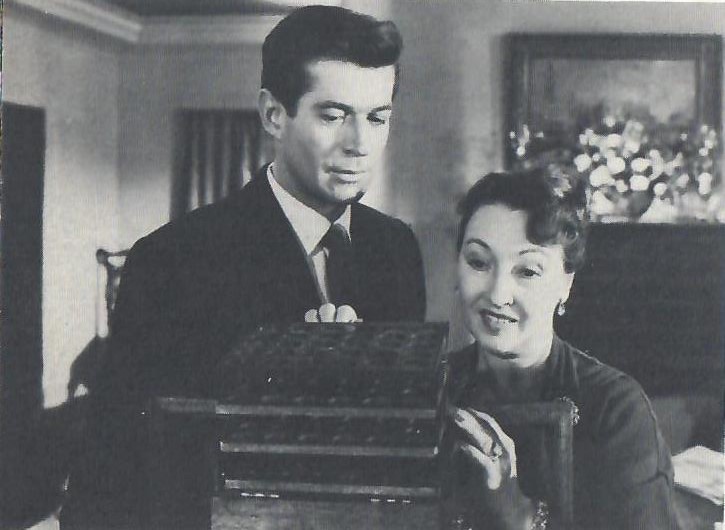
 

Rupert was played by Peter Wyngarde, better known as Jason King  and  John Phillips played Zapt. The adaptation was by Donald Wilson.
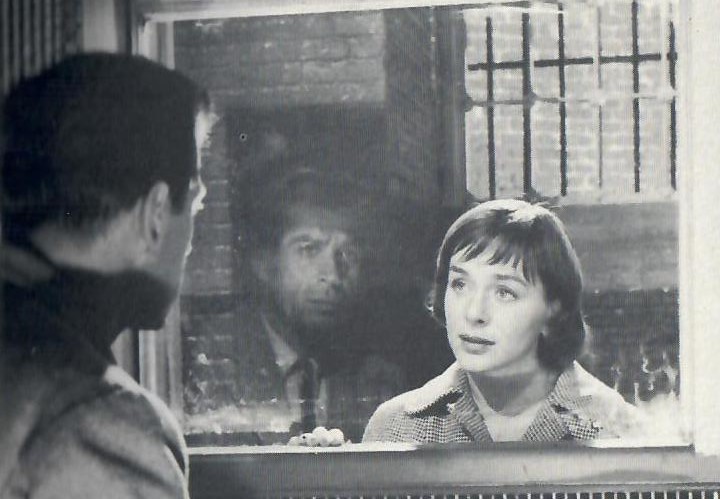


Rupert of Hentzau 1964 3   Rupert of Hentzau 1964 4

ABOVE: Peter Wyngarde played Rupert of Hentzau and George Baker as both Rudolph Rassendyll and The King.


On looking further into this Production one of the actors in it was a Derek Bloomfield who I did not know at all.

However it seems he died shortly after this serial went on air which was from the end of March 1964 – he actually died on 23 rd July 1964 at the age of 43 in Brittany.

Derek Bloomfield


ABOVE: Derek Bloomfield One other curious fact is that although he looked a very English type of actor and have been acting since he was very young – one of his early  roles in films was in the 1935 version of Mutiny on The Bounty. 


That, of course was made in Hollywood. The films he was in before and after were films made here in England.


Hobsons Choice 1954


He was in Hobsons Choice  ABOVE – that classic film of 1954 with John Mills, Charles Laughton and Brenda De Banzie.

Here he is above seated far left playing Freddie Beenstock – and in this he was 7th on the billing so it was a decent part to get.


posted by Movieman in Uncategorized and have Comments (2)

Frieda 1947 – with David Farrar and Mai Zetterling

Another one that featured on Talking Pictures today – I watched it and enjoyed it.    It had a lot of publicity and is quite well known although I cannot remember seeing it before.

It is the story of an Airman who after being shot down over Germany in the War meets and marries a young German girl bringing her back to this country and to the small market town here he had lived most of his life.  He marries the girl and they settle down to life in England but things don’t go too well as she is not accepted by certain folk both in her own family and the town itself.

We have a good friend in the next village, and his father married a German Girl and the settled in a similar small town, but our friend said that his Mother as far as he ever knew settled happily and uneventfully and stayed there all her life and was well received I am pleased to say. So this sort of event did happen.


Frieda

Frieda 2

Frieda 3

Frieda 4

Frieda 5

David Farrar and Mai Zetterling starred along with Glynis Johns, Flora Robson, Gladys Henson and many more well known faces.#

I wasn’t too keen on David Farrar in this one though. Can’t explain why but to me he didn’t seem to wholly get into the part and I thought that it was a stiff and stilted performance at times.


Frieda 6

Frieda 7

Frieda 8

In the Scenes above – a Bus arrives in the Town for an Election Rally – seems quite topical – where Flora Robson is addressing the crowd – she is somewhat bigotted against the German Girl.


Frieda 9

Frieda 10

Frieda 11

Frieda 12

Frieda 15


Freda 13

In a final dramatic sequence, Flora Robson comes good and sounds the Alarm as a tragic event is about to unfold.

I am convinced that the scenic bridge which we see at two different times – and in different weather – is a studio set as is the snowy woodland that they both run through – but it was certainly a very good set.


posted by Movieman in Uncategorized and have Comment (1)

The Moonraker – George Baker and Paul Whitsun Jones

This film was on Talking Pictures earlier today – it still looks good.


A British swashbuckler full of  heroics, sword fights, and in glorious Technicolor too.  It is a shame that this film is not more widely seen but maybe  Talking Pictures will remedy that.


The Moonraker 2


George Baker  in the leading role as The Moonraker is a very likable handsome hero and he copes with the  fight sequences very well.


The Moonraker


An the excellent supporting cast also with  Marius Goring as Colonel Beaumont, and John Le Mesurier as a sullen, though surprisingly good looking version of the  Oliver Cromwell.   S

ylvia Syms looks lovely, even if the character doesn’t call for her to do an awful lot and Patrick Troughton does well  as the harassed and hard-nosed Captain Wilcox.


However,the Star-supporting actor has to be  Paul Whitsun-Jones as Mr Parfitt.. Paul Whitsun-Jones shows his fantastic versatility at the end of the film, throwing off his blustery comic role, and donning that of a hero-  doing his part for King and Country when he sacrifices his own life so the King, and his hero The Moonraker, can escape.


It’s a work of fiction, but much thought has gone into the period design and sets and filming locations Location work is spread about the place,  Wiltshire, Dorset and Kent prove to be appealing places for scenes.

The Moonraker 3

Ronnie Hilton who would be big at the time, sang the  theme song over the opening credits.

Back to Paul Whitsun Jones – his name used to crop up again and again on British Television throughout the 1950s

He had an early role in ‘The Quatermass Experiment’ and then in a Francis Durbridge serial ‘The Teckman Biography’ and just after that I remember him playing Porthos in the serial ‘The Three Musketeers in 1954’ These were all for BBC Television – well they would be because that was the only channel available at that time.

Paul Whitsun Jones

ABOVE – As the Reporter in The Quatermass Experiment – an early role for Paul Whitsun Jones.

He worked very regularly in Television and Films throughout his life which sadly was cut short – he died aged only 50 following appendicitis. That does seem to want clarification because normally such things would be dealt with medically quite easily – so there is maybe more to that.

He certainly had a busy and very full acting  career – and is an interesting character.  In many ways he was the best performer in The Moonraker – and I suspect he stole the honours in many of the productions he played in.

On stage he was in the original production of Oliver in the West End


posted by Movieman in Uncategorized and have Comments (7)