Tarzans Magic Fountain 1950 – Lex Barker

Mainly for the reason that I like the storyline, this must be my favourite Tarzan film – and there are a lot of them. In this one Lex Barker takes over the main role from Johnny Weissmuller who retired after 16 years.  Lex went on to  make  five Tarzan films  before he too moved on.    This role however is the one for which Lex Barker is best known – even though it only accounted for about 4 years of his film acting career.
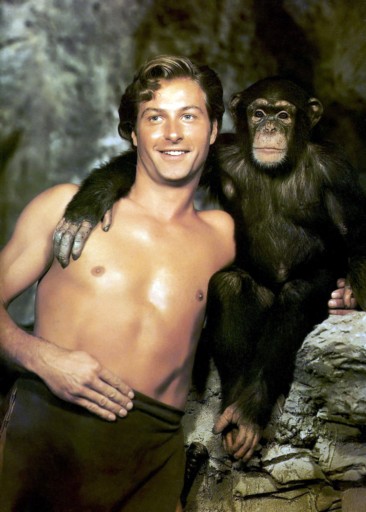
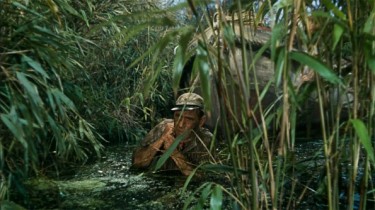
Lex Barker and Cheetah in Tarzans Magic Fountain – above
Tarzan’s Magic Fountain was Lex Barker’s first Tarzan film — producer Sol Lesser interviewed more than 1,000 actors to replace Johnny Weissmuller in the role of Tarzan. 

 Lex Barker turned out to be one of the better film Tarzans, even though Johnny Weissmuller was obviously a hard act to follow.

 The film is about a tribe of people hidden deep in the jungle. In their secret valley is a fountain of youth, which keeps a woman who crash landed in the jungle decades ago looking as young as she was when her plane went down. After she had returned to the outside world, word of the fountain leaked out and unscrupulous hunters try to find and exploit it. Tarzan tries to keep the hunters from finding the hidden valley of the fountain.   The flyer ages as the effects of the fountain wear off — a theme originally used in James Hilton’s wonderful film Lost Horizon years earlier. 

 Elmo Lincoln, the original Tarzan from 1918’s Tarzan of the Apes  has a cameo role as a fisherman in this film.

Brenda Joyce plays Jane in the film and became the only actress to play the part with two different Tarzans – she had made 4 films with Johnny Weissmuller – although after a reasonably long career in films , she packed it in after Tarzans Magic Fountain with Lex Barker and left acting for good.

Brenda Joyce swoons in Weissmuller’s arms

Away from the jungle sets at MGM  Brenda Joyce admitted that she did not like playing Jane and  she was upset by Johnny Weissmuller’s persistent sexual harassment.
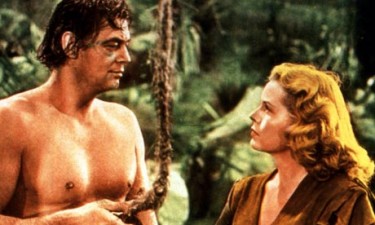
She once told one of  her friends   “How Johnny holds all that manhood tamed under his loincloths defies the laws of nature.”   . She was once certified as having the longest hair in Hollywood – 39 inches – outranking Katharine Hepburn and Veronica Lake.

Born Betty Graffina Leabo at Excelsior Springs, Missouri in 1912, she was educated at San Bernardino and Los Angeles High Schools and much later 20th Century Fox spotted her in a fashion magazine layout.

She was signed to a two-picture contract. but first 20th Century Fox changed her name to Brenda Joyce.

She made her screen debut as Fern Simon, the second lead in the Oscar-winning earthquake epic The Rains Came (1939) with Tyrone Power and Myrna Loy. The role won her good reviews and after Here I Am a Stranger (also 1939), about a young Englishman (Richard Greene) in search of his alcoholic father (Richard Dix), Brenda Joyce was signed indefinitely.

Her off-screen interests included gardening (she was one of Hollywood’s best horticulturists) and art.

She later  married Owen Ward, an Army officer. For this the studio punished her by relegating her to a string of B-pictures.

Following this and a bit of  cooling off time ahe came back  as a second-feature star at Universal and RKO and later more notable roles saw her star opposite Lon Chaney Jr and Gale Sondergaard in such B-chillers as Pillow of Death (1945) and The Spider Woman Strikes Back (1946Co-starring with Brenda Joyce is  Rondo Hatton (April 22, 1894 – February 2, 1946) – he was an actor who had a brief, but prolific career playing thuggish bit parts in many Hollywood  B-movies.  He was known for his brutish facial features which were the result of acromegaly  a disorder of the pituitary gland.
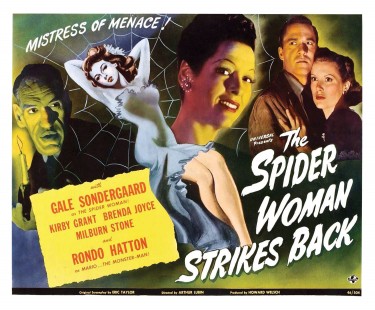
Acromegaly distorted the shape of Hatton’s head, face, and extremities in a gradual but consistent process.   Hatton apparently in his younger days had been voted the handsomest boy in his class at High School  but he eventually became severely disfigured by the disease.      Because the symptoms developed in adulthood,  the disfigurement was incorrectly attributed later by film studio publicity departments to his exposure to a German mustard gas attack during service in World War I.

Universal Studioss attempted to exploit Hatton’s unusual features to promote him as a horror star after he played the part of the Hoxton Creeper alongside Basil Rathbone as Sherlock Holmes  in  The Pearl of Death (1944).  He made a half dozen minor films playing variations of the Creeper character, including The Brute Man (1946). Hatton died of a  heart attack  in 1946.

I always felt so sorry for Rondo Hatton who was billed as The Screens Ugliest Man and yet off screen known by his family as one of the nicest kindest men you could hope to meet.

——————————————————————————————————————–

Back to Brenda Joyce :-

Two children later, Brenda Joyce seemed to have lost interest in her film career, but was coaxed back to the film set by the producer Sol Lesser after  Maureen O’Sullivan had  left the Tarzan series and Weissmuller approved  the athletic beauty as his new blonde jungle  mate.

Tarzan and the Amazons was followed by Tarzan and the Leopard Woman (1946), Tarzan and the Huntress (1947) and Tarzan and the Mermaids (1948).  After Weissmuller hung up his loin cloth, she played Jane for one last time, opposite Lex Barker in Tarzan’s Magic Fountain (1949) – making her the only Jane to co-star with two different Tarzans – before quitting show business forever.
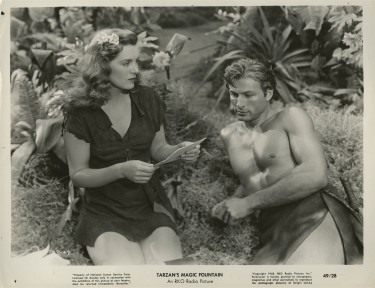
Between the Tarzan movies, Joyce made several B films for Universal, two with Lon Chaney Jr, Strange Confession and Pillow of Death (both 1945),  The Spider Woman Strikes Back (1946), pitted against Gale Sondergaard in the title role; and Little Giant (1946), with Bud Abbott and Lou Costello, playing it straighter than usual as a foil to the comedians.

After a painful divorce in 1949, she retired into obscurity, working for a decade (under her real name) in Washington for the department of immigration. She also kept her famous past in films from staff at the nursing home in Santa Monica where she spent her final years.  However she was visited there by actor Johnny Sheffield who played Boy alongside her in the Johnny Weissmuller Tarzan films.   She is survived by her three children.

Lex Barker.

Lex Barker collapsed and died whilst walking along the street in New  York in May 1973 at the age of 54.
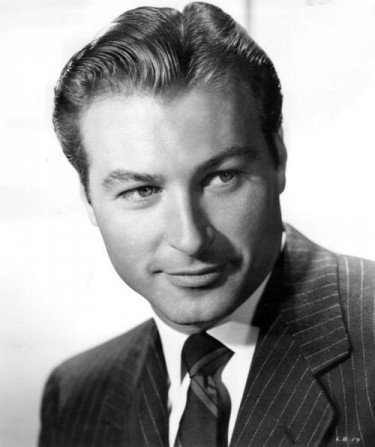
Lex Barker was a direct descendant of the founder of Rhode Island, Roger Williams, and of Sir ‘William Henry Crichlow’, historical governor-general of Barbados. He excelled in football and track at Fessenden School and Phillips-Exeter Academy.

He went to Princeton but left to become an actor. A year later he was spotted in summer stock and received a contract offer from 20th Century-Fox.  Then came World War II and he enlisted as an Infantry Private and rose to the rank of Major.     Signed initially by Fox  and then Warner, he was too tall for supporting parts and too unknown for leads.      Tarzan’s Magic Fountain (1949) (RKO) provided his first starring role.      After five Tarzans he went into other adventure films.    After 16 non-Tarzan films, mostly westerns, he went to Europe in 1957 .  He went on to make more than 50  films all over the world.

Must admit that I think Tarzans Magic Fountain was released in 1949 so technically doesn’t qualify as a ‘films of the fifties’ but maybe it came to England in 1950 – I will pretend it did !!!
posted by Movieman in Uncategorized and have Comments (2)

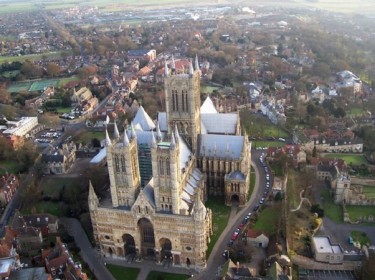
The Dam Busters – Lincoln Cathedral and The Lincolnshire Aviation Centre

Earlier I posted a subject on The Dam Busters which included a terrific shot of Lincoln Cathedral from the air.

In the film The Dam Busters there is a sequence where we see the Lancaster Bombers fly over Lincoln.


Follow this link below for a brief look at Lincoln Cathedral :-

https://www.youtube.com/watch?v=p9vk3v-MD0I&feature=player_detailpage

 Just down the road is the wonderful Lincolnshire  Aviation Heritage Centre.

I WOULD VERY MUCH RECOMMEND ANY READERS HERE TO VISIT. If you can’t make it however click on this link below and you will be taken there. You will see the only airfield in the world where you can see a Lancaster Bomber taxi on the runway – Thrilling !!!

https://www.youtube.com/watch?v=FnVqQQ0Jyno&feature=player_detailpage

Now Below click on the Link and YOU will fly over Buckingham Palace in the Lancaster for the Queens Diamond Jubilee earlier this year:

https://www.youtube.com/watch?feature=player_detailpage&v=_BoUIvfO3ys

History of the Museum

The Lincolnshire Aviation Heritage Centre is a privately owned and run Museum and was set up by two farming brothers, Fred and Harold Panton. It has been built up as a memorial to Bomber Command and primarily as a tribute to their eldest brotP/O Christopher Pantonher Christopher Whitton Panton; who was shot down and killed on a bombing raid over Nuremberg on 30/31 March 1944.
For a short time after the war there was interest from the brothers to visit Christopher’s grave in Germany, but their father denied them the chance as he wanted ‘nothing more to do with the war’. Until, in the 1970’s Mr Panton called Fred over and told him to ‘get off to Germany and bring me a photograph of Chrisy’s grave’ which of course Fred did as soon as he could. This reignited Fred’s interest in the War and when NX611 came up for sale it was eventually purchased by the brothers and brought to their land at East Kirkby. Even though they had planned to keep it only for their private collection it was suggested that they should make it into an exhibit for the public and this Museum was set up with the Lancaster and Control tower as its centre pieces.
The Lincolnshire Aviation Heritage Centre was then opened in 1988 and has hosted visits from many famous people both from the aviation and show-biz worlds. We are all extremely proud of the accomplishments of the Centre, one of the biggest independent museums receiving no funding or Lottery grants. We can only hope that we will be able to continue to educate the following generations to the sacrifices and roles of Bomber Command.


Only a few miles away is the Battle of Britain Memorial Flight at RAF Coninsby again in famous Lincolnshire.

Above Picture is of the City of Lincoln  PA474 which was transferred to the Battle of Britain Memorial Flight in 1973.   This is not the Lancaster at the Heritage Museum though.

In 1975 a mid-upper turret was found in Argentina and fitted.

The  City of Lincoln  now wears the KC-A markings from the 617 Dambusters squadron and wears the Thumper MKiii nose art, originally painted by Flt Lt Bob Knights upon posting to the 617 squadron . She displays the markings of bombs for operations over Germany, ice-cream cones for operations over Italy, and poppies for when she has released poppies during exhibition flights.

She had appeared in two films- Operation Crossbow and The Guns of Navarone.


Lincolnshire Countryside with Lincoln Cathedral in the distance.

posted by Movieman in Uncategorized and have Comments (2)

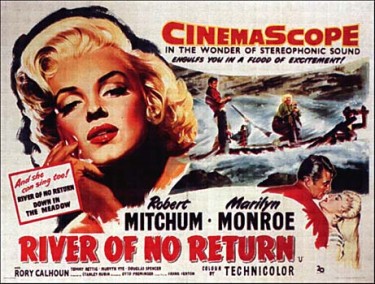
Marilyn Monroe – River of No Return 1954

We go back again to Marilyn for one of her best remembered films with Robert Mitchum made in Cinemascope and Technicolor. Much of the filming was done in and around Banff and Jasper in Canada.

Brief Synopsis of the Film:-

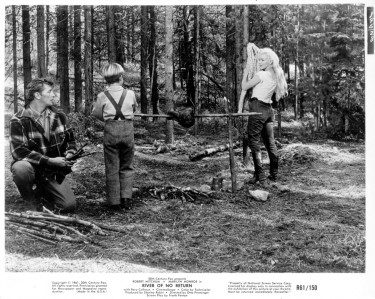
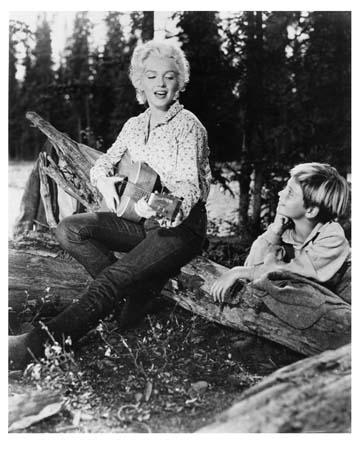
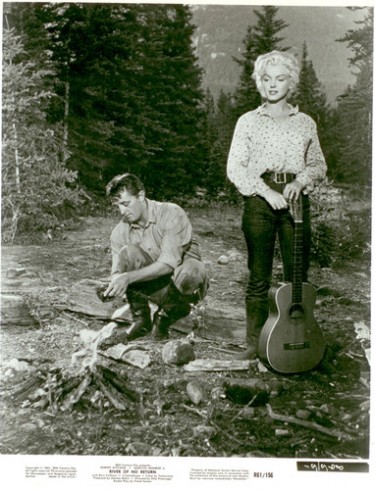
Robert Mitchum is released from jail, picks up his ten year old son and decides to live on a farm. He rescues a couple from a raft on the river (Marilyn Monroe and Rory Calhoun). Calhoun wants to register a gold claim, and from then on its Marilyn, Mitchum, the boy, the raft and the river –  not to mention the Indians.   Marilyn is fabulous in this role and at her most glamorous.   The beautiful scenery- made even more impressive by the use of cinemascope,   Marilyn at her prime,  Mitchum good as always  together make River of No Return an outstanding western.

Robert Mitchum was the only one of her leading men who knew her from way back in 1941 before he made his screen debut – in a film starring  Hopalong Cassidy.  Before his film career took off  Mitchum had worked in an  aircraft factory along with James Daugherty who had just married  Norma Jean and the four socialised on occasions.

He knew all about her psychological problems and when it came  to making  a film with her when both had become well known screen actors,  Mitchum did not seem keen to get  himself involved.  However  during the shooting of the film Marilyn and director Otto Preminger had a major fall out and stopped speaking and would only communicate through Mitchum.  This may not have been entirely Marilyn’s fault because Preminger was a difficult man – a few years later he subjected a young unknown Jean Seberg to quite a difficult time during the making of St.Joan 1957. In fairness to him though he had plucked her from obscurity to star in a major film – so he did give her a great chance.

In River of No Return Marilyn plays a  saloon girl who gets involved with  a no good gambler/drifter played by  Rory Calhoun.    Calhoun and Monroe almost  drown in a river when Robert Mitchum rescues them and their raft. Following such a good deed  Rory Calhoun  steals their horses and then the three – now including Mitchum’s son in the film played by a young Tommy Rettig – go in pursuit of him. 

Marilyn  proves to be quite a distraction and at one point Mitchum does give into his feelings ever so briefly.

Twentieth Century Fox decided to go out on location in a big way for the  shooting the film – in fact up to Banff  in the Canadian Rockies – although with Marilyn and Otto feuding it was not a happy set.   Preminger  eventually walked out on the picture and Jean Negulesco finished it off.   During this time  Joe de Maggio, Marilyn’s husband   flew up because of rumours about her and Mitchum which were unfounded .   This was a film though that Otto Preminger shuddered about when recalling it in later years.


Watch the Trailer to this exciting film on the Link below :-

https://www.youtube.com/watch?v=RSaI1CJPwEY&feature=player_detailpage

 It was made in Cinemascope and 3D apparently which I have only just learned about – although since writing this I cannot find any reference to it being in 3D from any official source – so maybe I have the wrong information here.  

 I do remember seeing it up on that large wide screen and it was very impessive.   Not really a film for TV though as it loses so much on the relatively small screen.

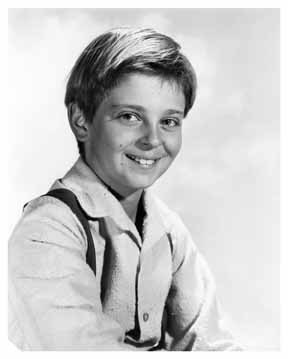
Tommy Rettig.

An interesting character – Tommy Rettig (December 10, 1941 – February 15, 1996) was an American child actor who later became a wizard on computer programming.    He will be best remembered for portraying the character “Jeff Miller” in the first three seasons of  the TV series Lassie between  1954 and 1957.    He was also in another Western which has been featured on this Blog – The Last Wagon – one of my favourites a few years after River of No Return.

posted by Movieman in Uncategorized and have Comments (6)

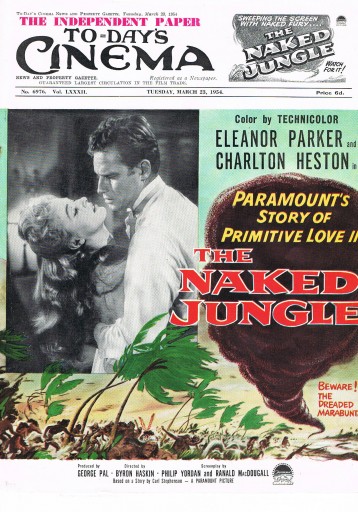
The Naked Jungle 1954 – All those Ants !!!

This was a big colour picture made in 1954 and directed by Byron Haskin – one of my favourites – He certainly knew what he was doing and was always able to deliver. I have written before that when Walt Disney came to England to film Treasure Island in 1950 he turned to Byron Haskin who brought in a great movie and because it was Disney’s very first venture away from animation it was vital that he did. It set them up to move forward – although surprisingly Walt turned to a then relatively unknown young director Ken Annakin for The Story of Robin Hood 1952 made in England at Denham and up to that time THE most expensive film ever made here – and it showed !  It was a sumptuous and expensive production that combined so many top technicians including Peter Ellenshaw, Carmen Dillon and Guy Green who supervised the stunning Technicolor production.   Ken Annakin was really made after he had a success with this one on a world scale.

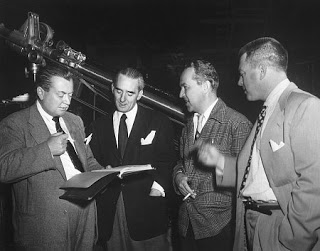
Above – Byron Haskin and George Pal ( and others ) in discussion

Coming back to The Naked Jungle though the film is set in Peru and stars Charlton Heston and Eleanor Parker and tells the story of an attack of army ants on a cocoa plantation.  The film  was based on the short story by Carl Stephenson.

Eleanor Parker who had top billing in this film plays a woman from New Orleans who  arrives at a cocoa  plantation in Peru to meet her new husband, plantation owner Christopher Leiningen played by Chalton Heston who she has married by proxy and has never met.

Leiningen is cold and remote to her, rebuffing all her attempts to make friends with him. She’s beautiful, independent, and arrives ready to be his stalwart helpmate but  no one it seems has told him she is a widow. He rejects her.

As she awaits the boat to take her back to the US.A.  they learn that legions of army ants – the Marabunta  – are on the move and will strike in a few days’ time. Leiningen refuses to give up the home he fought so hard to create and so  instead of evacuating,  he resolves to make a stand against the army of ants.   Joanna joins the fight to save the plantation and  so the film is set up for this final showdown.

 Ants everywhere – how did they do that in 1954 I wonder.


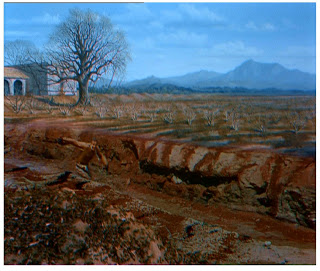
Above – The best effects sequence in the film – Charlton Heston on the run as an enormous tidal wave from the blown dam heads his way. Several brilliantly choreographed tricks were employed in this terrific sequence – the first shown above is a straight forward though perfectly matched split screen of Heston in dug out trench and Jan Domelas‘ sprawling matte painting dominating the shot.

Also cast in the film is William Conrad later to achieve TV fame as Frank Cannon.

I think this comment on one of the sites is interesting:-

THE NAKED JUNGLE is based on Carl Stephenson’s story “Leiningen Vs The Ants.” There was at least one excellent radio adaptation in which William Conrad (who has a supporting role in this film) played Leiningen. The first half of this screen adaptation is pretty ordinary mainly focusing on the romantic problems of Heston and his mail order bride Eleanor Parker.  

However when the ants arrive  this film really takes off.    One scene where the ants devour a drunk down to his bones must have looked pretty shocking in 1954.

 The film was reasonably successful and was actually re-released in 1960.

posted by Movieman in Uncategorized and have Comments (2)

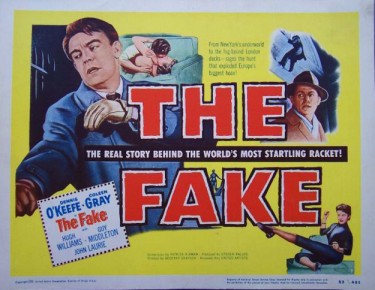
The Fake 1953

I have just received a DVD of The Fake having not seen it for years – and can’t in fact EVER remember it being on TV either.  By the way it is a very good copy on the DVD.

It was  1953 British crime film which starred Americans  Dennis O’Keefe and Coleen Gray who came over here as many did in the fifties.  Among the British actors were  Hugh Williams, John Laurie, and Dora Bryan.   

The plot concerns an American detective who tries to solve the theft of a priceless painting from the Tate Gallery in London. In this crime drama an American played by Dennis O’Keefe is assigned to guard a US art exhibit in London to protect one of da Vinci’s most priceless paintings- Madonna and Child.

A series of art thefts has put the museum officials on red alert and they anxiously await the painting’s arrival. Unfortunately, the painting is stolen en route to the show and replaced by an imitation. The intrepid guard follows the thieves to a private gallery run by a wealthy criminal.

This also was actress Billie Whitelaw’s very first film.

I do remember seeing this in St Albans , maybe at the Odeon, but certainly while we were down there on holiday – it was our regular holiday location for many years – and very good it is too. Can’t have been very old but I am pretty sure it was the supporting film to Raider of the Seven Seas with John Payne – which was very colourful.


St. Albans Odeon Cinema – above.

St Albans Odeon – the shot probably from the mid to late 1980’s – before screen 4 was added in 1988. The cinema originally opened in 1931 as the Capitol and  was enlarged and reopened in 1934 when it had  a staggering 1,728 seats. Renamed just after the War in 1945 the Odeon  eventually closed as a 4-screen operation in 1995.

It is currently being restored as the Odyssey Cinema – set to reopen in all its art deco splendour in the near future and I for one look forward to that  !!!

 The Odeon was one of the main cinemas in the City.

posted by Movieman in Uncategorized and have Comments (7)

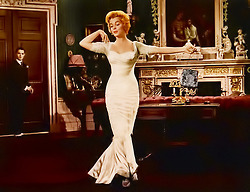
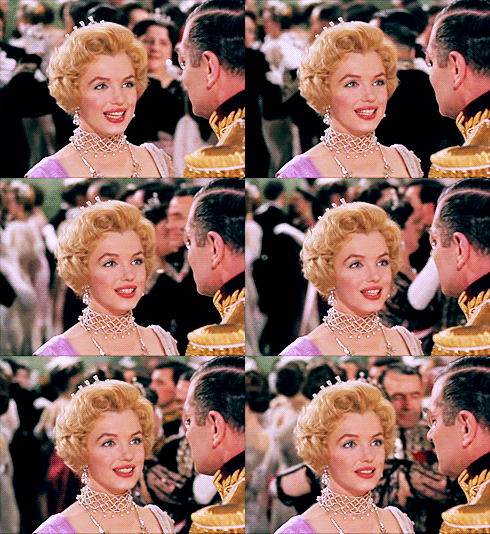
Marilyn Monroe – The Prince and the Showgirl 1957

I have just watched the  film ‘My Week with Marilyn’ which is adapted from diaries and a book written by Colin Clarke the 3rd Unit Director on the film ‘The Prince and the Showgirl’  who as a young man of 24 was lucky enough to befriend Marilyn and become quite close to her during that time in England in 1956.

I have featured The Prince and the Showgirl  before on this blog – in fact one of the first posts I ever did.   I am also pleased at least that Marilyn did come over to England and spent hopefully some happy time here. We would certainly have made her welcome – of that I am quite sure.

Marilyn is a great star of this or any other era.

She had come over to make what would be her only film outside the USA along with her husband playwright Arthur Miller.   In My Week with Marilyn Michelle Williams plays Marilyn quite brilliantly with Kenneth Branagh giving a good but slightly camp portrayal as Sir Laurence Olivier.  I thought one telling line of dialogue came from Colin Clarke when talking to Marilyn who had been upset by Sir Laurence’s treatment of her.   He says something like ‘ The trouble is that he is a great actor who wants to be a film star – and you are a great film star who wants to be an actor’

Above – Marilyn at her dazzling best – on screen.

I would ask any one reading this blog to view the film – if you haven’t already as it gives a wonderful insight into the fragility and naïvity of Marilyn and yet shows us also her incredible screen prescence and as my daughter pointed out maybe the ability either wittingly or not to  manipulate people – and men in particular.    In the film Olivier philosophically points out that any of them could practise their art until they were near perfect but even then they wouldn’t get 10 per cent of what she had – referring to her dazzling screen persona.

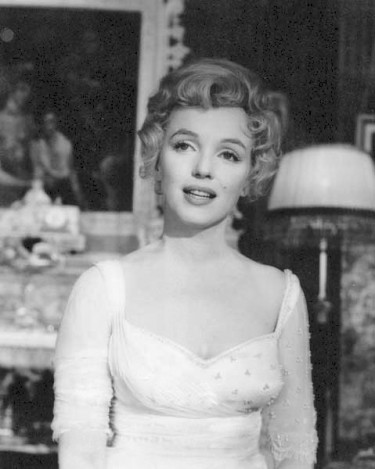
 Marilyn in The Prince and the Showgirl at Pinewood

See this Link to the film Trailer of My Week With Marilyn 2011 film

http://www.youtube.com/watch?v=NeHDZODFKNw&feature=player_detailpage

The Prince and the Showgirl was Olivier’s  first and last attempt at directing a film for an American movie star.  If Marilyn was ill-equipped to handle Olivier’s rigid stage-influenced directorial style,  then Olivier himself was equally as inexperienced at interpreting popular material and handling screen stars of this calibre.

The challenge of maintaining some semblance of a working relationship between Marilyn and Olivier fell on the shoulders of Milton Greene, while Arthur Miller assumed the duties of caretaker and manager for his unstable wife.  Arthur Miller was often placed in the awkward position of having to explain or defend Marilyn’s behaviour.

It was difficult for those living through the ordeal to have sympathy for Marilyn at the time –  particularly after an episode in which she kept the elderly Dame Sybil Thorndike waiting on the set in full costume for hours.

Dame Sybil Thorndike steadfastly refused to criticise  Marilyn though.       Instead she insisted   “We need her desperately. She’s the only one of us who really knows how to act in front of the camera.”

Watch the Trailer to The Prince and the Showgirl – Link Below:-

http://www.youtube.com/watch?v=PWa9lm7sILs&feature=player_detailpage

After filming had been completed Marilyn apologised to the entire cast and crew for her behaviour which was certainly not all her fault. She was in a foreign country after all where she had not been before – although a country that warmed to her in every way, and she suffered a miscarriage around this time also – so she was in a particularly frail and vulnerable state.

On screen though she was Marilyn Monroe – and when she appears she displays a magnetism and a screen prescence that very few come anywhere near.

posted by Movieman in Uncategorized and have Comments (3)

Skyfall – Pinewood Film Studios

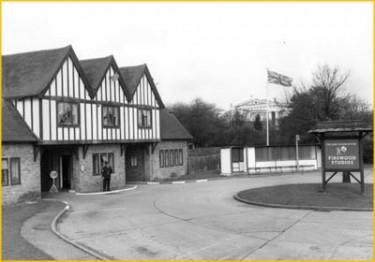
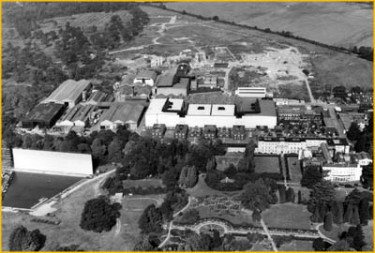
Pinewood Film Studios at Iver Heath, Buckinghamshire has been the home to most of the James Bond films – and many many more as well.

An iconic view of the entrance to Pinewood.

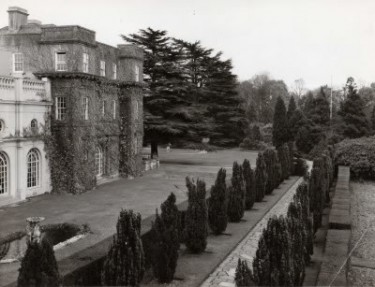
The Garden Walk at Pinewood.

Pinewood Studios was built on the estate of Heatherden Hall which was a large, attractive Victorian house with spectacular grounds. In 1934 building tycoon Charles Boot bought the land and turned it into a Country Club.

Then later in 1935  millionaire  flour magnate  J.Arthur Rank created a partnership with Boot and together transformed the estate into a film studio.  In December of that year construction began, with a new stage completed every three weeks. The studios were finished nine months later having cost £1 million (approx. £37 million at 2012 prices). Five stages were initially completed and there was  provision for an enclosed water tank capable of holding 65,000 gallons and taht is still in use today. In later years both the Pinewood and the Denham Film Studios justup the road  had by then become a part of their newly-formed Rank Organisation.


On 30 September 1936, the studio complex was officially opened and  the first film to be made entirely at Pinewood was Talk of the Devil directed by Carol Reed.

There followed a hugely prolific part of Pinewood and British film history.  Pinewood soon was leading the way in film industry innovation through a system that enabled several pictures to be filmed at the same time and ultimately Pinewood achieved the highest output of any studio in the world.

Denham closed in 1952 effectively with Walt Disney making the last ever film there which was The Story of Robin Hood starring Richard Todd and Joan Rice – a particular favourite of mine.

I always loved Denham Film Studios and wonder what might have been if the focus of J.Arthur Rank had been there instead of Pinewood. After all the two were built at around the same time but Denham was considerably larger and built on such a scale to rival anything in Hollywood or anywhere else come to that.

Then we move on to the fifties at Pinewood which saw films such as in The Doctor series and  Norman Wisdom with his own brand of comedy films. They did extemeley well at the Box Office during that decade. 

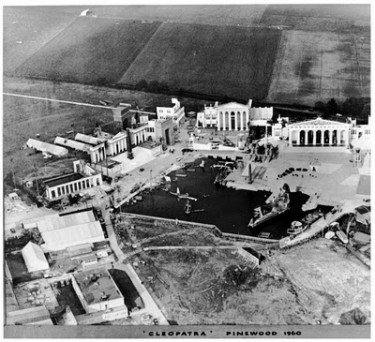
In 1960 came an ill-fated venture when some of the biggest sets ever were constructed for Cleopatra but Liz Taylor became very ill with pneumonia and the whole production was then moved to Rome.

 Above – the gigantic set for Cleopatra 1960

1962 saw the dawn of Pinewoods most famous enterprise- the James Bond franchise that began when Terence Young directed Dr. No.

In the same year  Lord Rank announced his intention to retire as chairman. He was to be succeeded by John Davis, who had consciously moved the Rank Organisation away from film production towards more profitable areas like bingo and holidays. The sixties were buoyant years for Pinewood, with more and more American pictures being shot there in the wake of Bond and Disney’s global success. Pinewood was no longer solely dependent on the Rank Organisation to fill its stages. The studios 30th birthday was celebrated in 1966, and worked had started on new stages to accommodate every aspect of film and TV production including  new viewing theatres, new cutting rooms and sophisticated stage lighting systems.

The seventies were an uncertain period for Pinewood although more television productions aimed at family entertainment were filmed there  including  The Persuaders starring Tony Curtis and of course our own Roger Moore – later to become Bond.  

In March 1972 J. Arthur Rank  died.  He played a great part in the formation of the British Film Industry as we know it

By that time though the Rank Organisation was in a healthy state.  The Superman films held things together through the 70s.      In the 90 s  many large-scale productions such as Kubrick’s Full Metal Jacket and Tim Burton’s Batman kept Pinewood ticking over.

The  summer of 1999 saw the inauguration of two huge new state-of-the-art sound stages as the first phase of Pinewood’s on-going expansion plans. As the new Millennium dawned, the Studios were acquired from The Rank Group PLC by a team led by media magnates Michael Grade and Ivan Dunleavy.

An iconic scene – At Shepperton Film Studios – One of THE great film scenes for me anyway.

 Early in 2001, it was announced that Pinewood Studios and Shepperton Studios had successfully completed a merger under the Pinewood Shepperton name. I still to this day hold a very few shares in that company although in 2012 there was a takeover by Peel Group from the Isle of Man so maybe those shares will become the subject of  a compulsory purchase order – who knows.   Either way there has been little upside in the price so any sale would be academic really.


Later in 2011 we saw the production of Skyfall with much of the film being shot at Pinewood – and compared to previous Bond films there were very few exotic locations – even the scenes in Shanghai were in the most part done back home with necessary shots cut in at strategic places.

posted by Movieman in Uncategorized and have Comments (4)

Skyfall – Opens in the USA

Skyfall looks like shattering the record for the biggest James Bond movie debut ever after taking in $30.8 million at the box office on Friday. That’s an average of nearly $8,787 from each of the 3,505 theaters that the 23rd film in the 50-year-old 007 franchise is playing on.

That may well  translate into an $80 million weekend.   Adding in $2.2 million from Thursday night previews at IMAX and other large-format theatres, “Skyfall” has taken in $90 million in America, according to studio estimates on Sunday.

That lifts the worldwide total for “Skyfall” to $518.6 million since it began rolling out in Europe in late October.


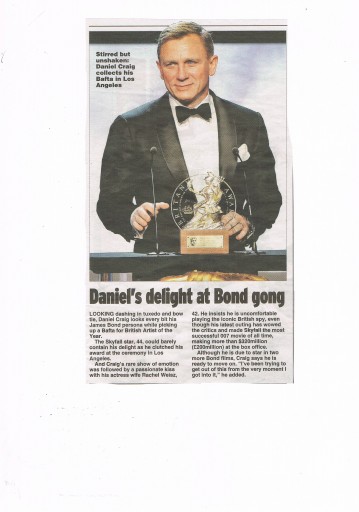
This picture shows Daniel Craig in Los Angeles

posted by Movieman in Uncategorized and have Comments (9)

Skyfall – Awards ?

With the standards that  Skyfall  has set and with the quality of actors, director, set design photography etc involved, it would be hoped that this film receives the recognition it deserves when the awards are handed out next year.

Berenice Marlohe, Sam Mendes, Barbara Broccoli and Daniel Craig

Berenice Marlohe, Sam Mendes, producer Barbara Broccoli and Daniel Craig

The  screenwriter John Logan also  hopes that his latest work on Skyfall will help the film gain such recognition at next year’s awards.

In the past Bond films have received only two awards – Goldfinger won best sound effects in 1964 and a year later in 1965, Thunderball got best visual effects.

 “Yes. I think we made a proper movie, which was our goal.”  said John Logan when asked if he thought an Oscar was possible

He has previous form with Academy voters, having been nominated for his work writing Gladiator, The Aviator and most recently, Hugo.

There has been talk that , just maybe, Judi Dench could be in line for an Oscar for her performance in Skyfall.  She has had six Oscar nominations to date, with one win in 1998,  for best supporting actress in Shakespeare in Love.

Judi herself dismissed such speculation  “Don’t let’s talk about that yet, that’s a long way off ” was her response.

Bond himself, Daniel Craig, was also keen to avoid Oscar hype at the world premiere, reluctantly admitting “of course” he’d like Skyfall to get noticed by the Academy Awards.

“I mean certainly Roger Deakins who did the camera work on this – it would be fantastic if he were to be recognised because he’s done such a wonderful job.”

Skyfall has already broken UK box office records and it has taken a mere 10 days to hit £50m in ticket sales – the fastest film ever to do that.    It opens in America on Friday of this week  9th November and my predicition would be that it will take the USA by storm so to speak and give audiences a welcome distration after the Presidential campaign.

There have been rumours suggesting that  that John Logan had already been hired  to write the next two Bond movies –  possibly as a sort of  two-part story but that has been denied by Daniel Craig.

Eon Productions have not made any comments either but Logan says that he would be very happy to work on another Bond film

“I think we’ve established, as with  Casino Royale and Quantum of Solace, a tone that is the base line reality of Bond now,”  he said.   “So it can’t become camp, it can’t become grandiose in a bad way at this point, it simply has to be honest to the tone that we’ve worked so hard to create in Skyfall.”


 On Location in Istanbul

Well after that all we can do is ‘Watch this Space!!’

John Logan

Above – Writer John Logan

posted by Movieman in Uncategorized and have Comments (6)

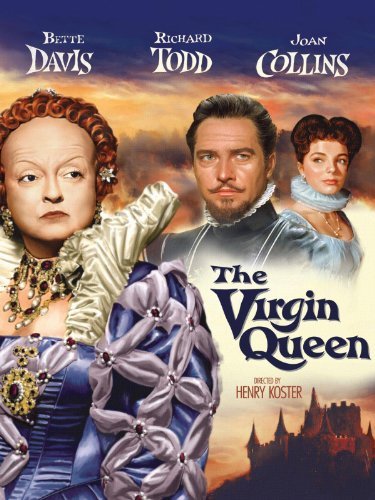
The Virgin Queen 1955 – Richard Todd and Bette Davis

After his great success in The Hasty Heart, Richard Todd was signed up on a One-Film-a Year Contract with 20th Century Fox – and this film was one of those. It was made in Hollywood and directed by Henry (Bobby) Koster in Cinemascope.

Also cast of course was Bette Davis as Queen Elizabeth in a role she had played before opposite Errol Flynn in 1939.    Co-starring with the other two was Joan Collins who at that time was also with Fox during the years she spent in Hollywood in the 50s.    I heard Joan being interviewed about this period many years later and she said that in the fifties she went to Hollywood, made a great deal of money and ‘spent it all’.

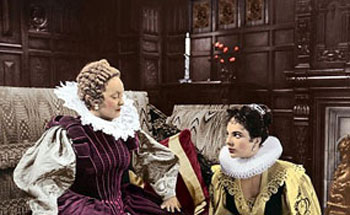
Above – Bette Davis and Joan Collins in a scene from the film.

The Virgin Queen was filmed in around 30 days which is very quick for a major Hollywood picture but Bette Davis insisted that she had a strict time limit because of other projects she had on the go.  She must have been reasonably friendly with Richard Todd because a few years later in a visit to England she did visit him at his dairy farm Near Henley on Thames.

Richard Todd related one little story that when he came to make the picture and realised that Bette Davis was playing opposite he was initially somewhat  daunted by the prospect because she had quite a fearsome reputation with other actors who maybe she felt weren’t quite up to the job. However the two of them  seemed to get on fairly well and he seemed able to avoid her displeasure- other than on one famous occasion when Bette had to make a long haranguing speech to her courtiers which she did word perfect and the scene would have been ok.  However the script girl pointed out that Richard Todd had forgotten to put on his garter chain which was part of the costume – so he had to go to Bette and explain what he had done and that the scene would have to be redone and she would have to make this long speech all over again. Her reaction was ‘You Bastard’ but she just got back in and  did the speech again  perfectly.

Another very strange incident occurred during this picture. There was among the courtiers in this same scene, an old actor who had just one line of intervention but for whatever reason the poor old chap just couldn’t get it right – he would either come in too early or too late or maybe not at all – and it became obvious to Bobby Koster that he was not able to do it.   So rather than humiliate him – on the next take – Bobby said ‘Good, Cut and Print’ implying he was happy with it but secretly he knew that he would have to get another actor in to do the scene.   He then thanked the old actor who left the studio a little later.   About 20 minutes after this there was a call from the gate and the caller asked ‘ Do You have a xxxxx  working on your film ? Bobby says ‘Yes We do he has just left’.   Then the gateman said ‘ I am sorry to tell you but he has just dropped down dead.’

So Bobby Koster had been very kind to him at the very end of his life and avoided any discord and the actor had left happily.

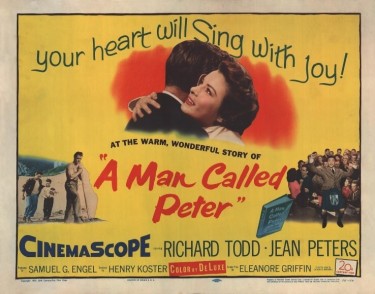
Above – A Man Called Peter – Richard Todd and Jean Peters.

Out of the five contracted films Richard Todd made this film and D Day the Sixth of June were good but the best one was by far ‘A Man called Peter’ in which he gave probably the best acting performance of his film career as Peter Marshall the inspirational  Scottish vicar who went out to the USA and created quite a following with his stirring sermons.    Whilst rehearsing one of these from the pulipt of the set he later found Marilyn Monroe watching from a seat at the very back and crying at the words she heard.    This film is much better known in the USA than England but it was a very good film indeed. 

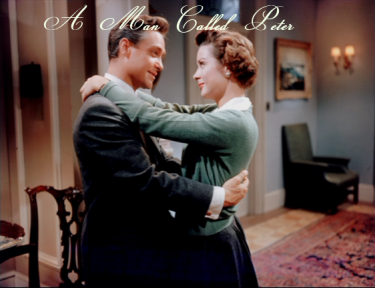
Jean Peters and Richard Todd above

Richard Todd’s  co-star in A Man Called Peter was Jean Peters – the very beautiful film actress – and in his autobigraphy he said that she was very good with her acting but once her scenes were done she would retire to her caravan or dressing room and she seemed always to be accompanied by another woman. She flew in just before filming started and flew out when she had completed the film and never socialised at all.  It later became clear as to why.    Not long after she married Howard Hughes and didn’t make another film.   The woman with her had been a sort of minder and the plane she travelled in was belonging to Howard Hughes.

Someone said of  A Man Called Peter that it was the best film ever made dealing with this subject and Richard Todd’s portrayal of Peter Marshall was wonderful.

posted by Movieman in Uncategorized and have Comments (4)