Gerald Parkes – A Tribute

To many readers this is may not be a name that you will know.   However to people of North Lincolnshire and East Yorkshire he was a very well known and well respected figure from the world of Cinema – not to mention one of the most knowledgeable people about films.

Mr Gerald Parkes – Above
I was so sorry to see the report that Mr Gerald Parkes the former owner of the Majestic Cinema in Scunthorpe Lincolnshire, has died. When, for many years I had an office on Oswald Road, he was a near neighbour and I would see him often to pass the time of day with. He also did an interview for Radio Humberside along with me – after we had had business dealings with Eon Productions who had made the Bond Film Goldeneye at that time. I remember him commenting about the Bond films and saying that many of the younger people who would see the film had never seen the Bond films- as he termed it – ‘PROPERLY’ and by that he meant that they had only seen them on TV and not as they should be seen – on the big cinema screen. I always remember that comment and think how true it is that many people have never seen films – properly !! One of his works colleagues summed him up by saying that ‘Mr Parkes strived to bring the magic of the golden age of stage and screen into the modern era’

Above – Gerald outside the Majestic Cinema in 1998

THE cinema world is mourning the death of Gerald Parkes, 69, the founder and  owner of Parkway Cinemas in Cleethorpes, Lincolnshire.

With the nine-screen Parkway in Cleethorpes, Lincolnshire  and the three-screen Playhouse in  Louth, he entertained  generations of film fans.

 Moving tributes have been paid to the much-loved entrepreneur who always had  a smile and a joke and was regarded as one of northern Lincolnshire’s greatest  showmen.

Only a week ago, in St Andrew’s Hospice, Grimsby, where he was cared for,  Gerald was presented with the MBE in honour of his lifetime’s service to the UK  cinema industry.

The one-time lighting boy who put the spotlight on The Beatles in 1963 at a  live show went on to become cinema company ABC’s youngest manager at The Ritz,  Keighley, in Yorkshire, in 1969.   Two years later he was in charge at  Harrogate.

It was a promotion which paved the way for a successful career in the cinema  industry and led to him establishing an independent business, along with his  wife of more than 40 years, Denise.

In Cleethorpes, he promoted live music and comedy nights, as well as live  links to grand operas and theatres throughout Europe.

He welcomed comedy stars such as Alan Carr and Jason Manford and jazz  performer Jamie Cullum to his stage at the Parkway.

Gerald Parkes had battled with cancer for two years and died on Thursday at  St Andrew’s Hospice in Grimsby.

His wife Denise and two sons Gerrard and Richard were by his side.

Just days before his death he was busy choosing the colour scheme for the  latest refurbishment of Louth Playhouse cinema – the latest part of the £200,000  investment in the popular art deco cinema in Cannon Street.

The Louth Playhouse – Above

Earlier last month, The Playhouse was awarded a Louth Pride of Place award by  the town’s Civic Trust.  He took over the cinema in 1996, boosting audiences  overnight and, having already run the Majestic Cinema in Scunthorpe, eyed the  opportunity to open a multiplex cinema in Cleethorpes.

This came in 2004 when the nine-screen Parkway opened after a huge building  programme.

Above – Gerald’s very own – Parkway Cinema Cleethorpes

It heralded a new era in cinema-going with plush seating and the latest  technology in picture and sound quality.

His insistence on giving all his customers the best experience possible  earned him a Lifetime Achievement award in 2011, marking 50 years in the cinema  industry.

He was also an executive board member of the Cinema Exhibitors Association,  representing independent cinemas.

The Cleethorpes Parkway was awarded Best New UK Cinema in 2007.

The following year Mr Parkes welcomed hundreds of supporters of When You Wish  Upon A Star charity when he hosted the regional premier of the Bond movie  Quantum Of Solace.

Guests raised more than £10,000 at the event and the auction held later at  The Beachcomber locally on Cleethorpes.

He and Denise founded the Parkway Entertainment Company Ltd in 1983. The  family business has grown to be one of the most successful independent cinema  operations in the country, with cinemas in Cleethorpes, Louth and Barnsley, and  plans for a new multiplex in Beverley.

Denise said: “We are particularly proud of our team at Parkway. We couldn’t  have got through without their support, and that of our family and friends.

“The doctors and staff of St Andrew’s were exceptional, as Gerald said – they  allowed him dignity at all times. Essential for such a proud man.

“It didn’t matter how poorly he felt, you could still see the twinkle and  cheeky smile, right to the end.”

Son Richard Parkes said: “His energy and determination was inspiring, for all  of us.”

Scott Marshall, managing director of Parkway Entertainment, said: “It is a  massive loss to the industry. Mr Parkes strived to bring the magic of the golden  age of stage and screen into the modern era.  His continued drive to do this  while adapting to the tastes of modern audiences shows his respect for everyone  who passed through his doors.

“It is my team’s responsibility to continue this legacy and maintain the high  standards he set.  He always said the show must go on and we will strive to  carry it on and expand it.

“He was a great guy to work with and a real gentleman.”

Editor’s Comment

The passion of a man can move mountains…and no one was more proof of that than the late, great Gerald Parkes.

His sheer enthusiasm and dedication to the cinema and film ensured that a generation has been entertained in Northern Lincolnshire.

There is little doubt that if it were not for him, the successful Cleethorpes venue may have stumbled…and who else would have had the drive to keep a great little cinema going in Louth.

It is clear that he loved what he did – his successful business was a by-product of his desire for the movies and the magic that came with the silver screen.

The world is a poorer place when the likes of Mr Parkes are no longer with us – but we thank him for his service to us all.
————————————————————————————–

He passed away just days after receiving his MBE, awarded in the Queen’s New  Year Honours, at Grimsby’s St Andrew’s Hospice, where he was being cared  for.

  1. Gerald Parkes, pictured when his MBE was announced

    Gerald Parkes, pictured when his MBE was  announced

His death was officially announced to filmgoers this morning, who responded  with a round of applause in tribute.

R

posted by Movieman in Uncategorized and have No Comments

Son of Paleface – again

sonofpaleface4

Bob Hope (May 29, 1903 – July 27, 2003)

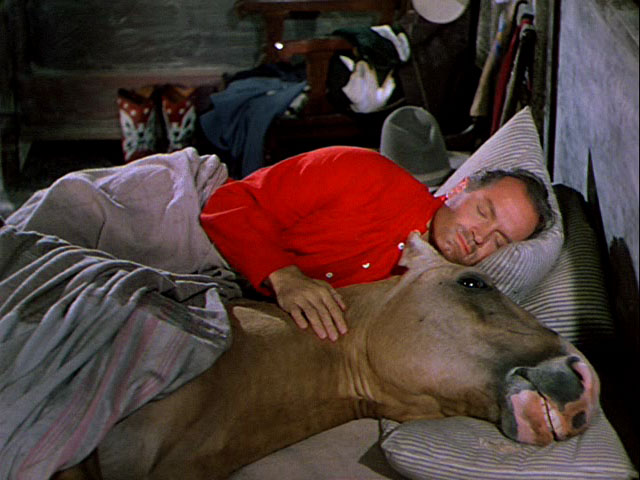
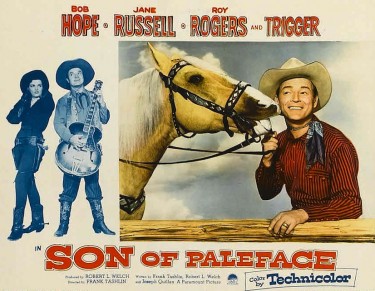
Son Of Paleface (1952) — directed by Frank Tashlin and co-starring Jane Russell and Roy Rogers (and Trigger, seen here) — is not only one of the best Western spoofs, but also it must be a strong contender for Funniest Movie Ever Made.

The original “Paleface” feature was pretty good, but this sequel is actually better, in large part due to the addition of Roy Rogers and Trigger. Rogers and Bob Hope are two of the most likeable performers that the movies have seen, and together they seem like old friends who have stopped by for an enjoyable visit. Jane Russell is also back from the original movie, though in a different role.
The story is good fun as long as you don’t take it seriously. It’s actually rather well-written, in that it accommodates all three stars with material well-suited for them.


Bob Hope gets plenty of one-liners and similar gags, and he pulls off even the goofiest of them with energy and aplomb.  Roy Rogers gets the chance to do some singing and to have some action sequences, and Trigger gets several good moments. Jane Russell is given a character that allows her to stay within the role of the tough, glowering beauty.
There are enough connections to the first movie to add to the enjoyment if you have seen it, but “Son of Paleface” could also easily stand on its own, and in fact overall it is probably the better film.

Towards the end of the film, is a chase with Bob Hope in the covered wagon, resulting in this great matte shot of the wagon careering along very close to a cliff edge – I love this shot –  above.   Maybe not the best matte in the world but pretty effective on screen.


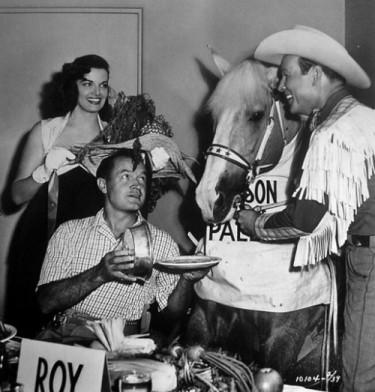
Another great picture – above – shows Roy Rogers and Bob Hope with Trigger and Jane Russell laughing along in the background.


posted by Movieman in Uncategorized and have Comment (1)

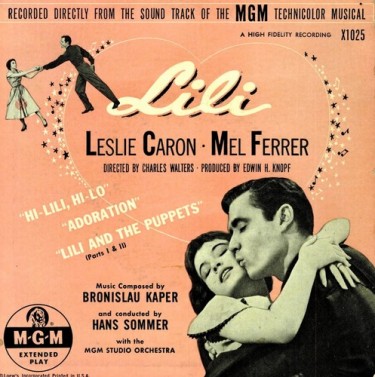
Lili 1953 with Leslie Caron

What a gem of a film this is – and so colourful. Showing my age a little now, I remember in the early days of British Colour Television I was out with friends at a local pub and showing on this NEW Colour TV was this film ‘Lili’ and that memory still remains with me to this day purely because of the  bright colour – actually on a TV screen !!!   That seemed miraculous after all the TV years in Black and White – although I have to say television was very good in those days too. This film though was perfect to show off colour – and still is I think.

The film was released in 1953.

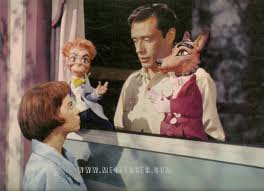
An absolutely perfect little film, “Lili” is probably Mel Ferrer’s best known movie role. He plays ex-dancer and crippled puppeteer Paul Bertholet opposite Leslie Caron in one of her most famous roles as the titled heroine. A musical fantasy based on a short story by Paul Gallico, Lili is a 16-year-old orphan left unexpectedly alone in a harsh world. She attaches herself to a glamorous magician called Marcus the Magnificent (played with just the right touch of shallow charm and careless concern by Jean-Pierre Aumont) and guilelessly follows him back to the carnival where he performs. When Marc’s half-hearted attempt to get her a job proves disastrous, the destitute Lili contemplates suicide, but the lame puppeteer Paul – who’s been watching from afar – uses one of his puppets to lure her back to safety and straight into his impenetrable heart.

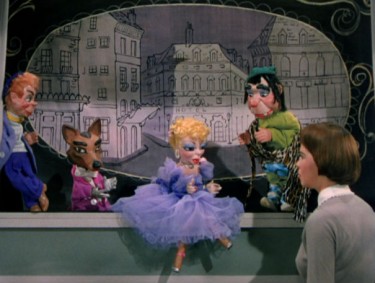
Paul hires Lili to be part of his act and the new show, which features Lili interacting with his four puppets, becomes an overwhelming success. But Paul is too bitter and jealous to express his love for Lili except through the puppets, and after a particularly ugly argument with him, Lili decides to leave the show. Miles away from the carnival, she daydreams that her only true friends –  the four puppets – are walking beside her. As she dances with each of them, they transform one by one into their puppeteer, and she understands at last that the puppets who love her are in fact Paul.

Much of the charm of Lili rests with the casting of the film and Charles Walters’ crystal clear conception of the fantasy that borders on reality. Lili’s dreams are expressed in dance sequences, immaculately choreographed by Walters.  Ex-ballerina Leslie Caron is still as much dancer as actress in 1953, and both her male co-stars have enough dance in their backgrounds to be effective. Mel Ferrer in particular brings elegance and musical style to the final ballet sequence.

This film was a huge hit for MGM, adored equally by critics and the public, and receiving Academy Award nominations for Leslie Caron in the leading role, director Charles Walters, a nomination for the film itself and most significantly an Oscar win for the enormously popular song used throughout, “Hi Lili,” written by Bronislau Kaper.


 The song was sung in the film by Leslie Caron as Lili and Mel Ferrer as the puppet Carrottop, and residuals from sales of released recordings still accrue, indicating how much the music continues to be loved. Variations on the tune were used effectively for the final ballet sequence, as well.

While many reviews indicate the film belongs to Leslie Caron, who is truly inspired as the sweetly innocent Lili, the success of the film owes as much to the ensemble cast. It’s difficult to imagine any of the roles with other actors. The final ballet owes much to Mel Ferrer’s dance background, but his radio experience and fluent language skills also helped him create the unique characters of the four puppets, all of whom were voiced by the actor. And the surly Paul with his tortured romantic soul suited him perfectly. After 50 years, it’s still the role for which Mel Ferrer is best known, a true tribute to his part in this flawless gem.

Ironically – given the film’s enormous success – “Lili” was to become Mel Ferrer’s final starring role in a movie made in Hollywood. Although he co-starred in two more movies for MGM they were filmed overseas, and it was while shooting “Knights of the Round Table” in England that he met Audrey Hepburn. After their marriage in 1954 he lived and worked predominantly in Europe, never really capitalising on his biggest cinema triumph. “Lili” played a pivotal part in their romance, however. Apparently Miss Hepburn fell in love with Paul Bertholet before ever meeting Mel Ferrer and it prompted her to ask Gregory Peck to introduce her to him during the summer of 1953 while all three were in London.  Less than a year later Mel Ferrer was seated next to Audrey Hepburn when her name was announced instead of Leslie Caron’s for the coveted Oscar.

Leslie Caron (b. 1931) was the star of this film.  She was 22 years old when it was made, playing a 16 year old girl.  Her first film was An American in Paris (1951) with Gene Kelly (1912 – 1996) and is certainly the film she is most remembered for.  Lili was her fifth film.

Lili had in it many of those 1950s actors and actresses that nobody remembers. It also included Zsa Zsa Gabor (b. 1917) as a magician’s assistant, also in her fifth film but this was very much a bit part.
For Mel Ferrer (1917 – 2008)  Lili was his seventh film.  Look for him in later hits; The Longest Day (1962), Sex and the Single Girl (1964), and on TV in “Falcon Crest.”
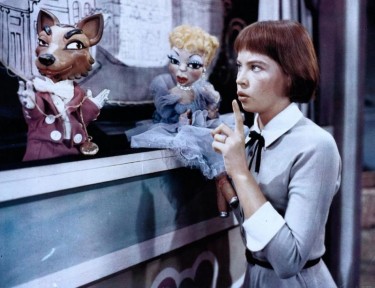
Leslie Caron – above – seen interacting with the puppets, who come alive for her and for the viewers.
I am also copying in this review from the IMDB site which I thought was a good one:-
‘Lili’ opens in the bright atmosphere of a French town with a likeable 16-year-old orphan looking for a job with her deceased father’s old friend… Lili soon discovers that the place is close and the baker with whom she came to work with has died a month ago…
With no money, no family, and no place to go, Lili meets Marc, a delightful entertainer who offers her a job as a waitress in a traveling carnival show…
Marc’s hilarious blend of comedy and magic leaves the wistful Lili roaring with laughter… Marc is breathtakingly good on stage… He is blessed with the fastest hands in the business… Lili is fired, that same night, for spending too much time watching his whole act…
Feeling intensely sad, hopeless, drained and helpless, Lili thinks of killing herself… She begins to climb a highly wooden staircase, ignoring a gently voice calling her to come along… She is distracted by a group of character puppets, who helps her forget her sorrow…
Lili is introduced to Carrot Top, the interesting fellow capable of running his life and everybody else; to Golo, the cowardly giant longing to be loved; to Reynaldo, the thief and opportunist full of compromises and lies; and finally to Marguerite, the vain, jealous beauty obsessed with self…
Childishly happy with the colourful puppets, and not realising that she is having a big impact, Lili receives the ovation that ignites her creative spark, responding to the four unique puppets losing herself in their questions and imaginations…
When she is asked to sing, Lili belts out an old song of love… The entire company of puppets behind her joined in for a stirring chorus… This was executed to perfection that night – accompanied by the waltzing music of the accordion…
The show is a hit! Lili’s childish manner proves she can entertain, persuade and appeal…
But Lili remains dazzled by Marc, who reinforces his spoken humor with visual effects… She dislikes the boss, Paul Berthalet, believing him to be cruel, heartless, frustrated and always angry…
Mel Ferrer had the talent for improvisation… He uses his puppets with humor, voice sound effects, stories and more…He captures Lili’s heart and soul… And by speaking through his models he was able to express his anxiety, curiosity, austerity, and confusion…
Lili, touched by the magic of romance, comes to understand the meaning of love much later… She tells Marcus: ‘I’ve been living in a dream like a little girl, not seeing what I didn’t want to see.’ She discovers that the love exuding from her adorable puppets comes from the loves of that unreasonable, mean, jealous, bitter puppeteer…
Jean-Pierre Aumont adds his charm to the whole story, and remains the beautiful magician armed with an exceptionally likable stage personality…
Kurt Kaszner continues to be Paul’s loyal and peaceful friend who explains to the delicate girl that the boss had once been a great dancer until his leg was injured in the war and could no longer dance…
Zsa Zsa Gabor behaves as the glamorous assistant whose fervent desire is to reveal to everybody her secret…
Charles Walters’ motion picture is not very musical, but his film culminates in a delightful dream ballet… Caron demonstrates a graceful dancing…
The movie received six Academy Award nominations including Leslie Caron as Best Actress in a Leading Role, and won the Best Music, Scoring of a Dramatic or Comedy Picture, and accommodated the hit song “Hi Lili, Hi Lo.’
posted by Movieman in Uncategorized and have Comments (2)

Star Trek Into Darkness

Well this is of course a new 2013 film but the Star Trek series both TV and film have conections with the fifties film era.

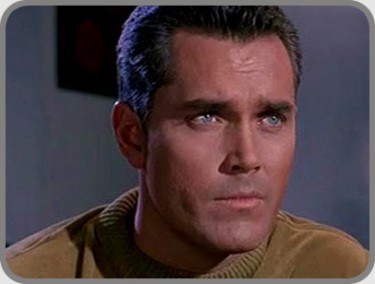
Originally Jeffrey Hunter who had quite a career in films throughout the fifties, had taken the lead in the famous TV series.


He was “Christopher Pike”, captain of the U.S.S. Enterprise, in the original “Star Trek” pilot in 1964. However, when an undecided NBC requested a second pilot in early 1965, Hunter declined, having decided to concentrate on his film career, instead.  Producer Gene Roddenberry, after hearing the news, wrote to Hunter, “I am told you have decided not to go ahead with “Star Trek”. This has to be your own decision, of course, and I must respect it”, and then asked Hunter if he would come back for “one day or two of shooting an additional action opening which can result in a fast, tightly cut, exciting film release”.  However Hunter, who had a six-month exclusive contract for the series lead, declined that request, too.

Footage from the first pilot was later incorporated into a two-part episode in “Star Trek” (1966)’s first season. (Roddenberry later tried to give the impression that it was he who decided not to rehire Hunter for the second pilot. But as executive producer Herbert F. Solow pointed out, major casting decisions for the series were made by Desilu and NBC executives, not the producer).

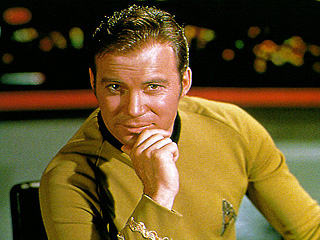
So the rest is – as they say – history and we then got William Shatner as Captain Kirk – and what a success he was in the role and in the series too.

This was a role he played on TV throughout the late fifties  –  and then after quite a while the films hit the big cinema screen to great success.

In 1961, Shatner had landed parts in two films, “The Intruder,” where he plays a rabble-rouser traveling from one Southern town to another, getting people to riot against court-ordered school integration. It was later released under the titles, “I Hate Your Guts!” and “Shame.” Shatner also appeared in “Judgment at Nuremberg.”
Then came the role for which he is undoubtedly best known: Captain James T. Kirk on Star Trek.   Unfortunately, during the three years that Star Trek series ran, Shatner not only separated from his wife, but lost his father, as well.
Following the cancellation of Star Trek on NBC in 1969, Shatner went on to star in seven Star Trek films, make appearances in countless television series (including several long-running non-Star Trek series in which he played a leading role—TJ Hooker and Rescue 911, among them).  Over the years, the actor’s self-assertive sense of humor has come to define his career, and even translated into the personality of his Emmy Award-winning character, Attorney Denny Crane, of The Practice and Boston Legal. He also made such films as “Sole Survivor,” and the Sherlock Holmes classic, “The Hound of the Baskervilles.” Guest appearances on series like The Sixth Sense, Barnaby Jones, and Hawaii Five-O kept him in the public eye.  In addition, Shatner has written numerous fiction and non-fiction books in and out of the Star Trek vein.

Star Trek Into Darkness 2013  – and this time in 3D.


The Review below is a really good one :-

Truly spectacular, one of those rare amazing, inventive and often unpredictable blockbusters. The acting was great all round, especially Cumberbatch – who was superb. The direction, cinematography and visual effects were all greatly innovative and brilliant; the screenplay fun, often humorous and has a lot of heart for all its characters which are all really well developed.
The villain was very interesting and the development, dialogue and motivations of his character were very convincing and inventive, Cumberbatch’s fantastic acting greatly helped bring this character to life. Also the way he executed his plan showed a lot more cutting edge creativity than especially most modern blockbusters, not to say it’s done nearly to the same level of genius but something I haven’t felt in a villain’s characterisation/acting since The Dark Knight.
Overall, a mesmerising film with nice homages to the original series, one filled with heart, grace, innovation, superb characters and acting and some impressive, clever visuals and immersive 3D. Up there with the 2009 one, not sure which I prefer, possibly the previous one largely due to the more clever story, despite this one having a much better villain, still not sure though. Still a very strongly recommended film.

and also this review I have seen :-

The previous Star Trek movie is a tough one to beat. It was close to perfection (lens flares and all). So this movie had a tough up-hill battle ahead of it. I am happy to report that the writing, direction, cinematography and acting were all at least as good as the last one.
Cumberbatch is brilliant. I won’t divulge any spoilers, but I will say that the throw back to the earlier movies is very very clever and well executed. It is hard to find fault with this movie, particularly as it had very big shoes to fill. But it does so brilliant and effortlessly. The added depth we see in the characters of Kirk and Spock is icing on an already delicious cake!
Well done JJ, producers, actors, writers and musicians. This is one of the very few movies I have ever given full marks, and deservedly so.

Now view the trailer :-

https://www.youtube.com/watch?feature=player_detailpage&v=yhz4A5BCMAA


posted by Movieman in Uncategorized and have Comments (5)

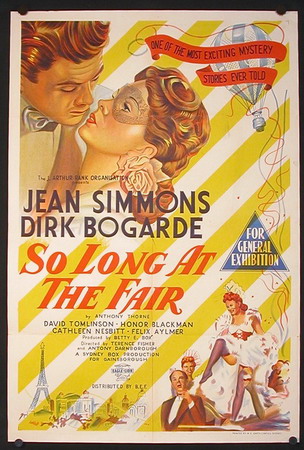
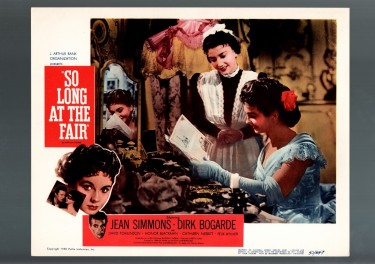
So Long at the Fair – 1950

I remember watching this with my daughter Joanna, a number of years ago and neither of  us knew the storyline at all, so we were completely baffled by the way things developed and we could not work out how and what the conclusion would be. It seemed very sinister but everything fell into place at the end. Great film though and a terrific story.

I really like this film and love the story !!!


It took two directors, Antony Darnborough and Terence Fisher, to create SO LONG AT THE FAIR in 1950.  This romantic mystery starred Jean Simmons, Dirk Bogarde, Honor Blackman, and David Tomlinson.  Jean Simmons looked stunning as a visitor to Paris searching for her missing brother. It really was a mystery because he had just simply disappeared and no-one in the hotel seemed to remember that he had ever been there.

So Long At The Fair – The Story.  – Dont worry we don’t give away the ending !!!

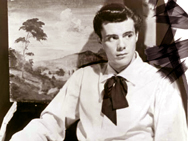
Vicky Barton (Jean Simmons) and her brother Johnny (David Tomlinson) arrive in Paris to attend the Great Exhibition of 1889 and enjoy a night on the town before returning to separate rooms at their hotel. The following morning Vicky discovers her brother is missing. Not only is there no record of his registration at the front desk but his room doesn’t exist either. No one on the hotel staff recalls ever seeing him and in desperation Vicky goes to both the British consul and the local police chief but neither one believes her story. Determined to unravel the mystery of her brother’s disappearance, Vicky enlists the help of a sympathetic stranger, British artist George Hathaway (Dirk Bogarde), and their valiant efforts eventually uncover the truth. Based on a novel by Anthony Thorne, So Long at the Fair (1950) has a premise that bears similarities with Alfred Hitchcock’s The Lady Vanishes (1938) but also looks forward to the “missing person” plot devices of Bunny Lake Is Missing (1965), Flightplan (2005) and other suspense films. Though leisurely paced, the intriguing narrative holds one’s interest through the unexpected but plausible resolution and the authentic period detail, lavish art direction and impeccable performances by the main principals help suspend disbelief. The directorial duties were shared by Antony Darnborough and Terence Fisher who displayed  who would eventually attain cult status for his stylish period horror films for Hammer Studios such as Horror of Dracula [1958], The Mummy [1959] and The Curse of the Werewolf [1961]. Both Jean Simmons and Dirk Bogarde were rising young stars in the British film industry when they appeared in So Long at the Fair. Bogarde, who was in danger of being typecast as a hoodlum after his two previous films (Boys in Brown [1949], The Blue Lamp [1950]), remarked in an interview at the time: “…personally, I’m a little tired of spivs  wide boys and junior crooks, however they come and in whatever period. I found So Long at the Fair a refreshing change after all these excursions into the shady nooks of petty crooks. For once I wasn’t sharp and sly, or imbued with the reckless daring which springs from cowardice.”
Bogarde and Simmons had never appeared in a film together before (and never would again) but they enjoyed a close working relationship on So Long at the Fair. Bogarde recalled, ‘Jean is about the sweetest girl you could wish to meet and all you read about her being natural and unsophisticated is absolutely true. She has a great sense of fun, and one of these days I would like to do a comedy with her.’ Simmons was equally complimentary saying, “He was such fun – a great giggler. I loved Dirk, and was hoping that perhaps we would be married one day; but I was dreaming, I was fantasising…I never really knew him. I didn’t realise he was gay – in those days people didn’t talk about it.” In another interview, Bogarde confessed that he actually didn’t care for So Long at the Fair, adding “but I had to do it, and at that point, I was very much in love with Jean Simmons. Rank thought it was a great idea to encourage their two juvenile stars and we were given this film which was supposed to launch our engagement. Unfortunately, by the time the film was finished Jean had fallen in love with Stewart Granger, thereby ruining the publicity effort.” Regardless of Bogarde’s own opinion of So Long at the Fair, however, it did help advance his career. One of the film’s producers, Betty E. Box, was so impressed with Bogarde’s performance that she thought of him for the lead in Doctor in the House (1954), the romantic comedy that catapulted him to major stardom in England and led to numerous sequels, two of which also starred Bogarde (Doctor at Sea [1955], Doctor at Large [1957]).
The critical notices for So Long at the Fair were generally positive, with many noting that the incident that sets the plot in motion was inspired by a reputedly famous disappearance case which had taken on the mythic proportions of an urban myth. The New York Times also commented that directors Darnborough and Fisher “have chosen to have their cast speak quite a bit of dialogue in French, a circumstance which may confuse American audiences. But they have also taken the trouble to set that cast, charmingly attired in Victorian bustles and top hats, in authentically bustling, carefree  Parisian locales.”
Producer: Betty E. Box, Sydney Box, Vivian Cox Director: Antony Darnborough, Terence Fisher Screenplay: Hugh Mills, Anthony Thorne Cinematography: Reginald Wyer Film Editing: Gordon Hales Art Direction: Cedric Dawe Music: Benjamin Frankel Cast: Jean Simmons (Vicky Barton), Dirk Bogarde (George Hathaway), David Tomlinson (Johnny Barton), Marcel Poncin (Narcisse), Cathleen Nesbitt (Madame Herve), Honor Blackman (Rhoda O’Donovan). BW-86m.
posted by Movieman in Uncategorized and have Comment (1)

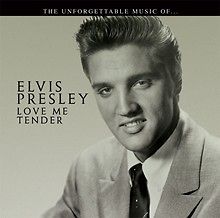
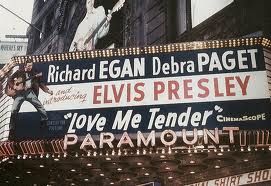
Elvis – Love Me Tender 1957

Elvis Presley’s first film. This is the only film he made where he didn’t get Star Billing – he played second fiddle to Richard Egan and Debra Paget.

After watching  Elvis Presley’s debut film in its entirety and in widescreen, and I think it’s a good deal better than it’s usually given credit for. Richard Egan plays Vance Reno, who is serving in the Civil War and returns home after the war ends to join his family and reunite with his lover (Debra Paget). But a tragedy ensues when it’s learned that while he was away, his young brother Clint (Elvis) fell in love with and married his girl, after hearing that Vance had died. Also factoring into the trouble is that Vance has kept some Union cash which he never delivered to its destination when he found out the war had ended in the interim.

This turned out to be a good, solid story with fine performances, especially by Richard Egan. But again, Elvis is very good as a completely first-time novice actor. He always wanted to be on the big screen from youth, after admiring James Dean, Marlon Brando and Tony Curtis. For a film fan who never had any professional acting training or experience, he’s really quite good as Clint Reno. Though he didn’t want to sing in this film, Presley was already a big recording star so of course there had to be songs in the movie. The title tune is a classic and it’s very emotional as performed within the context of the film. I also like the singalong ditty “We’re Gonna Move”, which is performed by Elvis on the front porch “1950s-style” with his family, even though it’s 1865. Other songs include “Let Me” and “Poor Boy”.

posted by Movieman in Uncategorized and have No Comments

Rosalyn Boulter – Wonder who remembers this actress

Sunny and self-assured, Rosalyn Boulter seems an unlikely lady of mystery. She is the perfect no-nonsense foil for George Formby in his final film, George in Civvy Street in 1946.
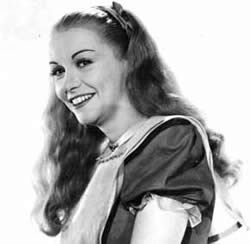
Rosalyn plays Mary Colton, George’s childhood sweetheart. When George returns from the war, he finds that both he and Mary have inherited their fathers’ rival pubs. She owns (but is too young to run) the Lion, across a canal from George’s Unicorn. We may wonder, of course, where she got her posh accent in a Lancashire village, but the fair-haired, feisty Mary is more than a match for the requisite villain who seeks her inheritance, her hand, and George’s downfall.
When she learns of the villainy afoot and tries to warn George, Mary is locked up. No shy violet, she overpowers her jailer, swims the canal, and even strips to her undies (or less) behind a convenient blanket. To balance all this athletic eroticism, she then appears as a demure Alice in Wonderland to George’s Mad March Hare in a dream sequence. A dynamic post-war woman played by an actress of considerable talent!
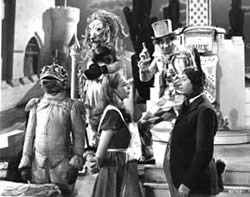
                 George sings ‘It’ll Make you Madder than the Mad March Hare’

Fair-haired Rosalyn Boulter was born in Burton-on-Trent, Staffordshire, on February 1, 1916, the daughter of Arthur Edward Boulter and his wife, Lillian (Douthwaite). Rosalyn attended the North Middlesex School and then studied for the stage at the Central School of Speech Training and Dramatic Art under Elsie Fogerty.


Her first professional appearance was at age 19 at the Arts Theatre Club on June 11, 1935, playing Lady Clive in Clive of India. That summer she had important roles in A Midsummer Night’s Dream (as Hermia) and Love’s Labour’s Lost at the Regents Park Open Air Theatre. (The following summer she returned for As You Like It and The Tempest.)


Her career took off quickly, bringing both stage and film roles. She was featured in 4 West End productions in 1935 and 1936. Her first 2 film roles, a romantic comedy called Love at Sea (1936) and Holiday’s End (1937), a thriller, gave her top billing. In 1937, she toured the U.K. and made her Broadway debut, playing the ingenue lead in the West End hit George and Martha.

Rosalyn married Stanley Haynes, a film writer, director, producer, and, according to one friend, “charming philanderer.” They had a daughter, Carol, in 1942 or 1943. Rosalyn remained active in films during this time, appearing in 1942 with Leslie Howard, David Niven, and Anne Firth (another Formby leading lady) in The First of the Few (aka Spitfire), a stirring biography of R.J. Mitchell, designer of the Spitfire airplane. In 1943, she made two wartime propaganda films, The Gentle Sex, about women doing war work, and Rhythm Serenade, a Vera Lynn vehicle.

Back in the West End, she starred with Barry Morse in The Assassin in 1945. A fellow performer recalls impressing his girlfriend by taking her to the splendid opening night party at the Savoy which was attended by Noël Coward and other celebrities. There, the young lady was introduced to Boulter’s husband, Stanley Haynes, and “two weeks later, he buggered off with my girlfriend!” Apparently, this marked the end of Boulter’s first marriage. Devastated, she remained with her daughter Carol in the family home at 2 Gloucester Walk in Kensington, London, getting emotional support from friends that included Marcel Varnel (a Formby director) and fellow actors Derrick de Marney and Richard Neilson.

1946 represented both a peak in Rosalyn’s career and a major disappointment. Every actor knows how the right role at the right time can make a star. On stage, Rosalyn had scored a major triumph as the unscrupulous and faithless wife of a man driven to murder in Dear Murderer. However, the film, starring Eric Portman and Dennis Price, used Greta Gynt in Boulter’s role. Then her luck changed — or so she thought.
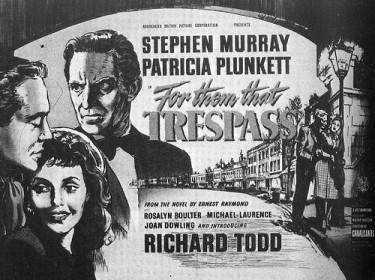
Rosalyn Boulter appeared in Richard Todd’s very first film ‘For Them That Trespass’ Directed by Alfredo Cavalcanti

She was cast in the key role of Burgess Meredith’s mistress in the film Mine Own Executioner. Unfortunately, Meredith’s wife, Paulette Goddard, was also in England, filming Oscar Wilde’s An Ideal Husband for Alexander Korda. Goddard decided that Rosalyn wasn’t sexy enough for the part and was instrumental in having her replaced by Korda’s current protegée, Christine Norden, a voluptuous green-eyed blonde who was playing Mrs. Marchmont in The Ideal Husband. Norden’s highly sensual performance as the mistress in Mine Own Executioner helped to establish her as the first postwar sex symbol of the British cinema, prior to the ascendancy of Diana Dors. So memorable was Norden’s performance that, after her death in 1988, part of the planet Venus was named for her!

Rosalyn was bitter about this loss for many years, feeling it blighted her career. Norden, aware of Boulter’s feelings, said in later years, “She blames me to this day, but I was under contract and simply did as I was told.”

On August 8, 1952 in London, Rosalyn married Joseph Sistrom, an American film producer (Double Indemnity, Botany Bay). A newspaper account described the happy couple accompanied by Rosalyn’s pretty, blonde daughter, Carol, then age 9. Rosalyn made only one more film, The Day They Gave Babies Away in 1959, and then her private life becomes something of a mystery.

According to one friend, she never remarried after Sistrom’s death in 1966. But another, actor Richard Neilson, recalls being introduced that year to Rosalyn’s husband William Dozier, “a prominent Hollywood producer with Universal….in a luxury high-rise in Greenwich Village. They later lived on a turkey ranch in Arizona.” William Dozier (1908-1991) was a Vice President at RKO Studios and later a CBS-TV executive.

“Ros was going on the road with some show,” recalls Neilson, “and I loaned her a rather beautiful — what we called in those far off days — wardrobe trunk, white leather, very posh. I had a few cards over the next months. Then Rosalyn — and my trunk — went out of my life.” (If indeed she did a U.S. road tour in the 1960s, this would indicate that Rosalyn remained active in the theatre well beyond Waggonload O’ Monkeys in 1951, her final, officially-logged U.K. stage appearance.)

Rosalyn Boulter died on March 6, 1997 in Santa Barbara, California. Her death certificate lists her Rosalyn Boulter Sistrom, indicating that either she never remarried after Joseph Sistrom’s death, or alternately, that she returned to his name after William Dozier’s death. To further muddle things, some sources recall that she married William Sistrom, a British film director (whose wives included Joan Fontaine and Ann Rutherford), but this clearly is not the case.  Perhaps a mental merging of Joseph Sistrom and William Dozier?

(The obituaries for neither William Sistrom nor William Dozier mention Rosalyn.)

Whatever her professional activities after her final film in 1959, Rosalyn Boulter deserves being remembered in the various biographical performing arts anthologies, both for her more than 20 years in show business with 12 films and 23+ stage appearances, and also for her obvious beauty and charm.

Real life, like reel life, can offer melodramatic twists and surprise endings.  Some of the George Formby leading ladies went on to well-documented fame. Others retired from performing, making it a challenge to locate them or find information about their later years.

One of the most elusive has been Rosalyn Boulter, who, despite extensive stage and screen credits, seemed to vanish when she left acting. No obituary has been found. Even a group of hardy scholars devoted to tracking the birth/marriage/death dates of obscure UK actors could not find a trace of her.
During several years of networking, I located two longtime Boulter friends. Both told me that Rosalyn Boulter had died “some years ago” in the United States — one thought in California, the other on a ranch in Arizona. They also differed on the name of her last husband. (Given the fallibility of human memory, it is a wonder that eyewitness testimony is ever permitted in court!)

Enter a recent boon for researchers: the on-line U.S. Social Security Death Index. As a matter of public record, it lists birth and death information for everyone with a U.S. Social Security number who has died since 1960. (Presumably earlier S.S. records will be added, back to its inception in 1933.) By checking maiden and all possible married names, I found that “Rosalyn Sistrom” died on March 6, 1997 in Santa Barbara, California. This was just 17 months before I was assured by good friends that she had been dead for a decade or two.

I sent for a copy of her probated will, another public document that could reveal the names and addresses of relatives or friends. However, another mini-mystery: her will wasn’t probated in the county where she died. Nor have I been able to determine if her daughter Carol (who would now be about 58) is still alive.

A poignant and probably fanciful explanation has occurred to me. Did Rosalyn suffer a stroke or incapacitating illness and enter a nursing facility several decades ago? Did her east-coast friends, having their Christmas cards returned and discovering her phone disconnected, decide that she must have died? And did she spend her final years alone and cut off from her old friends until her death in 1997? Or is there a simpler and less melodramatic explanation, such as a failure of the post office to forward letters?

Carol Haynes, if you are out there, we would love to know more about your lovely mother’s life after she left the spotlight.

POSTSCRIPT:

In the Spring, 2001 Vellum profile of Rosalyn Boulter, George’s sunny leading lady in George In Civvy Street, 1946, much of Rosalyn’s later life had evaded the author’s research efforts, making her something of a mystery lady.” But once the article was posted on the George Formby Society web site, a genealogical researcher in East Suffolk, Denis Sistrom, contacted the GFS to correct some errors [See Letters] and to put us in touch with Carol Johnson, Rosalyn’s only daughter. Here is a follow-up interview with Carol about the post-1952 life of her mother, Rosalyn Boulter.

Carol Haynes Johnson is the daughter of Rosalyn and film director-writer-producer Stanley Haynes. Their marriage broke up when Carol was quite young. “Daddy came into our lives when I was about 4,” she recalls,
referring to her step-father William Sistrom. “He was gentle, loving, giving. I always called him ‘Daddy.'”

Rosalyn married her second husband, William “Billy” Sistrom, in London on August 8, 1952 when Carol was 8. Sistrom was 68, Rosalyn 36. (Some newspaper accounts confused English-born William with his American-born sons, William and Joseph. Rosalyn’s Vellum profile erroneously reported that the groom was Joseph.)
As a child, Carol played with Jeremy and Jennifer Hanley, children of Dinah Sheridan (leading lady of Get Cracking) and actor Jimmy Hanley. Carol has a  wonderful photo of the 3 of them watching their parents on stage.

Billy Sistrom had produced 30 UK and US films between 1930 and 1949, including Dangerous Moonlight, A Dog Of Flanders, and Hungry Hill. After the marriage, he retired, and the family moved to Phoenix, Arizona. “It’s a dreadful memory for me, such a contrast between the desert of Phoenix and the green of England,” recalls Carol. Billy Sistrom managed a turkey ranch in Buckeye, about 40 miles outside the city.

Rosalyn worked with the Phoenix Little Theater, directing, acting, and producing 4 or 5 shows a year. She starred in a highly acclaimed production of Johnny Belinda for which she learned American sign language. The group frequently presented Shakespearean plays, and Rosalyn appeared in Othello (as Desdemona), Hamlet (as Ophelia), and Macbeth (as Lady MacBeth) — an extraordinary range for any one actress.

“The joke in the family to this day,” says Carol, “is that I have never read Shakespeare. Whenever a play was assigned in school, I’d ask mother to do it on stage so I could watch her do it and then report on it. I loved watching the plays, but not reading them. Which is odd because I’m a voracious reader.”

Carol appeared on stage only once as a child, a small role in a Phoenix Little Theatre production The Remarkable Mr. Pennypacker. She was not tempted to seek an acting career: “When you’ve watched perfection like my mother, it’s very intimidating.”

The “extraordinarily happy” couple had often talked of moving to Santa Barbara on the coast of California. Then Billy Sistrom died in 1972 in Arizona at the age of 88. Carol had already married Bill Johnson (“who also loves animals”) and moved to Texas. (They now live in Louisiana. Carol has a granddaughter and 3 grandsons.)
In 1975, Rosalyn made the move alone to Santa Barbara. “Mother was extraordinarily happy there,” recalls Carol. “She lived near the beach in a lovely home and had lots of friends.” Rosalyn got involved with the Lobero Theatre, connected to the University of California, Santa Barbara. She soon switched over from acting to behind-the-scenes activities. She was very active in fund raising and did benefits with people like Vincent Price, Dame Judith Anderson, Robert Mitchum, Jane Russell, and Jimmy Stewart.

Above – Lobero Theatre  Santa Barbara

Nearing the age of 80, Rosalyn developed macular degeneration which caused her eyesight to fail. Carol came to stay with her during the final 9 months of her life. “I’m so grateful that we had that time together.” Rosalyn went into the hospital for a fairly routine surgical procedure to remove plaque from an artery. The next day, she was chatting cheerfully with a dear friend when she collapsed unexpectedly and died of a blood clot.

A memorial service was held at the Lobero Theatre, attended by many of the celebrated performers she had known and worked with over the years. At the end of the service, actress Anne Francis stood and said, “Let’s give a hand for this great lady.” Everyone rose and gave a round of applause.

Carol recalls that her mother “had a fantastic sense of humour and loved to laugh. She was an incredible woman, very loving, very kind. She is terribly missed.” Eleanor Knowles Dugan




posted by Movieman in Uncategorized and have Comment (1)

Roy Rogers – King of Cowboys

Now we turn to a very well known star of film and TV of course  Roy Rogers, popular to kids of the fifties and before mainly because of his  comics – certainly in England that is – and the films he made of which there are many.

Most of his films were 60 or 70 minute B features but as you will see below he made a very good living from them. However in 1952 he shared star billing with Bob Hope and Jane Russell in the brilliant ‘SON OF PALEFACE’


Roy Rogers, born Leonard Franklin Slye (November 5, 1911 – July 6, 1998) inCincinnati, Ohio and  moved to California to become a singer. He quickly formed a Western cowboy music group called the Sons of the Pioneers with Bob Nolan and Tim Spencer and in 1934 the group hit it big with songs like “Cool Water” and “Tumbling Tumbleweeds”. He made his first film appearance in 1935 and worked steadily in western films including a large supporting role as a singing cowboy while still billed as Leonard Slye. In 1938 Gene Autry temporarily walked out on his movie contract  and needing someone to quickly replace him Republic Pictures decided on a name change and Leonard Slye was  rechristened “Roy Rogers”  and he then took  the lead in Under Western Stars.

What a break that was because quite quickly he became a matinee idol and American legend. He was then a competitor for Gene Autry as the nation’s favourite singing cowboy.

In addition to his own movies, Rogers played a supporting role in the John Wayne classic Dark Command (1940). Rogers became a major box office attraction.

Roy Rogers in The Carson City Kid

In the Motion Picture Herald Top Ten Money-Making Western Stars poll, Rogers was listed for 15 consecutive years from 1939 to 1954, holding first place from 1943 to 1954. He appeared in the similar Box Office poll from 1938 to 1955, holding first place from 1943 to 1952. (In the final three years of that poll he was second only to Randolph Scott.)  Although these two polls are really an indication only of the popularity of series stars, Rogers also appeared in the Top Ten Money Makers Poll of all films in 1945 and 1946.

Rogers was an idol for many children through his films and television shows. Most of his postwar films were in Trucolor during an era when almost all other B westerns were black-and-white.

With money from not only Rogers’ films but his own public appearances going to Republic Pictures, Rogers brought a clause into a 1940 contract with the studio where he would have the right to his likeness, voice and name for merchandising. There were Roy Rogers action figures, cowboy adventure novels, and playsets, as well as a comic strip, a long-lived Dell Comics comic book series (Roy Rogers Comics) and a variety of marketing successes. Roy Rogers was second only to Walt Disney in the amount of items featuring his name. The Sons of the Pioneers continued their popularity, and they have never stopped performing from the time Rogers started the group, replacing members as they retired or passed away (all original members are deceased). Although Rogers was no longer an active member, they often appeared as Rogers’ backup group in films, radio, and television, and Rogers would occasionally appear with them in performances up until his death. In August 1950, Evans and Rogers had a daughter, Robin Elizabeth, who had Down Syndrome and died of complications with mumps shortly before her second birthday. Evans wrote about losing their daughter in her book Angel Unaware.

Above – Roy Rogers and the Sons of the Pioneers in the film   Rainbow Over Texas

Rogers and Evans were also well known as advocates for adoption and as founders and operators of children’s charities. They adopted several children. Both were outspoken Christians. In Apple Valley, California, where they made their home, numerous streets and highways as well as civic buildings have been named after them in recognition of their efforts on behalf of homeless and handicapped children.

Rogers and Evans’s famous theme song, “Happy Trails”, was written by Dale Evans; they sang it as a duet to sign off their television show. In the autumn of 1962, the couple co-hosted a comedy-western-variety program, The Roy Rogers and Dale Evans Show  but it wascancelled after three months. Rogers also owned a Hollywood production company which handled his own series as well as others..

Roy Rogers and Dale Evans at the 61st Academy Awards in 1989


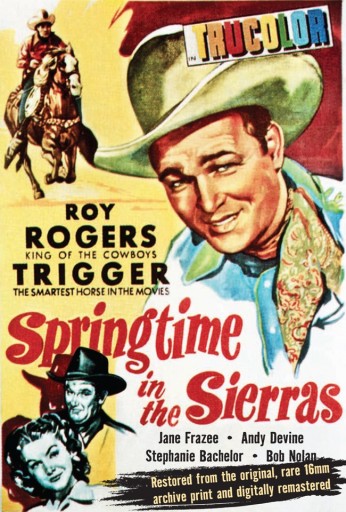
Below is one of the many films that Roy Rogers starred in in the late fifties – available now on DVD from the original Trucolor print :-


Directed by William Witney Associate Producer: Edward J. White Original Screen Play by A. Sloan Nibley Director Of Photography: Jack Marta

CAST: Roy Rogers, Trigger, Jane Frazee (Taffy Baker), Andy Devine (Cookie Bullfincher), Stephanie Bachelor (Jean Loring), Roy Barcroft (Matt Wilkes), Chester Conklin (Old Timer) and Bob Nolan and The Sons of the Pioneers.

————————————————————————————

For whatever crazy reason Republic Pictures saw fit to cut the Trucolor Roy Rogers films to a TV-friendly 54 minutes from running times of around 67-75 minutes each and, of course, the TV prints were black and white. What’s worse, they cut the original negatives and tossed the “scraps” away so the story goes.

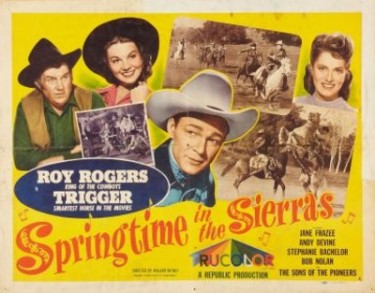
Tracking down the King Of The Cowboys’ Trucolor movies is a real challenge for DVD labels and collectors alike. So when another turns up uncut and actually in colour, it’s a real cause for celebration.    Such is the case with the recently-released Springtime In The Sierras  1947 from Film Chest. This has been transferred from an ultra-rare complete 16mm colour print


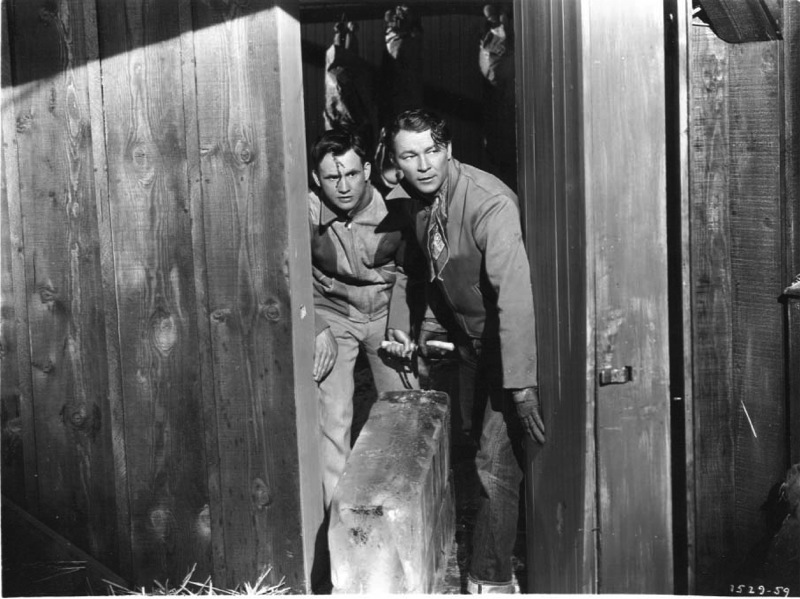
Roy Rogers is after a gang that’s slaughtering wild game illegally. There’s a lot of money in the meat, and these guys are willing to kill (both animals and people) to keep their operation going. Roy’s old friend Captain Foster (Harry V. Cheshire) is murdered, and Roy takes on the gang — with the usual Roy Rogers/William Witney mix of music, comedy and lots and lots of action. There are at least three fistfights, with one between Roy Rogers and Roy Barcroft taking place in a mammoth freezer full of slaughtered game. (Watching these later Rogers films, you have to remind yourself at times that these were aimed at kids.)

There’s plenty of singing, too, which is a real treat with Bob Nolan and the Sons Of The Pioneers on hand. Andy Devine provides his usual comic relief. Dale Evans isn’t around, but Jane Frazee is — and there’s Stephanie Bachelor as one of the deer-killing villains. Sloan Nibley wrote a number of the later Rogers films. This was one of his first, and it shows his flair for story (usually a somewhat oddball one) and gift for balancing the various elements that make up a Roy Rogers movie. Around the time Roy left Republic for TV, Nibley wrote a few good Western features (Carson City and Springfield Rifle, both 1952) before settling into a busy life as a television writer.

The stars here are Roy Rogers and director William Witney. Working together, they created a tough, lean, fast-paced series of films and  Witney’s under-cranked action scenes are incredible in Springtime In The Sierras, with a couple riding stunts that have to be seen to be believed.

So what does the DVD look like?  It’s a little soft, attributable to the 16mm material and the Trucolor process. (See picture left.) If you’ve seen Trucolor before (during this period when it was two-strip instead of three), you know what to expect. It’s a long way from Technicolor  though – because in colour terms that is about as good as it ever gets.

Film Chest has done us all a favour by releasing this one.

posted by Movieman in Uncategorized and have No Comments

Treasure Island 1950 – revisited

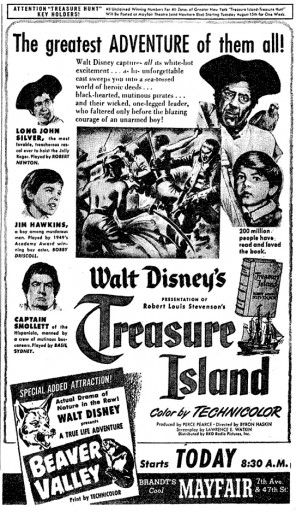
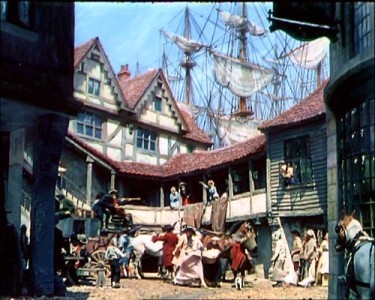
I make no apologies for returning to this classic Technicolor adventure film made by Walt Disney here in England at the famous Denham Film Studios. Even by todays standards this is still a very good film indeed and beautifully made in fabulous colour.

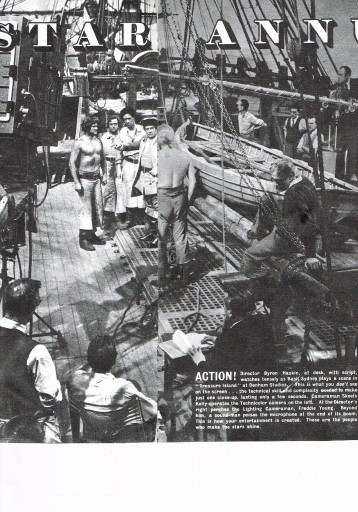
In the above picture, we see Byron Haskin the Director, sitting in the foreground with a book or script in his hand and to his right Award Winning Photographer Freddie Young as well as other technicians, and not forgetting the actors including Basil Sydney as Captain Smollett.


Above – This is not exactly the same scene but it is a colour still on board the ‘Hispaniola’

posted by Movieman in Uncategorized and have Comments (2)

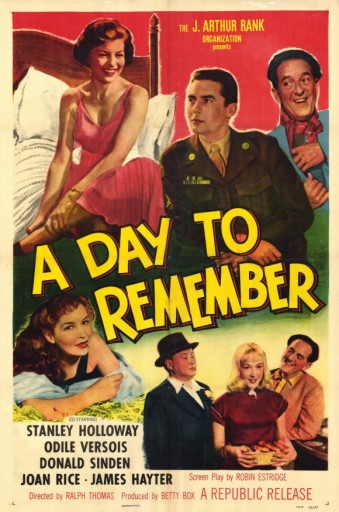
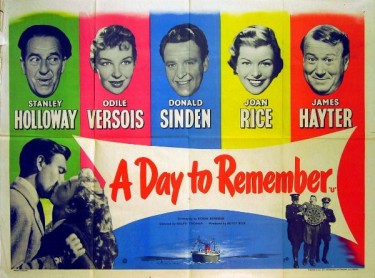
A Day To Remember 1953

On the eve of their visit to France the members of the Hand & Flower pub darts team gather for a drink. The day trip is being organised by one of their regulars who is a travel agent. For some of the team it is their first ever trip abroad, while for others it is the first time they have returned to France since the war. One of the team has developed a plan to buy watches in France and smuggle them back into Britain to sell at a profit. Another, Jim Carver ( Donald Sinden)  is going through a rocky patch with his fiancee, who he suspects considers him to be boring and plain.

The following day the group meet at London Victoria and catch the boat train to Boulogne. Once they have landed in France, despite the insistence of their unofficial leader the pub’s landlord that they stick together, Jim Carver departs to visit a farm where he had been involved in heavy fighting during 1944 when British troops had arrived to liberate France. He takes some flowers to the cemetery where his comrade is buried. He then meets a young woman, Martine (Odile Versois), who he first met eight years before, who invites him to have lunch with her family on the farm. They immediately strike up a chemistry, which his relationship with his fiancee in England lacks. However his newfound friend is also engaged to a local lawyer.

Back in the town, the rest of the group enjoy a lunch in a cafe and then break up into smaller groups to tour round the town. One goes to try to pick up his black market watches, another gets drunk and joins the foreign legion in spite of their efforts to stop him. One of the group becomes violent homesick despite having left England only hours before. After attempting to, and failing to retrieve their friend from service in the foreign legion the group begins to drift towards the docks and the ship that will carry them on their voyage home – and wonder what has happened to Carver who has been missing all day.

Carver has fallen in love with Martine, and she has broken up with Henri. However they argue and he heads for his ship without her. Unbeknownst to him, his fiancee in London has met and struck up a relationship with an American servicemen during a visit to Hampton Court. Carver seems to realise he is far better suited to Martine, and after he boards the ferry she drives hurriedly to dockside and shouts her true feelings for him. They agree to meet again soon when he returns to France.

I found this a totally delightful film. I have seen it several times and still love it.
It is particularly interesting because of the array of a galaxy of British talent. including  Joan Rice, James Hayter, Bill Owen, Stanley Holloway, Donald Sinden, Edward Chapman, Hary Fowler, Thora Hird and Brenda DE Banzie.
With such a wealth of talent this could never fail!  It is quite good fun and has recently been released on DVD.

posted by Movieman in Uncategorized and have Comment (1)