World 3 D Film Expo – Hollywood USA in September.

 Below just a sample of the 3D Films that will be shown at THE  EGYPTIAN THEATRE, Hollywood USA,  from September 6, 2013.

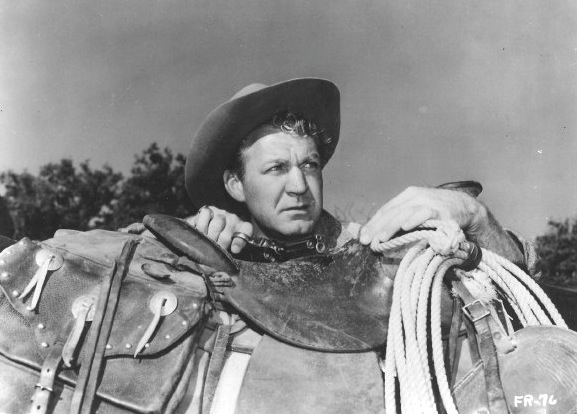
HONDO 1953 

HONDO - 1953, Batjac Prod., 83 min.
HONDO  1953, Batjac Prod., 83 min. Tribute to John Wayne & Batjac Productions CAST:  John Wayne, Geraldine Page, Ward Bond, James Arness. DIRECTOR:  John Farrow.
—————————————————————————————————————–
HOUSE OF WAX 

                     HOUSE OF WAX – 1953, Warner Bros., 90 min.


60th Anniversary Screening HOUSE OF WAX – 1953, Warner Bros., 90 min. CAST: VINCENT PRICE, PHYLLIS KIRK, FRANK LOVEJOY DIRECTED BY: ANDRE DE TOTH COLOR:
———————————————————————————————————

THE MAZE  –  as featured before on this Blog.

THE MAZE — 1953, Allied Artists (Paramount), 80 min.
THE MAZE — 1953, Allied Artists (Paramount), 80 min. CAST: RICHARD CARLSON, VERONICA HURST DIRECTED BY: WILLIAM CAMERON MENZIES COLOR: b/w VIEW TRAILER FORMAT:
————————————————————————————————————————–

BWANA DEVIL

BWANA DEVIL - 1952, U.A., 79 min.
BWANA DEVIL — 1952, U.A., 79 min. CAST: ROBERT STACK, BARBARA BRITTON, NIGEL BRUCE DIRECTED BY: ARCH OBOLER COLOR: color VIEW TRAILER FORMAT:  Dual 35mm

Welcome to 2013 World 3-D Film Expo

“Excitement That Can Almost Touch You!” … “Bwana Devil – A Lion in Your Lap – A Lover In Your Arms!” … “The Hand is at Your Throat — The Kiss is at Your Lips – House Of Wax!”

It’s been 60 years since 3-D literally leapt off American movie screens with films like CREATURE FROM THE BLACK LAGOON, KISS ME KATE, DIAL M FOR MURDER and IT CAME FROM OUTER SPACE.  Now, over half a century later, 3-D is back in the mainstream with a vengeance … and so is the World 3-D Film Expo!

3-D today may be technically different than the dual-35mm projector system of the early days – but whether you’re watching James Cameron’s AVATAR or Andre de Toth’s spine-tingling HOUSE OF WAX, there’s that same sense of childlike wonder and pure gonzo fun at watching images float/bounce/stab off the screen straight at you.  There’s no denying it:  3-D is Cool.

It is  kicking off with a special 60th Anniversary screening of the John Wayne western HONDO from 1953.

Also screening  classics like KISS ME KATE, HOUSE OF WAX, REVENGE OF THE CREATURE and IT CAME FROM OUTER SPACE, all in their original dual-interlocked projector format with a silver screen and polarized glassesalongside gems like the World 3-D Premieres of the Korean War drama DRAGONFLY SQUADRON (one of the last unseen 3-D features from the classic Fifties era) and the long-lost short “COLLEGE CAPERS” (restored from the only surviving print in existence.)   And let’s be honest:  3-D was never meant for a Chekov play, it was always best at pure genre filmmaking – and whether your taste is Gothic Horror (THE MAD MAGICIAN, THE MAZE), Film Noir (I THE JURY, INFERNO), Musicals (THE FRENCH LINE, THOSE REDHEADS FROM SEATTLE) or “What on Earth is That??!” (the indescribably deranged ROBOT MONSTER and GORILLA AT LARGE) — it’s here at the 3-D Expo.

Sadly, several of the 3-D features and shorts screened at the previous Expos are no longer available – yet another reason that Expo III is a once-in-a-lifetime event, because for many of the movies showing here, you literally will not see them projected this way again.  For the hardcore film-buffs, another reason not to miss the Expo is that we’ll be showing all of the features and shorts in their correct aspect ratio (many in widescreen); for the most part, these 3-D films have not been seen in their director-intended widescreen versions since their original theatrical play-dates nearly 60 years ago!

Hondo   3D screening


425010_408252855876758_1329021140_n

The third World 3-D Film Expo kicks off September 6, 2013 at the Egyptian Theatre, with a rare 3-D screening of Hondo (1954).  Above, that’s John Wayne on the ladder watching as a shot it being set up (that gigantic thing on the lift is the Warner Bros. All Media Camera).

Other 3-D Westerns being shown during the expo: Douglas Sirk’s Taza, Son Of Cochise and Budd Boetticher’s Wings Of The Hawk (both 1953). Julie Adams will be on hand for Wings Of The Hawk.

Who knows how many more 35mm 3-D presentations we can count on?

GRAUMANS EGYPTIAN THEATRE – Hollywood USA

The Egyptian Theatre was built by showman Sid Grauman and real estate developer Charles E. Toberman. The Egyptian Theatre cost $800,000 to build and took eighteen months to construct.

The Egyptian Theatre was the venue for the first-ever Hollywood premiere, Robin Hood,  starring Douglas Fairbanks, on Wednesday, October 18, 1922.

Grauman’s Egyptian Theatre exterior, 1922


Above:  The courtyard circa 2007

In 1996, the city of Los Angeles sold the theatre to the American Cinematheque for a nominal one dollar with the proviso that the landmark building be restored to its original grandeur and re-opened as a movie theatre. The Cinematheque committed to raising the funds to pay for the restoration and to using the renovated theatre as home for its programs of public film exhibition.

The Egyptian Theatre was re-opened to the public on December 4, 1998, after a $12.8 million renovation. The original theatre seated 1760  patrons in a single auditorium. In the restored Egyptian the building has been reconfigured to add a second screening theatre. The main theatre now accommodates 616 patrons. The smaller, 77-seat theatre is named for Hollywood  Steven Spielberg.


posted by Movieman in Uncategorized and have Comment (1)

The Ship That Died of Shame

Really good film this one.I never saw it on the big screen sadly but a number of years ago on TV. It is a good story – as you know it would be from the pen of Nicholas Monsarrat – and well filmed with a cast of top British Actors.  Richard Attenborough plays the heartless – and merciless – character who along with his pal from wartime days gets into smuggling – and worse.

George Baker is the good man here, his friend, who in the end just can’t take what is happening.

People these days when thinking of George Baker would come up  Inspector Wexford or another TV role but I think of him first in the swashbuckling ‘The Moonraker’ and then in this one – The Ship That Died of Shame

 The cast includes such actors as Virginia McKenna, Bernard Lee, and Roland Culver

The Storyline is concerned with the ship of the title  1087 which is a British Royal Navy motor gun boat that has faithfully seen its crew through the worst that World War II can throw at them and it has been a proud and heroic ship.   After the end of the war, George Hoskins (Richard Attenborough) convinces former skipper Bill Randall (George Baker) and Birdie (Bill Owen) to buy their beloved boat and use it for some harmless, minor smuggling of black market items like wine.

 They find themselves transporting ever more sinister cargoes – mainly because of the greed of Richard Attenborough –  counterfeit currency and weapons. Their beloved faithful craft had been utterly reliable and never let them down in wartime, but as if troubled by the work it is now doing,  it begins to break down , as if ashamed of its current use. The crew revolt when they are used in the escape of a child murderer.  At the close of the film George Baker realises that the ship just has had enough and realises she is dying of shame.


 Above – Bernard Lee ‘smells a rat’


This film is based on a Nicholas Monsarrat short story. It is brilliantly crafted and plots the downfall of two men – and the ship that served them faithfully through WWII. The logic of the tale is that the ship itself is so ashamed of the terrible things it is made to do that it “dies” despite the hard-headed sailor’s belief that this is impossible.

Earlier in 1955 (April, in fact), another of Ealing’s fascinating final films – the genre hybrid The Ship That Died of Shame – hit British screens. The ship in question is actually a Royal Navy motor gun boat. These were small, fast vessels, equipped with a mix of guns and big enough to carry a crew of up to 30 men. The Ship That Died of Shame follows the life of one boat, MGB1087, starting from the peak of its wartime glory, through to its postwar inactivity and its rebirth in a new role: a pattern that parallels the lives of its crew.

In a performance that compares well with his crazed delinquent, Pinky, in Brighton Rock (1947), Richard Attenborough gets his teeth into the role of 1087’s spivvish ‘number one’, George Hoskins. A star first mate, whose quick thinking and opportunistic instincts served him well in military life, Hoskins persuades his old skipper, Bill Randall (George Baker), to rescue their derelict former boat. They intend to fill a gap in the black market, pitched by Hoskins as a necessary and almost benevolent activity in a ration-weary Britain.

It’s here that The Ship That Died of Shame parts company with other British war movies, taking a sudden nosedive into murkier waters. The producer/director team of Michael Relph and Basil Dearden navigate into thriller territory as rival gangs, a nervous crew, the port authority and other parties with a stake in postwar dignity – including the boat herself – react to Hoskins and Randall’s new enterprise.

Mixing genres – war, crime, the supernatural – is a risky strategy, but it pays off here. The Ship That Died of Shame opposes the war film’s proud sense of propriety with the deviant cynicism of the crime film. In contrast with the optimism of many of Ealing’s postwar films – with their crowds pulling together; their defence of small communities against outsized corporations; the dreamlike vision of a new Britain forged in history but emboldened by progressive ambition – The Ship That Died of Shame reveals a darker side to the golden years of postwar reconstruction.

 Who’d have thought that the studio that gave us the giddy celebrations of George Formby, Passport to Pimlico (1949) and The Titfield Thunderbolt (1953) could sober us up with this tale of the sour taste of victory?

posted by Movieman in Uncategorized and have No Comments

The Blue Lagoon – Jean Simmons

Well I think this film just gets into the FIFTIES although it was actually  released here in England in 1949.  I have memories of the film – not so much about the film itself which I only saw on TV years later BUT my Mother and Dad bought me a jig-saw puzzle of a scene from the film – a scene in which  the two young people on the island are leaning  against an upturned boat on the beach. What an exotic scene that is.

Only recently have I managed to acquire all FOUR in the set, of the puzzles from the film – including the one mentioned.

 Jean Simmons in a beautiful colour shot from the film.

 Jig Saw Puzzle – Emmeline warns Michael above – which was No.4 in the series of four.

Original Film Still above

Another Original  Still from the film – above

Film Still from overseas – above – This picture would definitely be taken in Fiji !!!

Film Poster – above.

There will be more on this film in the future !!

posted by Movieman in Uncategorized and have No Comments

The Giant Claw – 1957 Columbia Pictures


The Giant Claw is a 1957 science fiction film about a giant bird that terrorises the world. Produced by Clover Productions it was released through Columbia Pictures and starred Jeff Morrow and Mara Corday. It was directed by Fred F. Sears.

It was summed up this way – ‘Arguably the worst sci-fi ever to emerge from a major studio.’

GiantClawmp.jpg

A giant extra-terrestrial buzzard with an anti-matter forcefield is terrorising the world, flying at intense speeds, downing vehicles in flight, chomping on parachuting innocents attempting to escape, and swooping down to cause death and destruction. It’s up to our brave government and scientists to figure out how to penetrate it’s forcefield so that the rockets and bullets we fire from our artillery can end it’s reign of terror for good. Directed by Fred F Sears.  Mitch MacAfee who works with the military to solve the crisis regarding the anti-matter forcefield, hopes to find a flaw, and create a weapon of some sort to remove this shield used to protect itself from invading hostile threats towards it’s body. Mara Corday is Sally, a mathematics genius and Mitch’s love-interest who helps keep him  focused. The giant killer bird swoops down to grab a moving locomotive train from it’s tracks, lands upon the United Nations building, smashing it to smithereens. Falling debris has city folk running for their lives.

 The killer bird has to be seen to be believed.


                                                                THE GIANT CLAW        HALF SHEET    1957 Original

The Giant Claw has been mocked for the quality of its special effects. The bird in particular is considered by many to be badly made, being a marionette puppet with a very odd face. The film is also riddled with stock footage, including clips of the explosion of the Los Angeles City Hall  from War of the Worlds and collapse of the Washington Monument  from Earth vs the Flying Saucers during the bird’s attack on New York City, making continuity a serious issue.


Morrow later confessed in an interview that no one in the film knew what the titular monster looked like until the film’s premiere. Morrow himself first saw the film in his hometown, and hearing the audience laugh every time the monster appeared on screen, he left the theater early, embarrassed that anyone there might recognise him (he allegedly went home and began drinking).

View the trailer  on this Link:                https://www.youtube.com/watch?v=hOj0nXpRqX8&feature=player_detailpage

However, despite all these shortcomings, James Rolfe of Cinemassacre named the Giant Claw as the number one greatest giant movie monster of all time due purely to the bird’s sheer ridiculousness.


Jeff Morrow.

Jeff Morrow turned to film acting relatively late in his career, commencing with the  The Robe in 1953. So he started with a big one.   He spent much of the 1950s appearing in a mix of A-budget epics in supporting parts, or ‘B’ Westerns such as The Siege at Red River (1954) and science fiction films , usually paired with a busty and beautiful actress.

Jeff Morrow carried over much of his acting persona from his radio days to his film acting roles, where his ability to rapidly alter both the tone and volume of his voice for dramatic effect frequently gave sound editors fits. He entered the science fiction/monster movie genre with the 1955 film This Island Earth, followed by The Creature Walks Among Us, The Giant Claw, and Kronos (1957).

                                                                    This Island Earth

Mara Corday – Below

Mara Corday (born Marilyn Joan Watts on January 3, 1930) is a showgirl, actress and model] and a 1950s cult figure probably because of the B movie films she made during the early part of the fifties.

 She signed on as a Universal International Pictures  contract player and there she met actor Clint Eastwood with whom she would remain lifelong friends. With UI, Corday was given small roles in various B-movies and television series. In 1954 on the set of Playgirl she met actor Richard Long. Following the death of Long’s wife, the two began dating and married in 1957.

Her roles were small until 1955 when she was cast opposite John Agar in Tarantula a Sci-Fi B-movie that proved a modest success (with Eastwood in an un-credited role). She had another successful co-starring role in that genre (The Black Scorpion) as well as in a number of Western films. Respected film critic Leonard Maltin said that Mara Corday had “more acting ability than she was permitted to exhibit.”


If someone mentions the names of Jeff Morrow and Mara Corday to me, I straight away think of such films as This Island Earth and Tarantula – and The Giant Claw for that matter – all of them products of a date and time. Such films could never be made now but they still hold a place in any genuine films fans heart I think. They were not that good but at the time – we loved them.

posted by Movieman in Uncategorized and have Comment (1)

Victor Mature – a few little anecdotes

In the book Richard Burton Prince of Players –  in the chapter “Lust and Life at 20th Century Fox”, there is this paragraph where the author recalls Richard Burton telling him that one of the pleasures of making The Robe was working with Victor Mature.
Richard Burton said:
“I’ve never known an actor so happily aware of his limitations. He rejoiced in them. He liked to joke that he was no actor and he said he had 60 films to prove it. But against him I looked like an amateur. We had a scene where the robe falls on to me and I scream like a girl before becoming overcome with religious fervour. And all the time Victor just stands there gazing into heaven with great conviction. I asked him, “How do you do it? What are you thinking?” He said, “I’m thinking of the money they’re paying me”. What a wonderful man.”

Above – Victor Mature in The Robe kneels before the cross. 

Just watch this Youtube clip of The Robe Premiere below:-

https://www.youtube.com/watch?v=A1CfMl1AJ7M&feature=player_detailpage#t=0s

Another Story about Victor Mature – The film composer, William Alwyn, used to tour film societies showing a clip from a western, in which Victor Mature played a settler who had just found his family massacred by Indians.

The director, according to Alwyn, had spent multiple retakes trying to conjure grief from Mature’s rocklike expression. The actor became the joke of the set. However when the film was previewed, audiences during the scene in question wept.

“That man knew something about film acting which we didn’t,” Alwyn said.

—————————————————————————————————————-

Jim Backus told this story about working with Victor Mature on the 1952 period film “Androcles & the Lion,”which was set in ancient Rome. Both actors were playing Roman soldiers from that era,Victor Mature as a captain,Jim Backus as a centurion.On a lunch break they walked into a restaurant,fully dressed in their Roman military costumes.The owner of the restaurant simply stared at them in mute disbelief when Mature asked for a table.  Finally Victor Mature said to him “What’s the matter,don’t you serve men in uniform?”

posted by Movieman in Uncategorized and have Comments (5)

North West Frontier 1959

This was a good Boys Own Type British Adventure film  set in India


This is British Cinema at it`s best, a rousing Northwest Frontier picture with all the right ingredients, lots of ‘goodies’, a real ‘baddie’, and a dashing hero, with a fiesty female lead in the form of Lauren Bacall.
Things do pile up on the characters in the old train as it goes from place to place in an effort to save a young Prince, but things never go over the top, and the acting is first rate, as well as the direction.

Kenneth More, as always, is top rate, also note worthy is I.S.Johor as the train driver, Wilfred Hyde White as the British Diplomat, and Herbert Lom as as bad a baddie as l have ever seen him….

                                                                                                                 Herbert  Lom

The  Story –

A young prince who is the sole survivor of a massacre that includes his family escapes a revolution with the help of Kenneth More and a band of supporters – at least we think so.  Their means is an old steam engine and a short train of wagons and carriage. With this, they run a blockade and must escape from the ‘Northwest Frontier’.
Set at the turn of the (20th) century, Kenneth More is, as usual cast as the thoroughly decent and honourable Brit. The cast in a shrewd mix of popular characters. Lauren Bacall provides an unlikely American love interest for More as the boy-prince’s governess. Wilfred Hyde-White does a great dithery bachelor inclining to old-age. Herbert Lom is a mixed-race reporter and Eugene Deckers does well as an arms dealer.   Ursula Jeans is the modestly authoritative MemSab.

I always remember the first time I ever saw the film at the cinema on the big wide Cinemascope screen, the scene where the main characters  are very high up on a broken bridge and have to walk along a single rail line which is still intact – and the prince has to do this with that enormous drop below – and waiting to catch him is Herbert Lom, who we just know by that stage is not exactly a force for good.

I S Johar turns out to be the most appealing character playing  ‘Gupta’ the Indian engine driver, with humorous and sympathetic panache.
Along the way, there are adventures. But no less entertaining is the spirited dialogue between the passengers, each of which has a conflicting or complementary viewpoint as the conversation waxes.
Although a tongue-in-cheek adventure movie, it doesn’t shy away from the darker elements of human nature. These are explored in the intelligent dialogue, but exposed in the circumstances too. At one point, they encounter an earlier train which has been intercepted by bandits. Everyone aboard has been slaughtered. It is very simply but grimly presented. No needless gore; just a sad pensive silence broken by the buzzing flies and caw of vultures. Herbert Lom’s character isn’t the impartial observer he pretends to be because he sympathises with the insurgents, and means to murder the boy himself if he can.


The movie is beautifully filmed, with great vistas of wilderness and excellent colour. Train-spotters will enjoy the railway details.
This is highly recommended family viewing that – like so many of those 50’s adventure tales – it  is great fun !!!
Great actors, good script, fine views, bags of excitement, a villain in the party and moral messages. What more do we need from a movie?

posted by Movieman in Uncategorized and have Comments (3)

Jack Hawkins wife dies aged 93

Doreen Hawkins

Doreen Hawkins, who has died aged 93, was a member of an Ensa unit which toured the battlefronts of Africa, India and Burma during the Second World War; after the war she married her glamorous boss, Col Jack Hawkins, who would become one of Britain’s most respected actors.

Doreen Hawkins with her husband Jack boarding the boat train at Waterloo bound for America  in 1956

Doreen Hawkins with her husband Jack boarding the boat train at Waterloo bound for America in 1956
28 Jun 2013
In a memoir of her wartime years, Drury Lane to Dimapur (2009), Doreen Hawkins showed that for a high-spirited young girl from the south coast the war was a liberation. When she returned to Britain after three years in the Far East, she recalled that “I was not the same person who had left, and was thankful for it.”

She was born Doreen Mary Beadle on July 13 1919 in Southampton, where her father, an unsuccessful businessman, devoted much of his time to amateur dramatics. After making her stage debut aged four at the Misses Bird’s Dancing Academy’s annual matinee at the city’s Grand Theatre, she went on to take children’s parts in productions there.

She began her professional career at the age of 15 when she landed the part of a flirtatious teenage girl in a play touring the north of England. From then until the early years of the war she appeared in rep around the country under the stage name Doreen Lawrence while falling in and out of love with mostly unsuitable young men.

Interlude with Peter Cushing  :-

Aged 16 she met the future horror film star Peter Cushing and was immediately smitten with his “splendid profile and dark wavy hair”. They became engaged shortly after her 18th birthday, but the relationship took a bad turn when, during an argument at a restaurant, he threw a plate of spaghetti in her face and burst into tears. The engagement ended after a tearful and embarrassing confrontation at Waterloo station, with Cushing’s parents in attendance.

To console him, she recalled, his father gave him money to go to Hollywood, so “without either of us realising it at the time I had given him the chance he needed”.

As war came, streets and trains began filling with “hundreds of men in uniform with kit bags”; and Doreen recalled that “bulbs on the trains were painted blue so you couldn’t see to read and you couldn’t get comfortable to sleep or sit because of the crush of rifles and gas masks. Everywhere was the thick fug of cigarette smoke and stale sweat. Nobody knew where they were because signposts had been concealed or removed.”

In 1940 she married a stage manager at the Sheffield Lyceum who had already been called up for military service. The marriage began badly when, during their wedding night, air raid sirens forced them to evacuate their room at the Grand Hotel in Sheffield. They spent the rest of the night sharing a bottle of Scotch with the tenor Richard Tauber.

With her husband away in North Africa, in 1942 Doreen signed up for the Entertainments National Service Association (Ensa), joining a queue of “strange folk, jugglers, dancers, actors”. After touring RAF bases in East Anglia, in 1943 she joined the Indian Repertory Company — the first acting troupe to be sent abroad to entertain the forces.

At Liverpool they embarked in a troop ship, which zigzagged down the Atlantic to avoid the U-boats, stopping off in Freetown, Accra, Lagos and Durban. From there they travelled by boat, lorry and train to Cairo, where she had a traumatic reunion with her husband, who had turned into a drunken bully of an Army officer. The marriage, she decided, was over.

Nine months after leaving Liverpool her troupe arrived at Bombay, on New Year’s Day 1944. For the next two years, with the help of professional actors lent from the forces, they toured cities and battlefronts in India and Burma, including war-ravaged Kohima and Imphal, putting on Noël Coward plays in hospitals, tents and barns.

The war was a good time for the profession, and Doreen often bumped into the likes of John Gielgud, Joyce Grenfell, Edith Evans and Gracie Fields, “who sang her heart out with that powerful voice and no microphone”. The ubiquitous Noël Coward “only needed a piano and would go anywhere to entertain the troops and improve morale”. Rather less popular was George Formby — or rather his wife Beryl, who insisted on top hotels and star treatment.

George Formby and Beryl entertained the troops.

For Doreen and her companions life was less luxurious as they lugged their props and scenery in the heat and humidity and spent interminable hours hanging about at railway stations. Malaria and dysentery were constant hazards, and Doreen was grateful if her sleeping quarters had a roof.

Rangoon, recently vacated by the Japanese, was swarming with rats grown fat on human flesh, and she was warned not to use the lavatories as the Japanese had booby-trapped everything they had not had time to smash. The troupe fled their sleeping quarters in a disused nightclub when monsoon rains came pouring through the roof; and Doreen had to beat a hasty retreat from a nearby lake, where she had gone to bathe, after being informed it was “full of dead Japs”.

She had first set eyes on Jack Hawkins in Bombay, where he “appeared as a shining hero to reorganise and redirect” her troupe. As she toured the subcontinent they continued to meet regularly. On one occasion, when acting the part of a secretary away with the boss for a dirty weekend, she persuaded Hawkins to step in as the “boss” when the actor who usually played the role was indisposed. They fell in love, but as Doreen was still married and Hawkins was in the process of getting divorced from his first wife, the actress Jessica Tandy, they were unable to get married until after the war.

When Doreen returned to Britain in 1946, she faced a freezing winter and a divorce suit. But after three years away she was a different person from the ingénue who had left England in 1943. She rented a flat near Covent Garden and resumed her life as an actress. In 1947, after her divorce came through, she married Hawkins.

She gave up her career to devote herself to her husband and their three children. They bought a villa near Cap Ferrat where they enjoyed happy family holidays.

In 1957 they revisited old haunts when Hawkins co-starred in The Bridge on the River Kwai, which was being filmed on location in Ceylon. Doreen recalled his amusement when, from their bedroom in a jungle hut, they heard, in the next door room, the producer Sam Spiegel trying to bed his girlfriend, and being brusquely rebuffed.

Doreen was in her mid-40s when, in 1965, Hawkins was diagnosed with throat cancer. She nursed him devotedly until his death in 1973, aged 63. Though she continued to enjoy a glamorous life, in her memoir she admitted that she had never recovered from her loss.

She is survived by her daughter and two sons.

Drury Lane to Dimapur (2009), above.
‘Youthful’ is the first word I would use to describe Doreen Hawkins’ memoir  ‘Drury Lane to Dimapur’. This is perhaps surprising as its author is all but 90  years old.

Subtitled ‘Wartime adventures of an actress’, it follows her life  high-spiritedly from her first stage appearance at the age of four, through her  time as an enthusiastic teenager in the flourishing weekly repertory theatres;  from there to a hasty ill-starved marriage after the outbreak of war and a  period as an ambitious hard-working actress performing amidst the blitz and the  blackout.

Soon she joined the Indian Repertory Company – the first acting troupe to be  sent abroad to entertain the forces. They were the product of ENSA: the acronym  for Entertainments National Service

Association or, according to Tommy Trinder, Every Night Something Awful.

This brings us to the main body of the book – describing Doreen’s travels to,  among many other places, West Africa, South Africa, Cairo, India and Burma. In  the course of this lengthy and arduous tour (1942-46) she had a stormy reunion  with her much-charged husband now a drunken bully of an officer. Their  short-lived marriage unsurprisingly collapsed.

Subsequently in Bombay Doreen met Jack Hawkins, later to be a major film star  but already an established stage one in charge of ENSA in the Far East. Their  mutual falling in love is very convincingly described. After a harrowing time in  war-devastated Burma and a further engagement in India Doreen returned to  austere post-war London.

She faced a freezing winter and an acrimonious divorce suit. Undaunted she  rented a cheerful bohemian flat near Convent Garden and resumed life as an  actress on home territory. At last she was granted a decree absolute and was  free to marry Jack Hawkins. She gave up her acting career as his flourished more  than ever.

Even if this book had been a duller one, it would have been well worth  writing. It gives a uniquely detailed documentary account of life in a war time  entertainment company of which fewer and fewer people can have first-hand  memories. Doreen Hawkins memory is quite simply phenomenal; her story far from  dull. It is romantic, often drily humorous, also dramatic, moving and at times  horrific with near-death, illness and nightmare journeys on primitive trains and  packed troopships; war continually raging in the background.

Doreen herself seems an admirable character – starting as an exuberant  stagestruck girl, briefly engaged to an equally exuberant Peter Cushing. She  inevitably matures with her marriage breakdown and gruelling wartime experiences  but seldom complains and never loses her wide-eyed curiosity.

From her brief comments on her craft, I imagine she was a charming, skilful  light comedy actress; her company providing sparkling entertainment for  exhausted and wounded troops.

Her eye for detail is outstanding – whether describing revolting food or  glamorous clothes. Her unpretentious writing brings past events back to life as  fresh as if they had happened yesterday.


posted by Movieman in Uncategorized and have Comments (2)

Eunice Gayson – With Bond and Zarak

I have just purchased Eunice Gayson’s autobiography. I remember her from the fifties more so for her occasional appearances on the BBC TV panel game Whats My Line – although why I remember this I’m not sure because she didn’t appear in that many of them.

She did seem to be in BBC TV drama a lot in those days and was in a number of films from the late forties onwards.

However there is one particular story that should be told – her meeting – face to face – with Howard Hughes.  The film she had starred in along with Victor Mature had had its premiere in New York – and a very successful one at that – and probably, because of the film, she was featured in a big American magazine in an article headed ‘the most beautiful Engish actresses’ and not long after she was approached by an American man after a performance of the play she was in, asking if she had ever heard of Howard Hughes. Of course she had and he promptly asked her to ask her agent to ring a specific Hollywood number.  From the subsequent call, she accepted a free trip to meet Hughes in Hollywood. She was flown over there in a special private section of the plane and put up in luxury in Hollywood.

When eventually she did meet him at his office she describes him as ‘this rather emaciated man dressed in what looked like an all-in-one cotton suit, sporting a very bushy beard with very long nails. But far from looking as he sounds, he was actually quite well groomed; weird looking but well groomed’.

He then said ‘ Good Evening Miss Gayson. I’m Howard Hughes and I have been looking forward to meeting you.’  She asked if he had a specific film part for her but he didn’t have exlaining that this was just a general meeting. Eunice was aware that Anita Eckberg had signed up with RKO which Howard Hughes owned, and then she had virtually disappeared from the public eye. She then told him that she was tired and needed to retire.

After this she seemed to be escorted around Hollywood by various ‘minders’ and would have been  treated to almost anything she wished for but she did not latch on to this at all. Then it was made known to her that Hughes wanted her to sign a long term film contract. She told his  secretary that she was unsure. She phoned her agent and he explained that she would be a millionaire within 18 months if she accepted but she was still wary and was uncomfortable and wanted to return home to England. This proved more difficult than she had imagined as she seemed to be chaperoned by the Howard Hughes organisation wherever she went although she tried to escape through all sorts of ways including the laundry shute from her hotel.

When  all else failed she got permission to stay with her aunt in New York who was troubled by these events, and managed to get her to the airport to fly home. Even then there was a considerable worry because the airline was TWA – owned by Howard Hughes.

With the help of her aunt , she finally escapoed the clutches of Howard Hughes and his entourage and arrived back in England. One of the first things she did on her return was to change agents

This, to me, nearly  coincides with another seemingly unrelated story – but I wonder. Around this time, or actually a little before this, Richard Todd had flown to the USA to make the film ‘A Man Called Peter’ and his co-star was Jean Peters. However he said that he never seemed able to meet her or have any social time with her for the whole eight to ten weeks or so. She had flown in just before the filming commenced and seemed to have a female minder with her at all times. He only discovered after the film was made that she was in a similar situation, again with Howard Hughes – and she married him shortly after this incident.

Jean Peters married Howard Hughes in 1957 and A Man Called Peter was released in April 1955. The Eunice Gayson episode was in very early 1957, so in a way these two stories do have a link.

Jean Peters.

Jean Peters was a very beautiful actress – and this is another angle on the story.

In 1957, after her divorce , Jean Peters married Howard Hughes. Soon after that, he retreated from public view and became considered an eccentric recluse.    The couple had met in the 1940s before she became a film actress.  One source said said that Jean Peters was “the only woman [Hughes] ever loved.” He reportedly had his security officers follow her everywhere even when they were not in a relationship. The actor Max Showalter confirmed this, after becoming a close friend of Peters during shooting of Niagara (1953).

In 2004, Showalter said in an interview that Hughes’ men had threatened to ruin his career if he did not leave her alone.

During her marriage, which lasted from 1957 to 1971, Jean Peters retired from acting and social events in Hollywood.

In 1971, Jean Peters and Howard Hughes divorced. She agreed to a lifetime settlement of $70,000 per annum, adjusted for inflation, and she waived all claims to Hughes’ estate. Despite being divorced from her though, a handwritten will was found three weeks after Hughes’s death where he gave US$ 156 million to split equally between Jean Peters and Ella Rice (his other ex-wife). In the media, she refused to speak about the marriage, claiming she preferred to focus on the present and future.   She said that she hoped to avoid being known as ‘Mrs. Howard Hughes’ for the rest of her life, although knowing that would be difficult.”I’m a realist. I know what the score is, and I know who the superstar is.”

Later in 1971, Peters married Stan Hough, an executive with 20th Century Fox.  They were married until Hough’s death in 1990.

posted by Movieman in Uncategorized and have Comment (1)

The Hound of the Baskervilles 1959

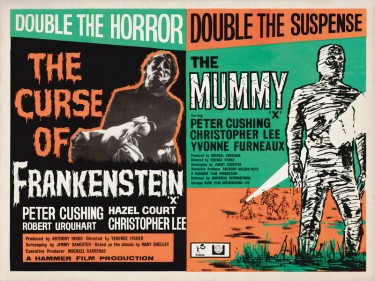
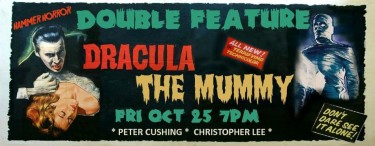
Hammer Films were riding on a high when this film was made. Following on from The Curse of Frankenstein and The Mummy – both very good films and ones that did well worldwide and particularly in the USA.

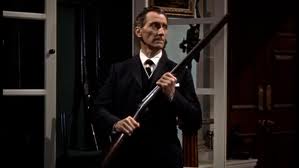
 Peter Cushing starred as Sherlock Holmes with Andre Morrell another favourite of mine and I really don’t know why, along with Christopher Lee as Sir Henry Baskerville who is in mortal danger from the legendary hound.


Also cast was Ewen Solon, Miles Malleson and the great John Le Meseurier.

Miles Malleson appears as the local vicar who is an expert in spiders – this was a part written into the story for the film version only becuse it does not appear in the book at all.

The story opens with a sequence back in history which tells of the origins of The Hound of the Baskervilles when the wicked Sir Hugo brutally deals with his staff and particularly his women – one of whom refuses his advances and runs away. He pursues her with a pack of hunting hounds but they turn back in fear when they get into the marshes – there is obviously something that they don’t like.   Sir Hugo in his wild mood just carries on and attacks and kills the young woman – and at that point he hears the growl of a wild animal. He looks terrified and his end comes at that point although we do not see it.

See this excerpt in the Link below :-

https://www.youtube.com/watch?feature=player_detailpage&v=VEbPcsIcJ_8

This was Hammer Films at their best almost –

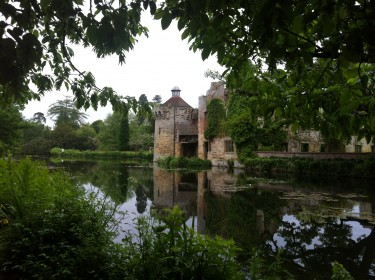
Shortly after their brilliant adaptations of the classic tales of Frankenstein and Dracula,  British Hammer Studios decided to have their take on Sir Arthur Conan Doyle’s immortal detective Sherlock Holmes with “The Hound of the Baskervilles” (1959). This turned out to be a splendid idea, as the Hammer formula works magnificently with Doyle’s work. Hammer once again teams up Horror’s greatest duo, Peter Cushing (as Sherlock Holmes) and Christopher Lee (as Sir Henry Baskerville).  In addition, the film features André Morell (who would also star in several other Hammer productions including “The Plague of the Zombies” of 1966) as Doctor Watson. Hammer’s trademark eerie Gothic atmosphere with foggy grounds, dark forests etc. fits the “Baskervilles” story like a glove.
The film begins truly creepy, with a prologue set in the early 18th century, when Sir Hugo Baskreville, a cruel nobleman who likes to play sadistic games with peasants, gets what he had coming when he makes the encounter of a mysterious beast. From then on, the wild, dog-like creature is known and feared as the ‘Hound of The Baskervilles’; according to a curse, this hound is supposed to return and kill any Baskerville who dares to enter the moorlands where Sir Hugo found his end… In the 1880s, the great detective Sherlock Holmes is told about the sudden and mysterious death of Sir Charles Baskerville, a descendant of Sir Hugo.  Holmes and Doctor Watson travel to the Dartmoor in England  to investigate and to meet the new owner, Sir Henry Baskerville, who does not believe in what he considers to be ‘old wive’s tales’… at first…

The film does change the original story in some details, mainly by adding Horror elements that underline the Hammer-typical creepiness and Gothic atmosphere. Peter Cushing simply is the perfect choice to play Sherlock Holmes. This brilliant actor was fantastic in any role he played, of course, but that of the most famous detective in fiction is one of those that he is particularly predestined for. André Morell is great as Dr. Watson and Christopher Lee is, as always, good  in his role. Cushing and Lee truly were the ultimate duo in Horror cinema.  It is easy to see why Christopher Lee and the late Peter Cushing were best friends in real-life, when watching their ingenious work in any of the films they did together.   Directed by Hammer’s  Terence Fisher, “The Hound of the Baskervilles” is another great example for Hammer’s glorious style of eerie yet beautiful settings, haunting atmosphere and suspenseful storytelling. The settings and photography are wonderful as in most classic Hammer tales, and the entire film is greatly crafted.

posted by Movieman in Uncategorized and have Comments (2)

Marilyn Monroe – New revelations surrounding her death

Private eye ‘listened to Marilyn die’

Marilyn Monroe

THE publication of files belonging to one of Hollywood’s most notorious  private detectives has shed new light on the 1962 death of Marilyn Monroe  and her relationships with John F Kennedy, then the president of the United  States, and Bobby, his younger brother.

More than half a century after Monroe’s apparent suicide, a startling account  of her last day alive has emerged from the notes of Fred Otash, who had  installed bugging devices in her Los Angeles home.

“I listened to Marilyn Monroe die,” Otash claims in the notes recovered from a  suburban storage unit by his daughter Colleen more than a decade after his  death.

Files shedding new light on Marilyn Monroe’s last night alive  and her relationships with President John  F Kennedy and his younger brother Bobby have emerged 51 years after her  death.

Documents  belonging to the late Fred  Otash, one of Hollywood’s most notorious  private detectives, were uncovered by his  daughter Colleen after being found in a suburban storage unit.

According to Otash, who died in 1992, Monroe had a  relationship with the  brothers and complained about being ‘passed around like  a piece of meat’.

Otash, who had installed bugging devices in  her Los Angeles home, has long been  derided by Kennedy admirers for his claims to have listened to a tape of Monroe  and JFK in bed together.

But the notes published by The Hollywood  Reporter  magazine last week contained a detailed account of his bugging  activities and  what he heard.

Shortly before his death, he told an  interviewer: ‘They were having a  relationship … ‘ and in his notes, Otash claimed: ‘I listened  to Marilyn Monroe die.’

Fred Otash (January 7, 1922 – October 5, 1992) was a Hollywood police officer, private investigator, and author.

Otash worked for Hollywood Research Incorporated, which did business with the  magazine Confidential  He is also known for being hired by Peter Lawford to investigate the death of Marilyn Monroe.  Otash died at the age of 70 on October 5, 1992.  He wrote about his life in his memoir, Investigation Hollywood: Memoirs Of Hollywood’s Top Private Detective.

———————————————————————————————————————————————————————

He recorded that on August 5 1962, she had a  violent argument with the Kennedys and that she felt  that she had been ‘passed  around like a piece of meat’.

The notes read: ‘She was really screaming and  they were trying to quiet her down.

‘She’s in the bedroom and Bobby gets  the  pillow and he muffles her on the bed to keep the neighbours from  hearing. She  finally quieted down and then he was looking to get out of  there.’

Otash only found out she had died later  on.

Otash claimed he had listened to Marilyn Monroe die after he had taped an argument she had with Robert Kennedy and Peter Lawford. “She said she was passed around like a piece of meat. It was a violent argument about their relationship and the commitment and promises he made to her.


posted by Movieman in Uncategorized and have No Comments