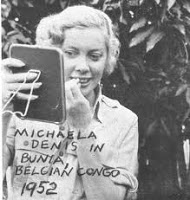
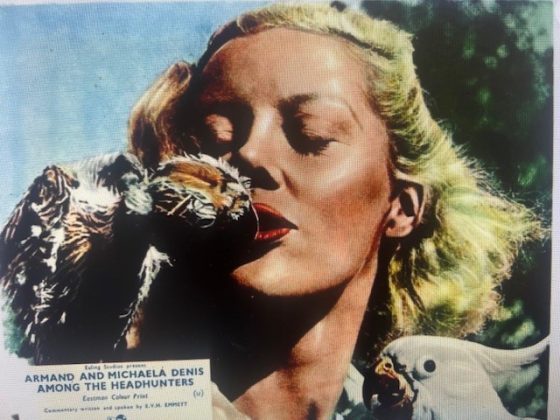
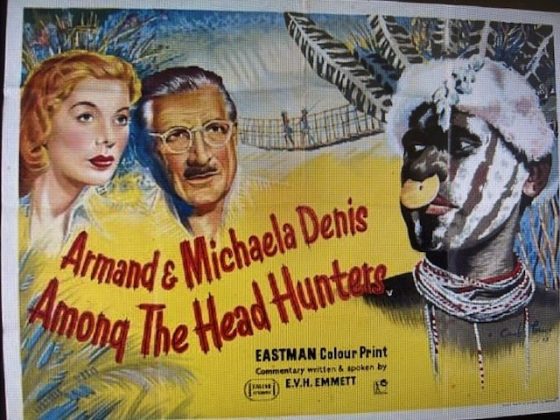
ARMAND and Michaela Denis had settled in Kenya in 1949 – they had marries the previous year -and became very popular on BBC Television with their wild life series from Africa. Armand was a film maker and together they had filmed much of the location footage in Africa for ‘King Solomon’s Mines’ released in 1950.
After this came the BBC TV Series – “Filming Wild Animals” which was broadcast in 1954, and thereafter, they regularly contributed African documentaries to the BBC and ITV.
Michaela had a wonderful sense of humour and greatly enjoyed life. Later in life she supported and assisted several local projects to help the community around her.
After he divorced his first wife, Armand Denis married Michaela in 1948 and the two set out to make wildlife films together. Many of their films were made in Africa, though they also traveled to other exotic locales around the world. The results of these efforts were turned into several British television series, including Filming in Africa (1955), Michaela and Armand Denis (1955-58), On Safari (1957-59, 1961-65), and Safari to Asia (1959-61), as well as the films Below the Sahara (1954), Under the Southern Cross, On the Great Barrier Reef, and Amongst the Headhunters.
MichaelaDenis became particularly popular for her photogenic good looks, enhanced by her insistence on always bringing makeup with her no matter where the couple went.
She also wrote several books about her experiences, including Leopard in My Lap (1955), Ride a Rhino (1959), and Voice of the Lark (1964).
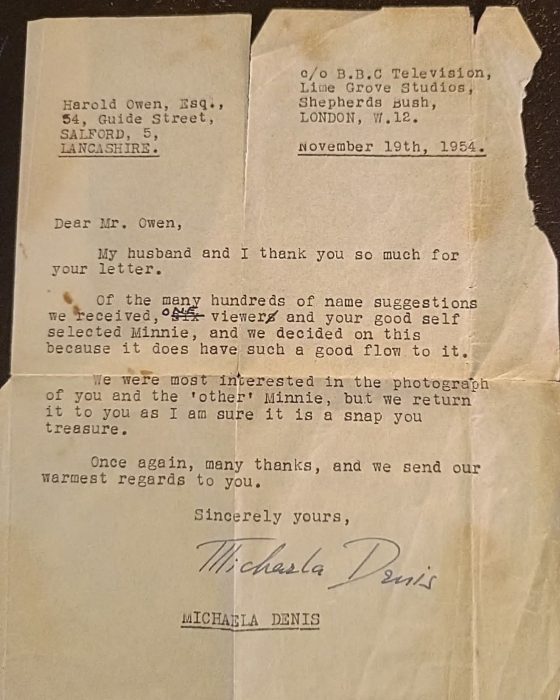
From one of the BBC TV programmes, Michaela had asked viewers to write in with a suggested name for a mongoose – she replied to one such viewer as below in a letter that went out from the BBC Studios in Lime Grove
Minniewas the name chosen
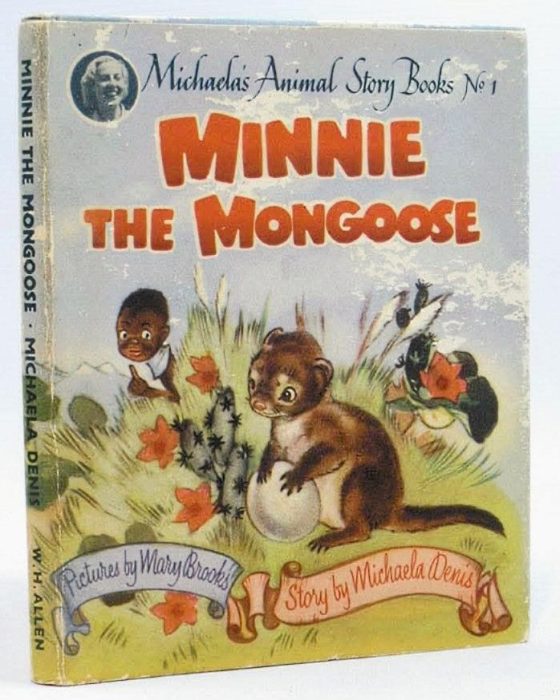
Michaela capitalised on her TV fame and following the naming of the mongoose wrote this Children’s book
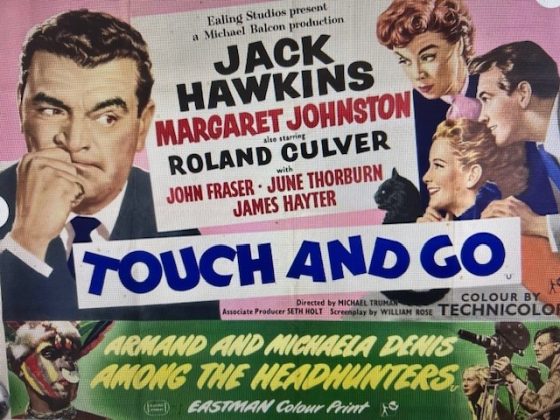
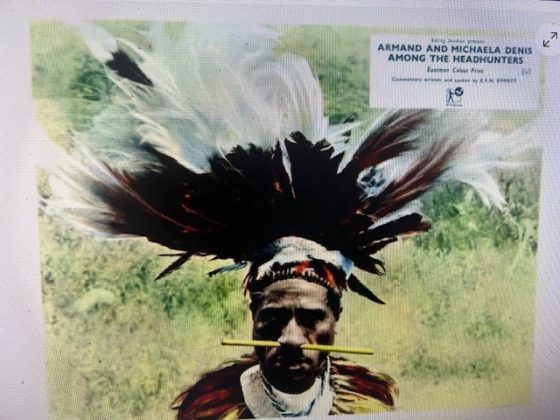
BELOW – a later film made and released in 1955 ‘ Among the Headhunters’ – made in colour as they tended to do with all their films. It obviously enhanced the jungle beauty.
Released in October 1955
I had wondered if these films got a cinema release – I was sure they would be as supporting films – and this BELOW seems to be proof that they did. It does mean also Armand Denis would use some pretty sophisticated kit
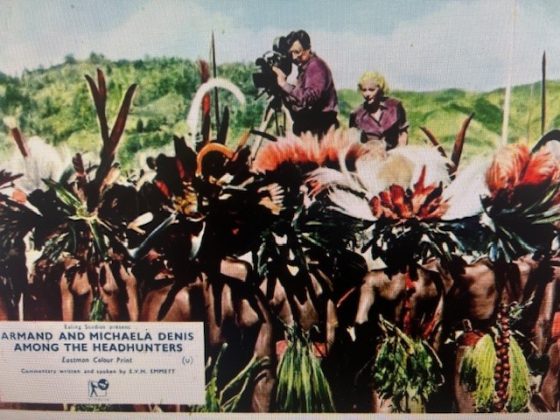
Armand Denis shown BELOW operating the camera – with Michaela close by
I watched a very good documentary on Television last evening featuring the career of Jean Simmons and this film cropped up – ‘Angel Face’ gave Jean Simmons one of her best roles
In Otto Preminger’s Angel Face, Robert Mitchum is anemergency medical technician, who responds to a call at a mansion high up a hill. There a wealthy woman (Barbara O’Neil) has almost asphyxiated from the gas in her unlit bedroom fireplace. Was it a suicide bid, or something more sinister? Her husband (Herbert Marshall), a burnt-out novelist she supports, can’t explain it. Neither can his daughter by a previous marriage (Jean Simmons).
Mitchum finds Simmons quite the dish, but she finds in him something more than a passing fancy. She jumps into her sleek sports car, follows the ambulance back down to the hospital and waylays Mitchum in a diner. Generous with his affections, Mitchum breaks a date with his steady girlfriend (Mona Freeman) in order to spend a perfectly `innocent’ evening of dining and dancing with Simmons.
But his medical experience hasn’t equipped him to deal with a dangerously scrambled psyche. Jean Simmons first invites Freeman to lunch so she can humiliate her by spilling all the details, cunningly tweaked up, of her `innocent’ rendezvous with Mitchum. Then she arranges for him to take on the job of family chauffeur, installing him in a garage apartment. And she persuades her stepmother to lend Mitchum the money to start up his own business as a car mechanic. Telling himself that he’s just looking out for Number One, Mitchum blithely lets her erase any boundaries between them.
The main players
Robert Mitchum – Frank Jessup Jean Simmons – Diane Tremayne Mona Freeman – Mary Wilton Herbert Marshall – Charles Tremayne Barbara O’Neil as Catherine Tremayne Kenneth Tobey as Bill Leon Ames as Fred Barrett
Film Trailer
Warning signs appear, however, when she pounds on his bedroom door in the middle of the night with a crazy story about O’Neil hovering over her bed and playing with gas again; the earlier incident, she claims, was just a smokescreen. She tells him, too, that the stepmother reneged on his loan in order to get back at her. Robert Mitchum ‘s wariness enrages Simmons and redoubles her delusional obstinacy.
When her father and stepmother perish in a spectacular freak accident (their car plummeted in reverse down the steep ravine abutting the driveway), the heiress Simmons finds herself charged with murder. As does Mitchum he had the expertise to sabotage the vehicle. Wily attorney Leon Ames (in a small but succulent part) sees the defendants’ marriage as the path to acquittal. Which leaves Mitchum with a Hobson’s choice risking either the gas chamber or the psychotic wrath of a woman he never loved….
Though Preminger can deploy twists of plot with the best of them, he had a subtler knack of keeping his audience off-balance, never quite sure in which direction the story might develop. So for a while we share the perplexity of Mitchum, so laid back that he doesn’t grasp that he’s playing with a five-alarm blaze until it’s too late; opportunistic but lazy, he’s the perfect stooge.
Simmons may have been working within her limitations in her low-voltage, passive-aggressive performance, but she fits the character, who operates in a world inhabited only by herself. She’s not a duplicitous vixen scheming to get what she wants; what she wants is the only reality she knows. Preminger recognises this, and gives her one of the film’s quietest, most scary scenes: During one of Mitchum’s flights from her, she snoops as if sleepwalking through his rooms, finally curling up in his easy chair, his sport coat draped around her shoulders against the dawn chill. It’s an eerie calm before the final storm.
The film is ultimately a wicked study in obsession – the kind of obsession that has no boundaries – the kind of obsession between a man and a woman – the kind of obsession that is so self-serving. And, interestingly, it is largely one-sided – since Frank may enjoy the delights of Diane, but also knows deep down that she should be put back on the shelf. Diane’s obsession is so real that you do basically know that Mitchum’s Frank Jessup doesn’t really stand a chance.
Jean Simmons was a revelation here. She’s a good actress
.I would have not have thought that she could have played opposite Mitchum’s cool, relaxed persona and have made it work, but she did.
This film is dark to the extreme and is as fresh, as vital, and as pertinent as though it were made just yesterday.
Verdict
This picture is filled with high intensity. All coming from Jean Simmon’s magnificent performance. Each lingering shot of her face reveals another level of unhinged cracks.
Robert Mitchum is his usual cool self, wandering from one scene to another popping a cigarette into his mouth. Even though he has a lovely girlfriend waiting for him he seems so attracted to this un-hinged girl
Otto Preminger manages to fit a hell of a lot in. There’s even time for some court room drama.
.It is at times haunting, has a flash of the outlandish and that feeling, that we are heading down a doom-laden path? Thus is a must-see film
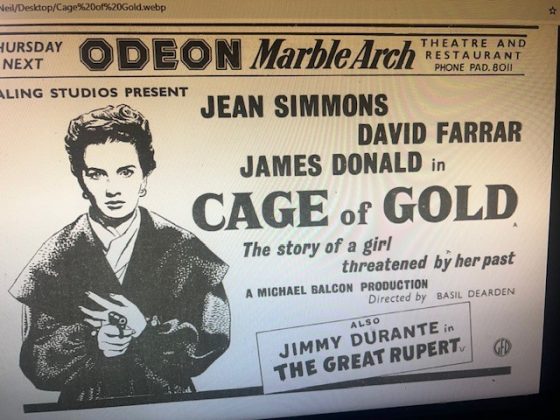
The first film ‘Cage of Gold’ with Jean Simmons, David Farrar and James Donald.
I do remember an article in one of the Film Annuals I have in my collection, written by a friend of David Farrar’s daughter, who spent a lot of time with the Farrar family when they lived in Dulwich. She recalls Mrs Farrar taking them to the cinema to see this film and the young girl says that she felt uncomfortable watching David Farrar in a love scene = presumably with Jean Simmons – but also that she looked across at Mrs Farrar who didn’t seem to be troubled by it at all.
I always liked James Donald for his style – he was first rate tending to under-play his characters and it was all the more impressive.
Jean Simmons by this time had returned from Fiji after filming ‘The Blue Lagoon’ there and would shortly go to Hollywood and become a major star. She would probably have married Stewart Granger by now
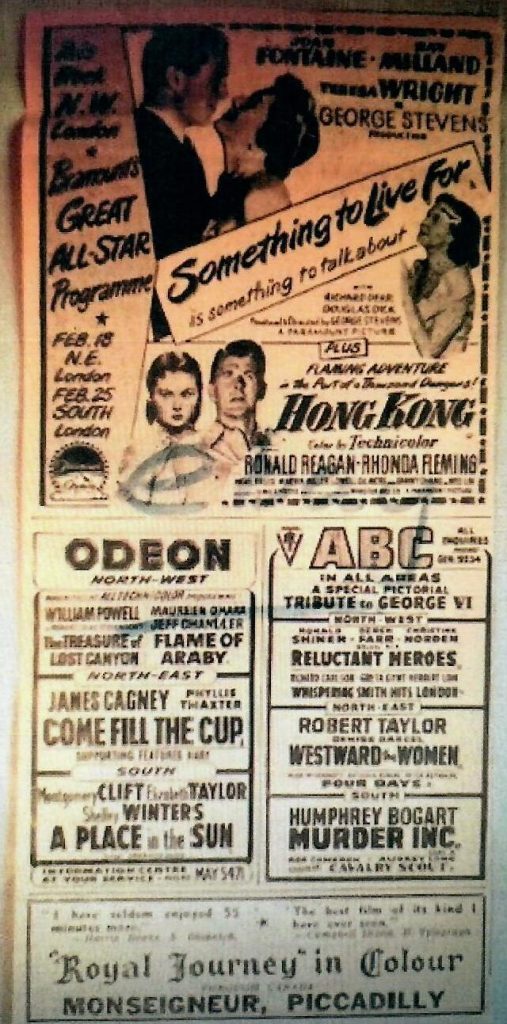
Good choice of films
The ABOVE feature a tribute to George V1 so this programme must be later in 1952.
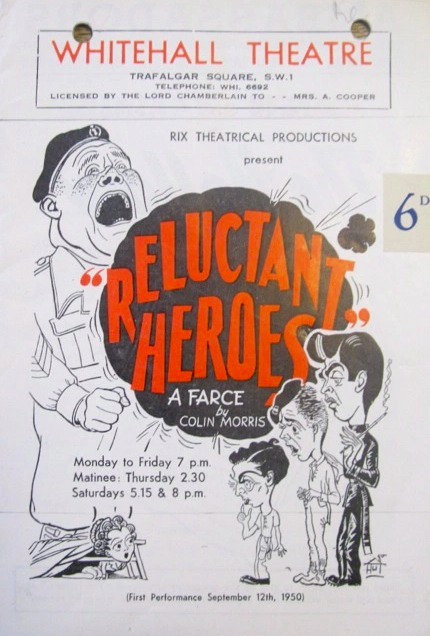
I remember ‘Reluctant Heroes’ which had been a famous stage play at The Whitehall Theatre
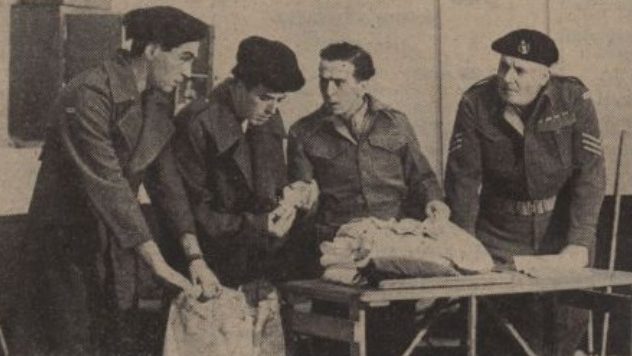
This excellent film accurately reflects life as a National Serviceman in the 50’s and 60’s.
The film started life as one of run of Whitehall Theatre farces in London in which Brix Rix ( l;ater Lord Rix) and his wife Elspeth Grey starred. Wally Patch played the indomitable Sgt Bell on the stage and Brian Rix re-created the part of Gregory he had performed on stage.
Between 1952 and the late 1960s BBC Television broadcast some seventy live comedies and farces from the Whitehall Theatre in London.The series is the most sustained and successful partnership between a theatre company and a broadcaster, yet the productions were rarely discussed by journalists at the time and have been ignored by writers on television ever since. Recordings of only a handful survive, but there is extensive documentation of almost all of them in the BBC Written Archive Centre.
On 14 May 1952 BBC Television showed just the first act of Colin Morris‘ hit comedy Reluctant Heroes. Morris had begun writing his tale of army life during the war, when he served as a Major in the Eighth Army in North Africa and Italy. In 1949 Reluctant Heroes was presented by a repertory company in Bridlington, where it was seen by the young theatrical manager Brian Rix. Rix secured the rights and mounted a touring production that opened in March 1950 with himself and his wife Elspet Gray in the cast. By the time it came to the Whitehall, where it opened on 12 September 1950, Morris too had joined the cast. The anonymous reviewer for The Times was resistant to the fourteen first-night curtain calls:.