One of my Dad’s favourite films and because of that it is one of my mine too – Victor Mature was my Dad’s favourite actor.
I have not seen this photograph before. At first I thought it was possibly at the Premier of the film but of course it is not – Richard Burton looks still to be in costume and Jean Simmons looks uncomfortable for some reason.
At the time Richard Burton and Jean Simmons were not film stars on a truly international scale. Alright both of them had successful careers in England but is wasn’t until this film was released that step up came and they became well known. On the other hand, Victor Mature was already established on the World scale due a decade at the top and big money making films like ‘Samson and Delilah’ Earlier than that he was a superb Doc Holliday in John Ford’s ‘My Darling Clementine’
After The Robe he again hit the Box Office jackpot with ‘Demetrius and the Gladiators’ – a follow on from ‘The Robe’. Then came ‘The Egyptian’
Financially a very productive few years for Victor Mature.
Just come across these which I found particularly interesting
I Was A Teenage Werewolf / Dragstrip Girl:
One of those teenage classics; both made by American International Pictures in 1957
I Was A Teenage Werewolf starred a young Michael Landon and was the first film ever to have the word ‘teenage’ in its title,
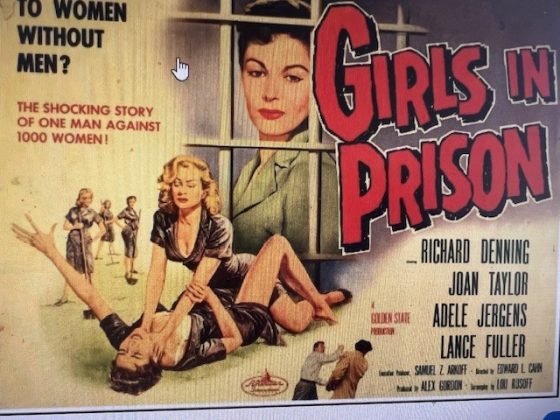
Dragstrip Girl was co-produced by the legendary Samuel Z. Arkoff
This poster is most likely a late 1950s, possibly early 1960s re-screening of the films, billed as ‘The double thrill sensation of the century!’, distributed by Anglo Amalgamated with the Hammer House Wardour Street address printed at the bottom of the poster.
Viking Women / Back To Nature / The Mysterious Invader: Late 1950s, possibly early 1960s, film poster for a triple bill of 1957 Anglo International Pictures features. Viking Women, also known as The Saga of the Viking Women and Their Voyage to the Waters of the Great Sea Serpent, produced by Roger Corman and the legendary Samuel Z. Arkoff.
The Astounding She Monster, here billed as The Mysterious Invader, directed& produced by Ronald V. Ashcroft, who employed the B-movie king Edward D. Wood, Jr. as an unofficial consultant after having worked on his Night of the Ghouls.
his ‘Colossal Triple Attraction’, distributed by Anglo Amalgamated with the Hammer House Wardour Street address printed at the bottom of the poster.
The third part of the bill is a nudist film, Back To Nature, filmed in colour and set in the Elsinore nudist colony California, I seem to recall that Michael Winner started his career with a couple of such films made in England around the same time. One called ‘Some Like it Cool ‘ springs to mind – a film written, financed and made by Michael Winner – and one that made quite a lot of money and kick-started his career
Well this is really a chart from the USA. Scanning down the chart, certain ones surprise me – for instance I hadn’t realised that ‘The Country Girl’ was such a popular film at the time nor for that matter ‘The Caine Mutiny’
The Country Girl is a brilliant piece of work thanks in part to a fine adaptation by director and screenwriter George Seaton (Oscar for best screen adaptation, 1954) and performances by Grace Kelly, Bing Crosby and William Holden.
I didn’t think that ‘The Caine Mutiny’ would be so highly placed
One interesting snippet on the film though is that the original Vinyl record of the score of ‘The Caine Mutiny’ would be now, so highly valued. Apparently the Studio withdrew the record almost immediately after it’s release because of contractual issues. As regards the film – a wonderful performance by Humphrey Bogart. Who can forget the final scene where he virtually goes to pieces giving evidence – brilliant acting.
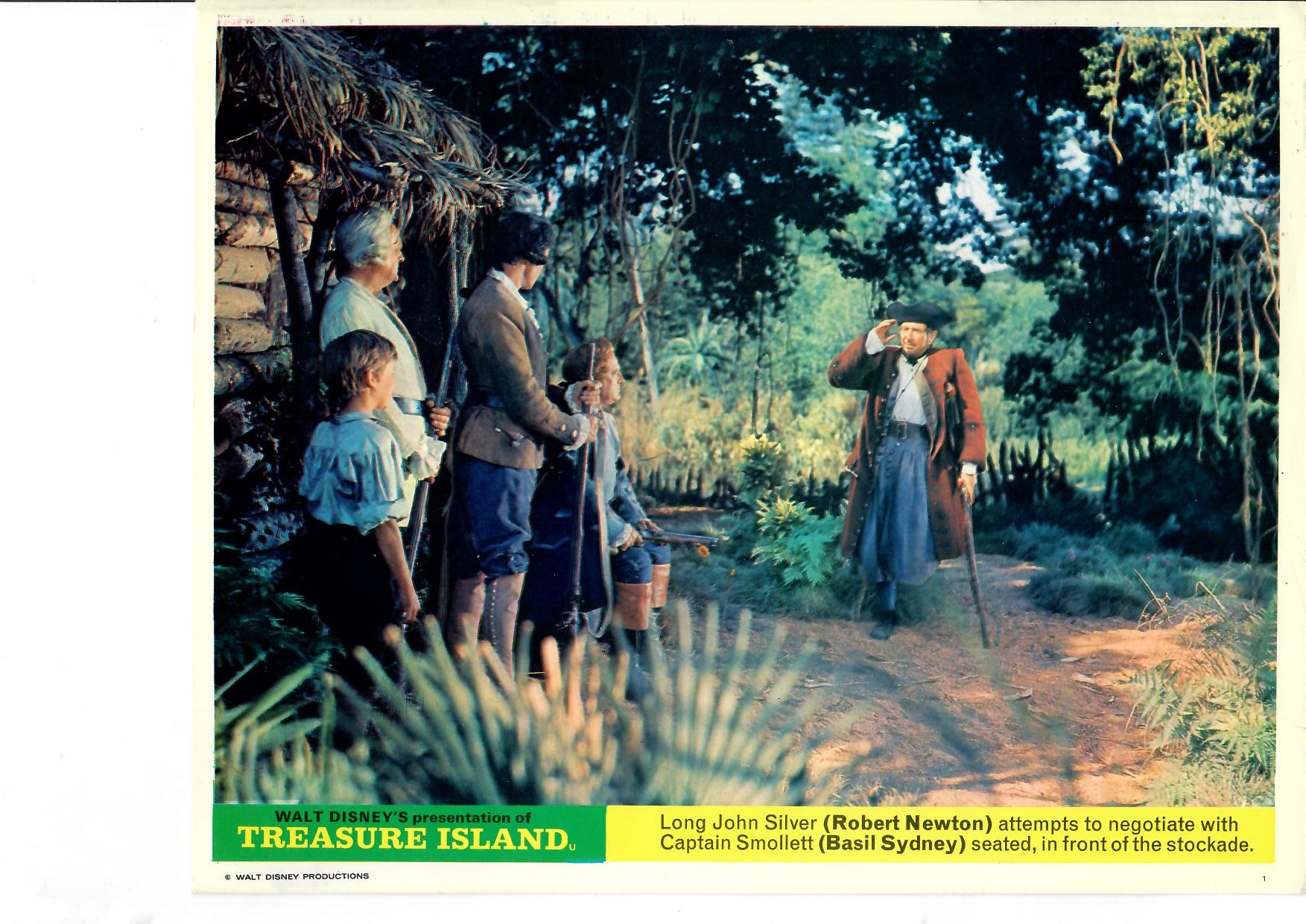
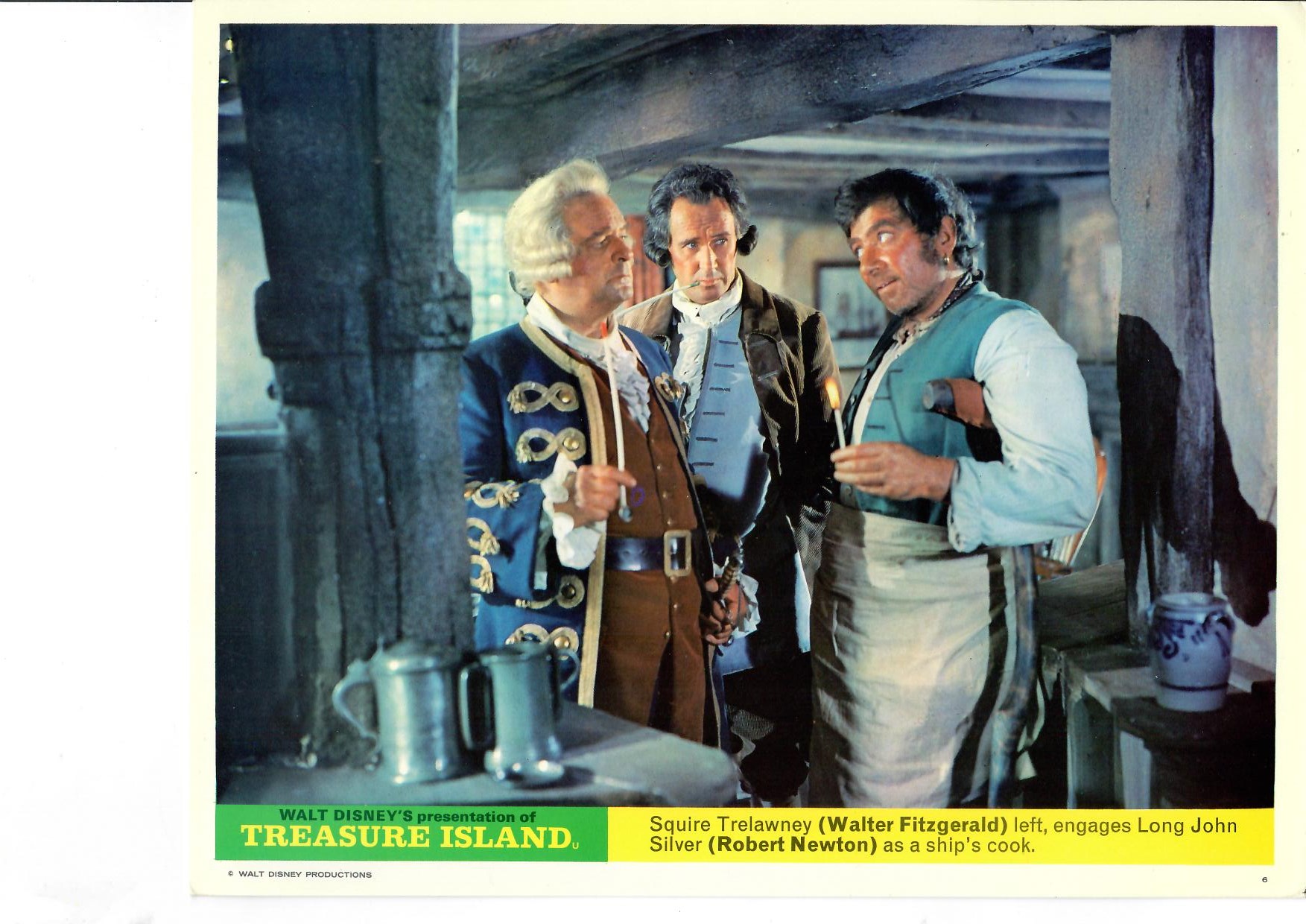
‘20,000 Leagues Under The Sea’ was a real hit for Walt Disney who only a few years before had got into ‘live-action’ films with ‘Treasure Island’ and ‘The Story of Robin Hood and His Merrie Men’ – I have to say that I thought these two films were better than 20,00 Leagues. Kirk Douglas was to the fore in this one though. He was popular at the Box Office and in fairness to him, he realised his own worth and capitalised on it.
Recently I read that Kirk had been approached for a key role in ‘Lawrence of Arabia’ but he also demanded star billing and the largest of all the other actors in salary – Sam Spiegel the Producer told him NO
I read also about ‘Spartacus’ which he had co-produced that he had one Director fired from the film. One of the producers commented that ‘Spartacus was a good film -‘ it could have been a great film if that bastard (Kirk Douglas) had not insisted in being in every sceneof the film’
James Stewart has two films here in the top ten – quite different ones – ‘The Glenn Miller Story’ and Hitchcock’s classic ‘Rear Window’ – both very good and entertaining films.
We all know ‘Rear Window’– it is film that leaves you on the edge of your seat right up until the last scene. Very much done on an elaborate Studio set
‘The High and the Mighty’ is there as a big box office winner. It was little seen after it’s original release but in the last decade or so, it has had a DVD release and has been on Television. It is a film packed with suspense – This was an original in it’s time but all the ‘Airport’ films followed with stories similar in style to this
‘White Christmas’ tops the chart here – this iis almost always on Television in England at Christmas and like ‘Its a Wonderful Life’ always has a big viewing audience
The unique and beautiful Cinema – The Kinema in the Woods at Woodhall Spa in Lincolnshire – shows ‘It’s a Wonderful Life’ each year just before Christmas and even now in November this year, a number of the showings are sold out
In 1935 Alexander Korda, a Hungarian film impresario of international stature who had rejuvenated England’s film industry with his productions of The Private Life of Henry VIII (1933) and The Scarlet Pimpernel (1935)capitalised on his box-office success by securing finance from the Prudential Assurance Company to help him build own studio – Denham. A studio to rival Hollywood that would make big World targeted films at least the equal to anything from the US
ABOVE – Alexander Korda sitting in his office at the old house overlooking the lake at Denham.
It was here that he sat alongside Producers, Directors and writers as he planned his next production
It was here in this very office that Michael Powell was called along with others to discuss the making of a major Korda Film ‘The Spy in Black’ 1937′. As they talked Korda interrupted and said that he would like to introduce someone who had written the screenplay for the film – and then introduced Emric Pressburger who quietly went through hat he had written – Michael Powell sat transfixed – he did not know this man but thought what he had written was brilliant and vowed that he just had to work with him again which we all know he did for many years
So it was in this office in the old house at Denham, that Michael Powell first met Emric Pressburgerthus beginning their unique collaboration which resulted in some of the finest British films ever made
Korda felt that the only way to bring the English film industry to prominence would be by concentrating on quality films. Alexander Korda organised London Film Productions, and risked everything on a deceptively-lavish movie The Private Life of Henry VIII (1933) starring Charles Laughton and Elsa Lanchester. The film became a worldwide blockbuster.
Following the success of this film, Korda was hailed as the saviour of the British film industry. On the strength of this film, he was also able to land an American distribution deal with United Artists.
Korda constructed the stately Denham Film Studios on a 165-acre estate outside London. He also established his own stable of contract actors – and very impressive they were – including Leslie Howard, Merle Oberon (who became the second Mrs. Korda in 1939), Wendy Barrie, Robert Donat, Maurice Evans, and Vivien Leigh.
Some of his more ambitious films included Rembrandt (1936), which he also directed; Things to Come (1936) a $1.5 million adaptation of the H. G. Welles book; and The Thief of Bagdad (1940).
While Britain was war-torn in the early 1940s, Korda took up an extended residence in the United States.
In March 1943, Korda entered into a merger between his independent company London Film Productions and MGM-British. Korda would become the new executive producer of the English division of Metro-Goldwyn-Mayer.He returned to England. However, his dissatisfaction with the deal brought about his resignation in 1946.
Korda then with his London Films, bought a controlling interest in British Lion Films which was involved in such productions as The Third Man (1949).
In 1948 he received an advance payment of £375,000, the largest single payment received by a British film company, for three movies, An Ideal Husband (1947), Anna Karenina (1948) and Mine Own Executioner (1948). He released three other films, Bonnie Prince Charlie (1948), The Winslow Boy (1948) and The Fallen Idol (1948).Some of these films did well but others were expensive failures, and Korda was badly hurt by the trade war between the British and American film industries in the late 1940s. In 1948 Korda signed a co-production deal with David O. Selznick.
Korda did recover in part due to a ₤3 million loan British Lion received from the National Film Finance Corporation. In 1954 he received ₤5 million from the City Investing Corporation of New York, enabling him to keep producing movies until his death. The last film with Korda’s involvement was Laurence Olivier’s adaptation of Richard III (1955).
A draft screenplay of what became The Red Shoes was written by Emeric Pressburger in the 1930s for Korda and intended as a vehicle for his future wife Merle Oberon. The screenplay was bought by Michael Powell and Pressburger who made it for J. Arthur Rank. During the 1950s, Korda reportedly expressed interest in producing a James Bond film based upon Ian Fleming’s novel Live and Let Die but no agreement was ever reached.
He died at the age of 62 in London of a heart attack and was cremated. His ashes are at Golders Green Crematorium in London.
There are not many so called ‘giants’ in any industry but that work could sum up Aleaxander Korda – The Man who built Denham Film Studios and very nearly pulled it off and put British film studios on a par with Hollywood.
Sadly Denham with its sheer size was forced to close in 1952 and now it is not easy to know where it was. I am pleased to say that I know where it is !!! – and as a film lover it is a place that is very special to me. I do drive past and look when I am down that way.
When he started London Films, he soon became a partner at United Artists, an equal of Charlie Chaplin, Douglas Fairbanks Jr. and Mary Pickford. I am pretty sure that is Sam Goldwyn in the picture too
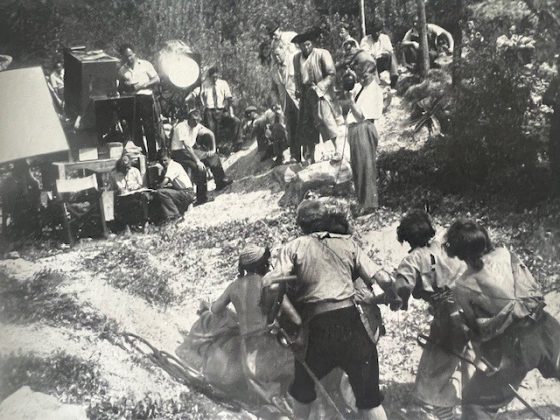
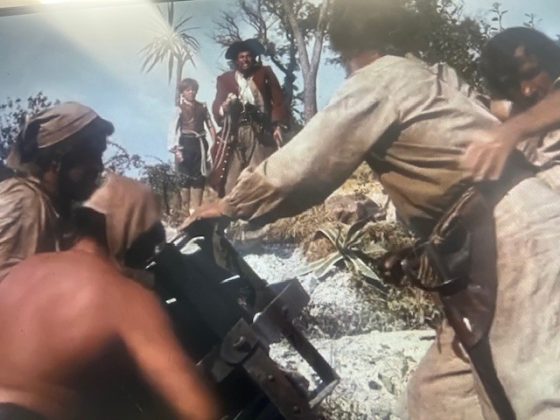
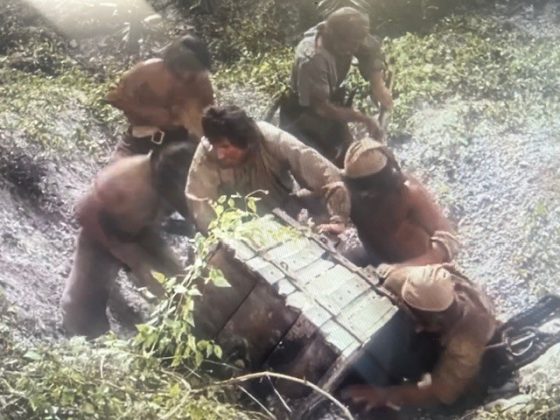
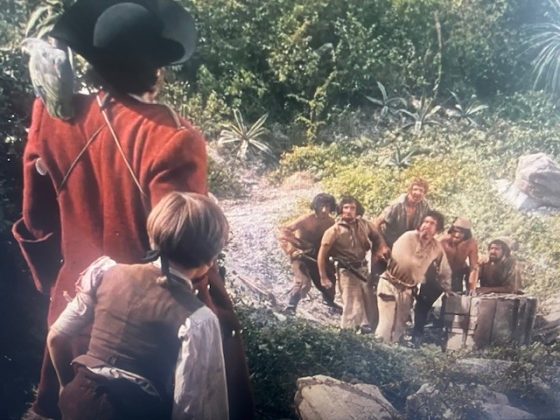
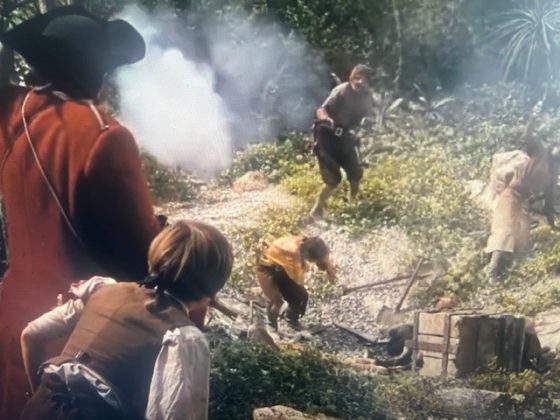
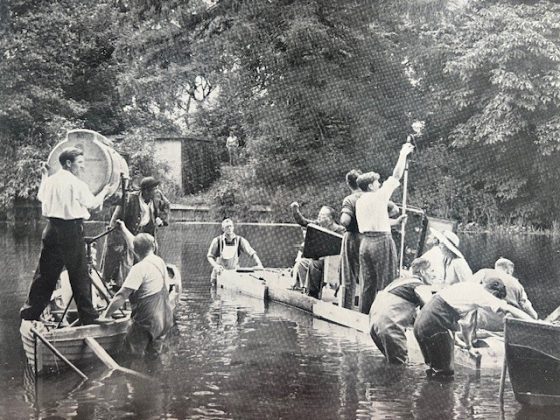
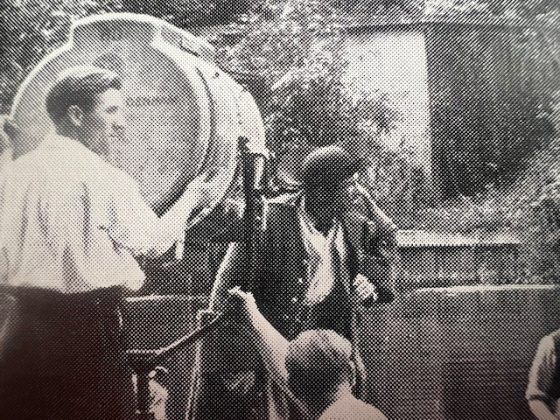
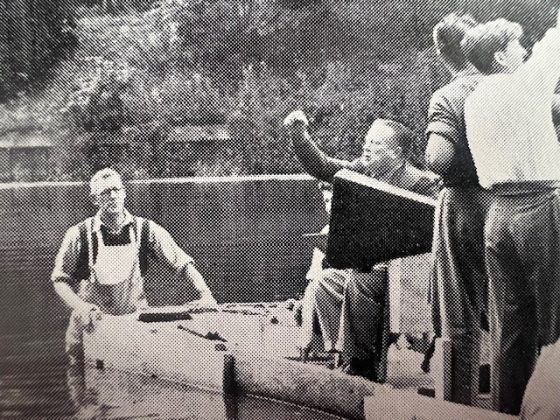
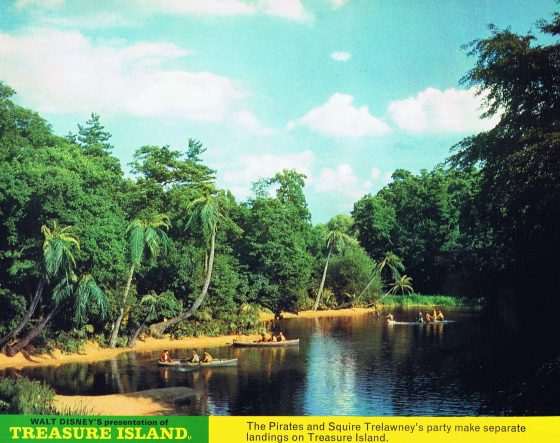
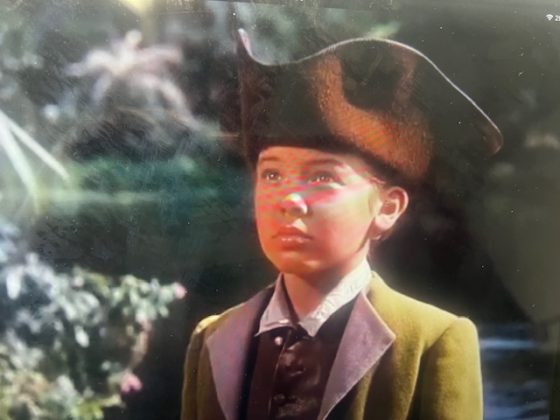
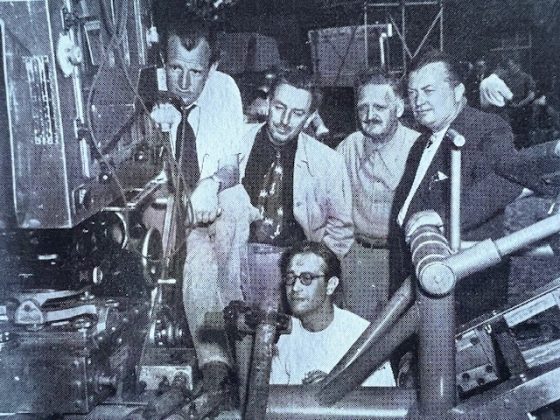
What might have been the saviour for Denham came when Walt Disney decided to make Live Action films as opposed to Cartoon feature and he chose Denham as the Studio making ‘Treasure Island’ there in 1949 and then ‘The Story of Robin Hood and His Merrie Men’ in 1951 released in 1952.
These were bold Technicolor Productions with plenty of money lavished on them – and it shows. !!
However they maybe came a little too late to save this wonderful Studio.
Rudyard Kipling and H Rider Haggard were great friends – my family and I, on more than one occasion have visited Kipling’s house ‘Batemans’ in Sussex and I remember the guide showing us round on one occasion and when we went into Kipling’s study she said that Rider Haggard often visited and he would sit and chat for long periods in that same room.
I felt a shiver of excitement to think that I was actually standing where these two colossal figures had often been together exchanging notes no doubt because in terms of story telling these two are in a class of their own.
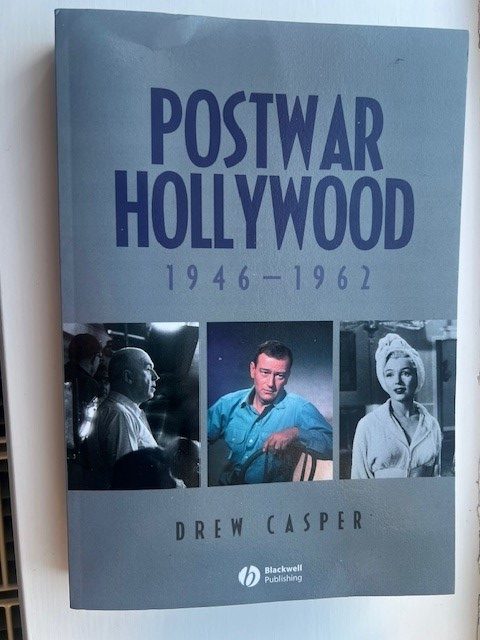
Two giants of Literatureand this book which I have just acquired, details the film and television adaptations of their stories
King Solomons Mines
‘King Solomons Mines’ – a big and impressive picture – . Looking even further into this, it appears that most of the African location filming for King Solomons Mines was done by February of 1950 –
‘King Solomons Mines’ proved a massive hit at the Box Office for MGM
Stewart Granger and Deborah Kerr were top billed – Elizabeth Curtis (Deborah Kerr) is missing her husband, who departed on a quest to find King Solomon’s lost diamond mines. She meets and hires a disenchanted safari guide – Allan Quatermain (Stewart Granger) to lead a search party to find him.
Richard Carlson, Deborah Kerr and Stewart Granger
Along the way they are besieged with several challenges, including a tremendous animal stampede which even today makes one wonder how it was filmed – and this was way before the days of CGIspecial effects.
Even now this must rank as one of the best stampede scenes ever done.
‘King Solomons Mines has a strong storyline loosely based on H Rider Haggard’s magnificent novel –
I remember someone quite famous saying that he loved H Rider Haggard’s books and he used to encourage his children to read them – this is in quite recent times. He made a deal with them to read the first 50 pages of any one of his novels – and he said he knew that after that they would not be able to put the book down.
H Rider Haggard’sremains one of the greatest adventure story tellers in English Literature of all time
In the very early days of Television – when there was only ONE channel – the BBC – this young lady appeared very regularly on screen
Shirley Abicair with a zither, 1961.
Shirley Abicair, who has died aged 96, introduced British audiences in the 1950s to new sounds and songs from around the world. She played the zither, a stringed instrument with its origins in Austria and Bavaria, and her repertoire included folk songs not only from her native Australia but also from France, Italy, Ireland, the US and Asia. A great storyteller, she became a regular fixture on British TV variety shows and children’s programmes.
She was around at about the same time as another artist who also seemed a regular – namely Elton Hayes
She appeared with Norman Wisdom in the film ‘One Good Turn’ along with Joan Rice
She arrived almost penniless in London from Australia in 1952 – after stops in Singapore and Karachi to play at nightclubs to pay for her onward journey – and her career took off almost instantly. A newspaper photo of Abicair arriving at Heathrow was seen by a BBC radio producer looking for Commonwealth artists to appear in a radio programme. The band leader Geraldo heard her and booked her for a concert and a further audition, after which she appeared for the first time on the BBC TV programme The Centre Show, on 20 January 1953. Within a few weeks she had her own series with her zither and “a rhythm quartet”, and later that year released her first 78rpm single, an orchestra-and-zither treatment of Careless Love, once recorded by Bessie Smith.
Shirley Abicair with Norman Wisdom in One Good Turn, 1955, directed by John Paddy Carstairs.
She went on to appear alongside Norman Wisdom in the film One Good Turn (1955) and in the same year made the first of her appearances on the children’s TV show Crackerjack.
Her skills as a children’s entertainer were further demonstrated by her appearances on the TV programmes Studio E and Children’s Hour, which she hosted with her puppet “friends”, Tea Cup and Clothespeg. The BBC request programme Children’s Favourites regularly featured her recording of Little Boy Fishin’ (1956), written by the Australian Bill Lovelock.
Shewas Roy Plomley’s castaway on Desert Island Discs in 1956, and chose music by Bach, Fats Waller and Burl Ives, and, for her luxury item, a “case of avocado pears”.
, she worked with the producer George Martin, of Beatles fame, on the theme song for the 1956 film Smiley, set in a small country town in Australia, and praised Martin’s “warm, silent understanding and musicianship”.
She also worked with Lovelock to collect what she called “some of the most beautiful folk songs in the world” for her solo albums. It’s Shirley! (1958) included the English traditional Green Willow, which Steeleye Span later recorded as their hit All Around My Hat. The follow-up album Look! It’s Shirley (1959) included Willie the Weeper, a song recorded by Louis Armstrong and now arranged by Humphrey Lyttelton. A Delicate Air (1960) included Walzing Matilda and Spanish Is a Loving Tongue, a song written in the 1920s that became a Bob Dylan favourite.
In 1957 she appeared on the BBC’s first rock-era programme Six-Five Special, alongside Lyttelton and the Vipers skiffle group.
In the 60s she travelled extensively, touring Russia and the US, and entertaining British troops in the far east with the comedian Frankie Howerd. But she continued to work in children’s entertainment, and published a collection of children’s stories about an Indigenous Australian boy, The Tales of Tumbarumba, in 1962. Her final singles included covers of Paul Simon’s Flowers Never Bend With the Rainfall (1966) and the Beatles’ This Girl (1967).
Shirley Abicair with the astronaut Yuri Gagarin in Moscow, 1962.
In the 70s, in a move that would have surprised those who remembered her as a family entertainer, she toured the US college circuit with the counterculture writer Ken Kesey (the author of One Flew Over The Cuckoo’s Nest, known for his drug-induced adventures with the Merry Pranksters), and lived on his farm in Oregon.
Born in Melbourne, Shirley grew up in Adelaide, South Australia, the daughter of an RAAF wing commander and a music-loving mother. Her musical career started when she discovered a zither while looking through the attic of her parent’s home, and taught herself to play. At Sydney University, where she studied philosophy, she supported herself by working as a typist. At night she would sing to friends, and after winning a radio contest she began to sing professionally.
She was followed to Britain in 1952 by her then boyfriend, Murray Sayle, whom she had known since her university days. Both of their careers flourished in the UK – Sayle became a celebrated war reporter and adventurer – but their relationship was less successful.
She spent her final years living in London.
Shirley Abicair, musician, writer and entertainer, born 25 October 1928; died 27 September 2025
I never realised that there was such an event as this but the pictures appeared in a magazine of 10 July 1952
There was a large film conference arranged by Pathe in the resort and this of course would concentrate very much on British films of the time – ‘Angels One Five’ to name one filmwas promoted here
It does seem from the pictures below that MGM sort to capitalise on the publicity this conference would get, by promoting their films in the town
Two big films promoted here – ‘Quo Vadis’ and ‘Scaramouche’
The Black Knight ABOVE and BELOW were from ‘Ivanhoe’ and not to be confused with the Alan Ladd film of that was made here in England a couple of years later
Don’t say that The Black Knight is going to confront a very up to date bus of the era
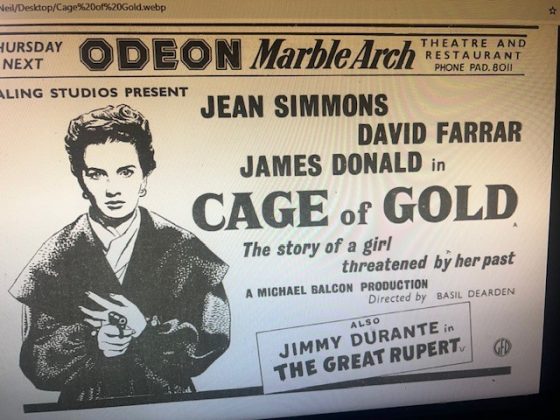
My post back in August concerned David Farrar’s Autobiography ‘ No Royal Road’ which I had then just acquired and now have got down to reading. I am quite a slow reader as opposed to a skim reader, so hopefully I make sure I retain the majority of it – if I don’t then often I re-read a passage.
David Farrar was the youngest child of the family and was born in1908 in Forest Gate London– or so it says on Wiki. Not sure about this as I can’t find where he actually says this in his book. i maybe think that he was born in Essex and moved to London at a very young age.He had an older brother Albert, a sister and another brother.
David seemed to get on very well with Albert and looked up to and admired him. Albert could and often did play the piano that they had and David started to learn but he does not refer much to his sister or other brother.
David along with his father and Albert often went to the cinema at a weekend – in those silent days – something they all three loved. His father had a love for entertainment particularly the Music Hall.
He describes very clearly the tragedy that befell the famiiy when David was 13 – so 1919 or so.
Albert became unwell and confined to bed at home. Doctors came but he didn’t improve and so he was admitted to hospital where he died some days later. What he died of isn’t made clear but at that time it could well have been the terrible Flu epidemic that ravaged the World.
The family were devastated – the piano was not played as it wrought such painful memories for them – although after some weeks Mrs Farrar realised that this was doing the remaining children no good at all and so playing was then recommenced
What a sad time that would have been for them
On a lighter note, the family always looked forward to their holidays down on the farm in Hainault, Essex owned by relatives of his mother.
There is much more to come from this Autobiography which has been very hard to find – and expensive when you do
I certainly don’t remember this at all – in fact this is the first time I have seen such a TV setwith a coin operated addition.
Is this for real ?
I am wondering if this was an idea from the USA although the television is showing ‘Andy Pandy’ so maybe not
I have since discovered that this type of TV set was used by people who rented their sets as we did for many years in the early days of Colour.
To me and to many I suppose, the launch of Colour Television does not seem that long ago – in fact on occasions in conversation with younger people I will say ‘that was the first place that I saw a Colour Television’.
I don’t think that they grasp that there was actually a time that we only had ‘Black and White’
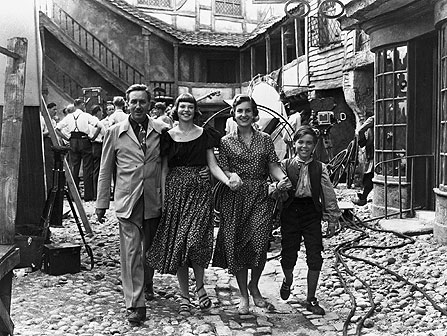
I have previously posted an article here about Walt Disney who along with his wife and daughters visited Norton Disney in Lincolnshire way back in 1949 while he was over here overseeing his film ‘Treasure Island’ being made at Denham. He was looking to find evidence of his family roots to the village.
Walt Disney and his family visit Norton Disney in Lincolnshire
Fast forward to 2025 and very recently Lincolnshire now has a Lancaster Bomber statue at Norton Disney depicting Lincolnshire’s unique connection to the plane and to the Dambuster 617 Squadron which was Lincolnshire based.
Walt Disney of course had used Richard Todd in the title role in ‘The Story of Robin Hood and His Merrie Men’ released in early 1952 and three years later he had played Wing Commander Guy Gibson in ‘The Dam Busters’ – he also live much of his later life in Lincolnshire just a few miles South of Norton Disney.
So it is Richard Todd that connects Walt Disney to the new Lancaster Bomber memorial
ABOVE – What a picture as the only existing Lancaster still flying passes by above the new memorial